


Gallery in desert
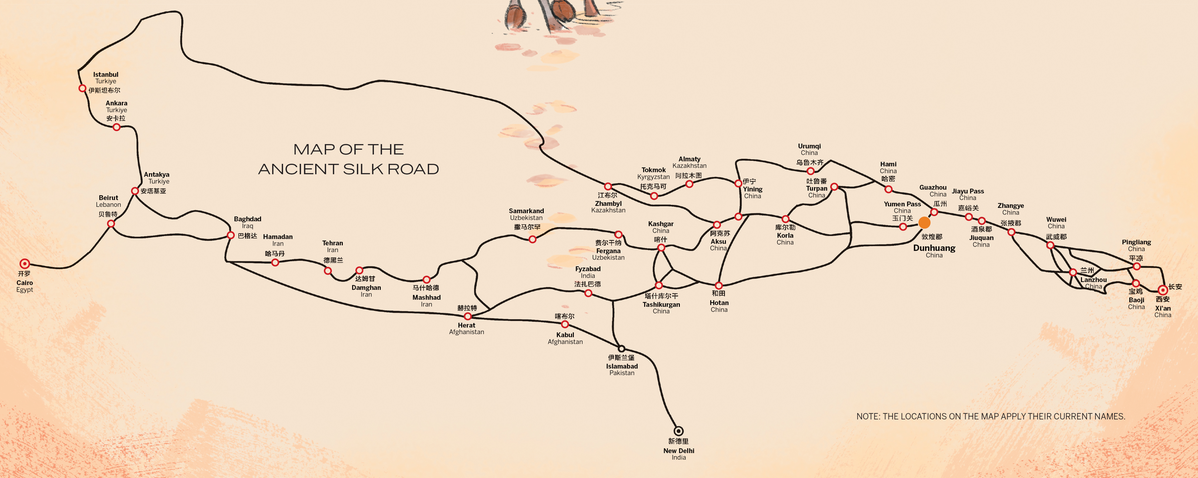
Amid the flourishing East-West trade, diverse civilizations converged in Dunhuang. Here lies one of the world's oldest and largest artistic treasures: the Mogao Caves. Dating back about 1,600 years, it is known as the "art gallery in the desert".
In the fourth century, a virtuous monk named Lezun (or Yuezun) arrived at Mingsha Mountain and saw a burst of golden lights with the image of thousands of Buddhas inside. Inspired by this, he constructed the first cave on the cliff. Subsequently, artists and craftsmen from diverse dynasties continued to expand the caves. During the Sui Dynasty (581-618), artists blended previous styles with bold innovations, creating more harmonious color and painting schemes. This laid the foundation for the peak of Dunhuang art in the Tang Dynasty (618-907), whose murals are renowned for their vibrant colors, rich compositions, and lifelike figures, demonstrating highly advanced artistry and technical skills.
The exquisite murals and painted sculptures in the Mogao Caves carry the cultural legacy of Buddhism's spread eastward. At the same time, figures from traditional Chinese mythology, such as Fuxi and Nyuwa - believed to be the creators of the Chinese people - also appear in Dunhuang's murals.
In several Mogao Caves, the motif of Three Hares Sharing Ears appears. Three hares, each sharing one ear with another, run in a circle and are connected by the head. Yet, from all angles, each hare appears to have two ears. This design reflects the traditional Chinese creative concept of symbiosis. Hares, known for their strong reproductive ability, symbolize fertility and endless vitality. The number three in traditional Chinese culture represents auspiciousness and infinity. The three hares may also symbolize the Buddhist concepts of "past life", "present life" and "future life", embodying the ideas of reincarnation.
The motif first appeared in Dunhuang in the sixth century and later spread along the ancient Silk Road to Central Asia, West Asia, Egypt, and Europe. It appeared on items such as metal plates in Afghanistan and church clocks in Germany, serving as a microcosm of cultural exchange.
As a unique form of Buddhist art, the flying apsaras depicted in Dunhuang murals captivate viewers with their graceful and ethereal dance poses. The apsaras are shown playing the pipa lute with controlled and delicate hand movements, and their attire and makeup reflect women's fashion of that era. Breaking free from traditional conventions, the artists employed exaggerated techniques and dynamic lines, creating some of the most enchanting images in the caves.
On the walls of the corridor in Cave 61 of the Mogao Caves, amid colorful clouds, the 28 constellations are depicted. Interspersed with 12 circular patterns, they showcase the images of the 12 zodiac signs. Although these zodiac images originated in the West, they coexist in the Mogao murals with the 28 constellations from Taoist and Confucian cultural elements.
Beyond this, Greek deities appear as guardian figures in the Mogao murals, while Indian mythological stories are woven into the narratives of the sutra illustrations. Exotic elements in diet, clothing, and music were all adapted in Dunhuang, ultimately creating a scene of "each culture showcases its beauty and all beauties are admired".
Cultural bond
Dunhuang culture is not only a crystallization of exchanges and mutual learning among multiple civilizations but a testament to the continuity and inclusiveness of Chinese civilization. It stands as a quiet testament to history.
In the early years of the Eastern Han Dynasty (25-220), the smooth operation of the ancient Silk Road was repeatedly challenged by the fight against the nomadic Xiongnu people. During this turbulent time, diplomat Ban Chao embarked on a mission to the western regions, where he remained for over 30 years. In his later years, however, Ban, with silver hair, missed his hometown deeply. He worried that physical weakness would stop him from pacifying the western regions. After careful consideration, he wrote to the imperial court: "I do not dare to hope to return to the heartland of China's Central Plains. I only wish to step into the Yumen Pass alive and see my homeland once more." These words convey the yearning of an elderly man who had spent half his life away from home. The Yumen Pass, standing at the western end of the Hexi Corridor, was an emotional landmark separating "hometown" from "foreign land" in the hearts of border defenders.
The art of the Dunhuang Caves is a valuable source for modern cultural and artistic creations. These cultural elements have been widely applied in urban symbols, brand logos, craft design, fashion design, as well as films and television shows, providing inspiration to countless Chinese and international artists.
In Cave 257 in the Mogao Caves, the painting The Deer King Jataka might evoke childhood memories for many born in the 1980s and 1990s. The animated film The Nine-Colored Deer, produced by the Shanghai Animation Film Studio in 1981, drew inspiration from this mural, bringing millennium-old Dunhuang art to modern audiences. Through the kindness and compassion of the nine-colored deer, the dishonesty of the king, and the greed of the queen, the story promotes virtues such as integrity and kindness. Looking at the eyes of the nine-colored deer in the mural, many children can see the emotion of benevolence and justice.
The sacred canopy above a bodhisattva in the Dunhuang murals symbolizes the protection offered by bodhisattvas to all beings. The patterns of the sacred canopy in the Dunhuang murals did not follow a fixed style but continuously evolved with each dynasty. Later, when designing decorations for temples or cultural venues, artists drew on the form of the sacred canopy to create ceilings or decorative structures. Today, tourists can buy refrigerator magnets in the shape of the sacred canopy, inviting good wishes from Dunhuang into their own homes.








