China's JUNO neutrino detector delivers first results, hints at 'new physics'







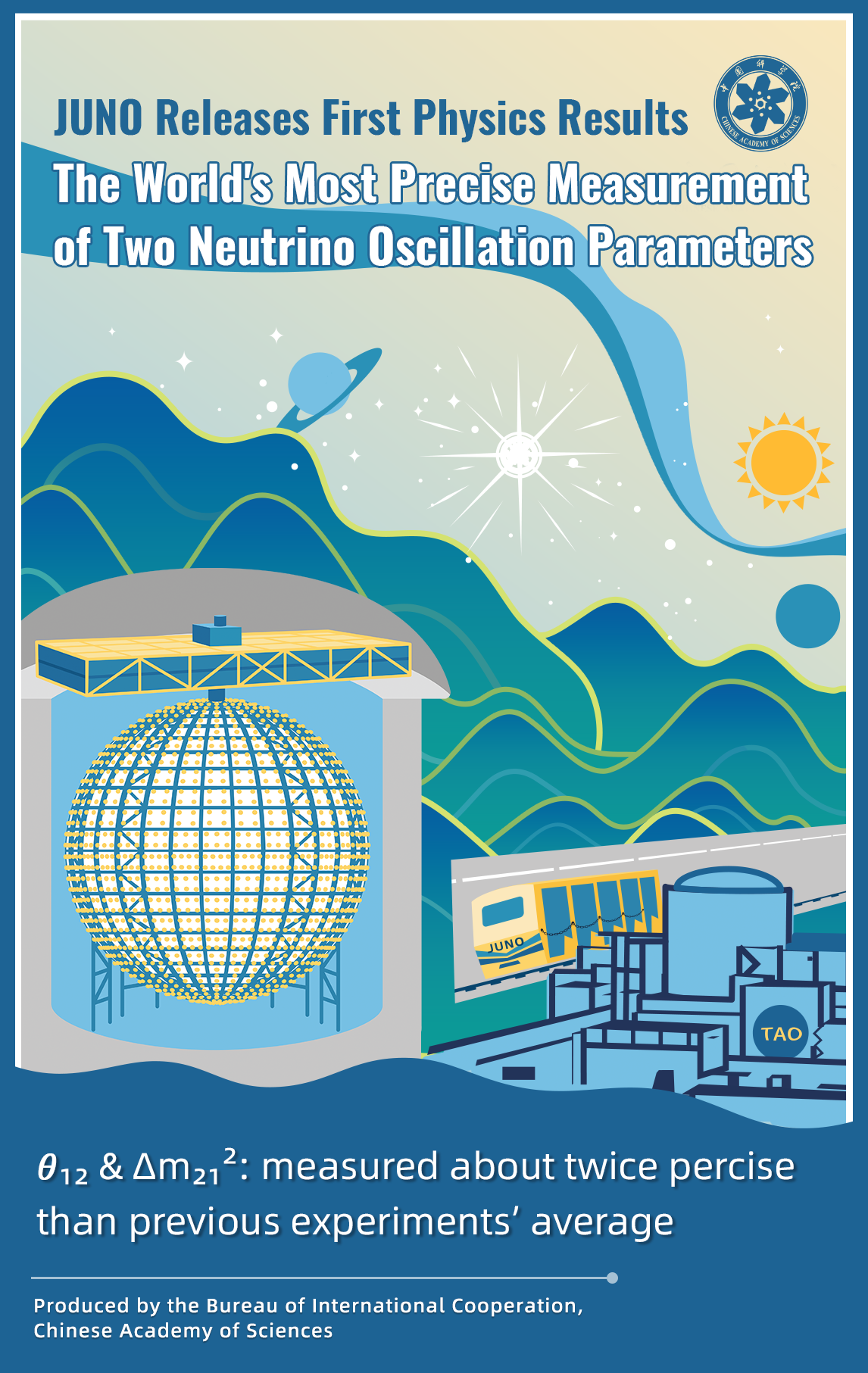
The world's largest neutrino detector, a massive, spherical facility located 700 meters deep underground in South China's Guangdong province, has delivered its first set of experimental results. Scientists leading the effort say the findings from the Jiangmen Underground Neutrino Observatory, or JUNO, have achieved impressive accuracy.
The JUNO facility, the world's first next-generation, high-precision detector, took a decade to design and build. It is designed to detect and measure the energy spectrum of neutrinos — tiny, fundamental particles — produced by the Taishan and Yangjiang nuclear power plants, which are located 53 kilometers away.
"Neutrinos are fundamental particles. Their mass is around one-millionth that of an electron, and they travel at speeds close to the speed of light," said Wang Yifang, academician of the Chinese Academy of Sciences and leader of the JUNO project. He noted that neutrinos play a key role in cosmology, particle physics, and astrophysics, and that their properties influence the history and future of the universe.
Scientists know there are three types of neutrinos. As they travel through space, they can spontaneously switch, or oscillate, between these types. This phenomenon, which is governed by six key parameters, happens because each type is a quantum superposition of three distinct mass states.
"Neutrino oscillation provides the most sensitive probe of neutrino mass hierarchy," Wang said, referring to the crucial question of how the three types of neutrinos are ordered by their mass.
Using effective data collected over 59 days after the facility began operation on Aug 26, the JUNO detector has already measured two key parameters with nearly twice the precision achieved in the last 50 years.
Cao Jun, director of the Chinese Academy of Sciences' Institute of High Energy Physics, explained that these two parameters, originally figured out using solar neutrinos, were confirmed to be measurable using neutrinos produced in nuclear reactors. Earlier studies showed a small but noticeable difference between the solar and reactor neutrino results, which scientists believe hints at possible new physics.
Cao said JUNO's latest measurement of 2,397 neutrinos from the nuclear reactors confirmed this difference. The discrepancy, which could be caused by the neutrino sources or measurement accuracy, can only be definitively proven or disproven by using the JUNO detector to measure both solar and reactor neutrinos in the future.
"Achieving such precision within only two months of operation shows that JUNO is performing exactly as designed," Wang said. "With this level of accuracy, JUNO will soon determine the neutrino mass ordering, test the neutrino oscillation framework and search for new physics beyond the standard model of particle physics."
The JUNO project is a major international effort led by China's Institute of High Energy Physics, involving more than 700 scientists from 75 institutions across 17 countries and regions.
Ding Chibiao, vice-president of the Chinese Academy of Sciences, said the project is a large-scale international cooperative effort in basic scientific research that demonstrates China's "open, cooperative and win-win philosophy."
"As the chair of the JUNO Institutional Board, I am proud to see this global effort reach such a milestone," said Marcos Dracos, a high-energy physicist in France.
The detector's concept was proposed in 2008. Its core component is the world's largest acrylic tank filled with ultra-transparent liquid scintillator, which is used to interact with neutrinos and emit faint flashes of light.
JUNO follows China's first-generation neutrino detector, the Daya Bay Reactor Neutrino Experiment in Guangdong, which operated from 2011 to 2020.





- China-Europe youths look toward a shared future
- China releases latest findings from second Qinghai-Tibet Plateau scientific expedition
- Mainland spokesperson rebukes Japanese PM's provocative Taiwan-related remarks
- China launches three new satellites into space
- China's JUNO neutrino detector delivers first results, hints at 'new physics'
- New study reveals snow-ground thermal coupling on Qinghai-Tibet Plateau