



A timely marine ecology conservation move







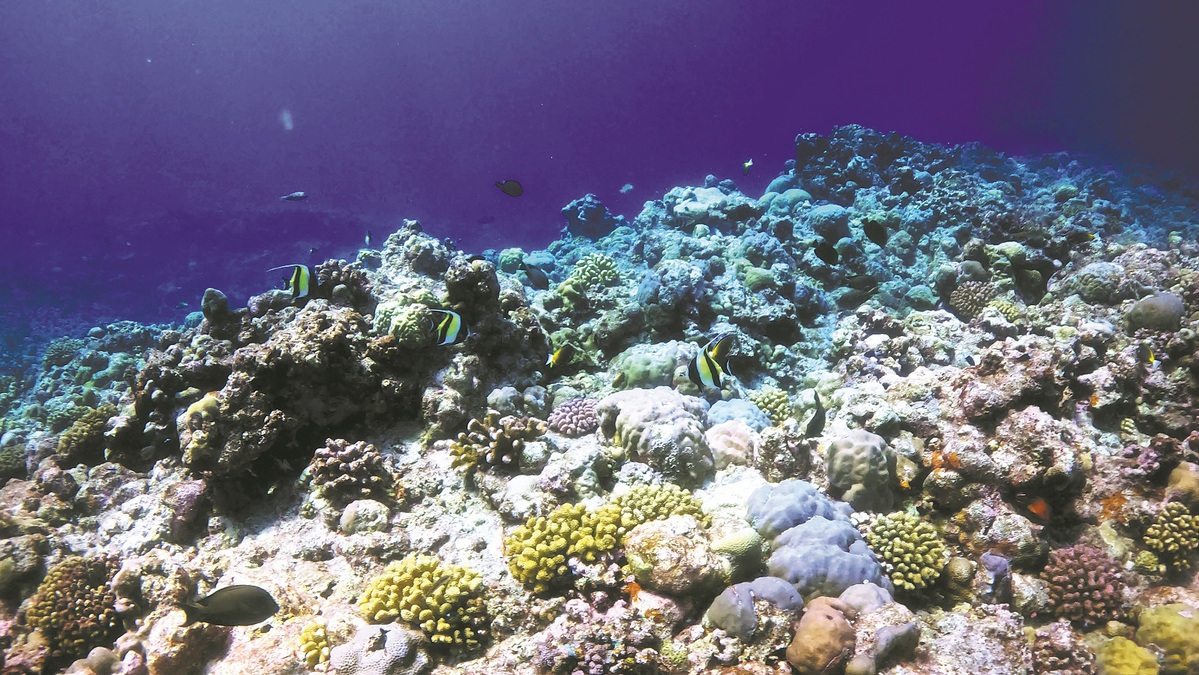
The government announced the establishment of the Huangyan Island National Nature Reserve on Sept 10, which reflects the advancement of China's ecological governance in the South China Sea that will have far-reaching implications.
The move underscores China's commitment to mitigate regional geopolitical tensions through science-based environmental stewardship, transcending traditional zero-sum games with a cooperative, ecology-centered vision.
The establishment of the national nature reserve, far from being an isolated policy move, is an essential component of China's evolving maritime strategy — one that connects legal foundation, operational jurisdiction and ecological sustainability with a coherent and forward-looking framework.
This systematic approach was foreshadowed in 2024 when China publicized the baselines of Huangyan Island's territorial sea, according to both the United Nations Convention on the Law of the Sea and the country's Law on the Territorial Sea and the Contiguous Zone. By clearly delineating the legal status of the island and its adjacent waters, China established an unambiguous juridical basis for all subsequent administrative actions, including environmental regulations, resource management and public enforcement.
The establishment of the nature reserve follows logically from this legal groundwork, and reflects a consistent governance principle: sovereignty is the foundation, jurisdiction the mechanism, and long-term ecological preservation the ultimate objective. The principle aligns with China's policy on ecological conservation, which emphasizes harmony between humans and nature.
The establishment of marine protected areas is globally recognized as one of the most effective ways of preserving marine biodiversity and sustainably managing fishery resources.
Moreover, the move shows the development of China's maritime strategy — from the previous emphasis on security to a more integrated, ecologically-informed and globally responsible role. By designating Huangyan Island, a site of considerable ecological and geographical importance, as a protected zone, China has not only fulfilled its duty as a major power to preserve marine ecosystems but also shown its leadership in fostering regional collaboration to achieve common environmental goals.
Of even greater significance is how the establishment of the nature reserve would help deconstruct harmful narratives, such as the "China threat" theory and the notion that the South China Sea is being increasingly "militarized" or "securitized". By prioritizing ecological protection, China has sent a peaceful message to the international community, rebutting many of the misleading allegations and conspiracy theories spread by some vested interests.
As a result, any efforts to provoke militarization or escalate security dilemmas in the region in the future will encounter stronger moral and legal resistance.
The nature reserve will also serve as a sophisticated response to the provocative actions taken by other claimants, including illegal "beaching" of vessels, expansion of artificial islands, and so-called joint drills and patrols aimed at politicizing the South China Sea issue.
Rather than resorting to direct military countermeasures, China has chosen a more visionary and constructive form of action — redirecting attention from sovereignty conflicts toward shared ecological responsibilities. The "governance over confrontation" approach not only seizes the ethical high ground but also opens new avenues for dialogue and problem-solving through cooperation.
The Huangyan Island nature reserve should not be interpreted merely as an isolated conservation effort or a tactical geopolitical move. It is a pioneering effort, which introduces a new model of dispute resolution and cooperative governance in a disputed region.
Its core philosophy can be summarized as using protection to prevent encroachment, employing care to curb destruction, and choosing governance over confrontation. The move extends China's environmental principle of blue waters and lush mountains being invaluable assets to the maritime domain, and highlights that the country is determined to not only safeguard its terrestrial environments but also nurture and sustain its extensive marine territories.
It also gives a practical meaning to the concept of building a maritime community with a shared future. By promoting the conservation of the South China Sea — a vital international shipping corridor and a global marine biodiversity hub-China has shown that it is committed to providing regional and global public goods.
Ecologically-oriented governance possesses the unique capacity to rise above traditional sovereignty disputes and yield results that benefit all parties. China's decision to establish the nature reserve represents a tangible effort to replace zero-sum competition with shared protective responsibility, setting a good example of regional cooperation.
China's move is the application of a novel idea with the aim of transforming the South China Sea into a sea of peace, friendship and cooperation, and signals to all stakeholders that there exists an alternative to conflict — a path defined by cooperation and mutual benefit.
Looking forward, China is poised to facilitate deeper ecological collaboration in other disputed waters, forming a chain of protected transboundary marine areas. China's move could help transform the South China Sea from an area of regional confrontation into a source of blue hope, which would benefit both humans and nature, and promote shared sustainable development.
The author is a deputy director of the Institute of Maritime Strategy Studies at the China Institutes of Contemporary International Relations.
The views don't necessarily represent those of China Daily.
If you have a specific expertise, or would like to share your thought about our stories, then send us your writings at opinion@chinadaily.com.cn, and comment@chinadaily.com.cn.





