More youngsters going under knife in quest for 'beauty ideal'
Experts caution against impulsive cosmetic surgeries, encourage ethical approach







Under partial anesthesia, 18-year-old Irene could sense the burning of fat and the tug of sutures through her eyelids as she lay on an operating table undergoing cosmetic surgery.
"I was scared the entire time," said the Shandong province native, who chose to use her English name for privacy.
"But I put all my trust in the doctor and believed that no matter what I had to endure, it would be worth it when exiting the surgery looking better than my old self."
Now, three years later, Irene is studying in Australia. She can still recall the sleepless nights leading up to the surgery, her fear of the scalpel, and a month of recovery at home, waiting for the swelling and bruising around her eyes to subside.
Despite the ordeal, Irene has no regrets about her decision to go under the knife that summer. "The procedure has fundamentally changed my mindset. I've only grown more confident since then," she said.
Younger patients
China's medical aesthetics market — which includes cosmetic surgery and less invasive beauty treatments — grew to nearly 300 billion yuan ($42 billion) last year, up from 65 billion yuan in 2015, according to market research data. It is expected to maintain an annual growth rate of around 10 percent over the next four years.
While the core consumer group remains people aged 26 to 40, a growing number of teenagers and adults in their early 20s are also driving the market's expansion. Many are seeking to address long-standing insecurities about their appearance and boost their self-confidence.
"The number of young patients who have just graduated from high school, or are in college, began rising about a decade ago, leading to a surge in consultations during summer vacations," said Guo Xin, a surgeon at the Plastic Surgery Hospital of the China Academy of Medical Sciences.
"In recent years, we are seeing even younger patients, including those in junior or senior high school," he added. "On average, students account for about 20 percent of the consultations I handle, though the proportion may be higher for doctors who specialize in procedures like double eyelid surgery."
Double eyelid surgery, which creates a crease to make the eyes appear larger and brighter, and procedures to remove hereditary bags under the eyes are among the most sought-after treatments for young patients. Other popular procedures include nose bridge augmentation with implants, as well as injectables to slim the face and narrow the jawline, Guo said.
Plastic surgeons who work with younger patients emphasize the importance of conducting comprehensive assessments of their motivations and expectations. This includes screening for underlying mental health concerns and clearly communicating potential side effects and surgical risks.
"There is no doubt that plastic surgery can enhance one's appearance, and being considered attractive can significantly influence a young person's life trajectory," he said.
"However, it is crucial to conduct a thorough evaluation beforehand. Are the patient's natural features suitable for the procedure? Are they prepared to accept the outcome if the surgery is unsuccessful or yields unexpected results?" Guo said.
Desire for change
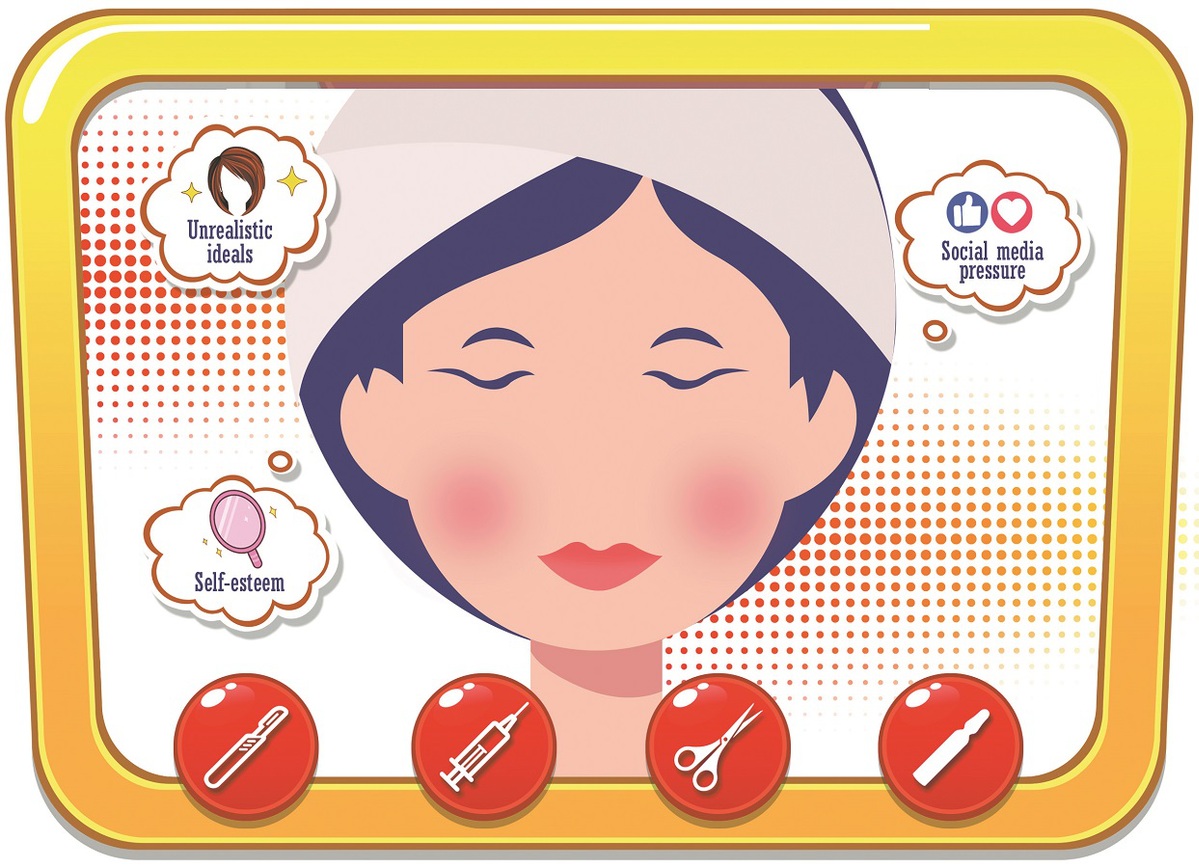
Peer pressure and idealized body images on social media tend to create a desire for a better look in young minds.
During high school, Irene was mocked by classmates for her droopy and mono-lid eyes. At the time, a "baby face" look characterized by big, round eyes and small chins was in vogue online.
Her resolve to undergo double eyelid surgery was hardened after meeting many good-looking girls during the art college entrance exams in 2022. "I could not help but feel envious of their appearances," she said.
"Undergoing eyelid surgery felt like a bold and unconventional move to me, and my parents were initially reluctant to see me go through what would inevitably be a painful process," she said. "But after I expressed my intentions repeatedly, they gradually understood my desire for change."
Irene said that her parents accompanied her to consultations and covered the cost of the 9,000 yuan procedure. "They only had two conditions — that I must secure my college admission first, and that the surgery had to be performed at a major, reputable hospital," she said.
Wang, a sophomore at the University of Science and Technology Beijing who preferred to give only his surname, paid for his own rhinoplasty last summer after graduating from high school.
"I had always felt insecure about my flat, wide nose and had been teased by peers since primary school," he said.
"The idea of getting nose surgery formed around junior high. Learning that the operation would cost about 15,000 yuan, I started saving my monthly allowance from my parents."
Wang turned 18 in 2023, when he started planning to undergo a surgery. Last summer, he managed the entire process himself, from consulting doctors to scheduling the surgery at a private clinic in his home province of Hunan.
"I didn't tell my parents until just a few days before the operation. They were opposed to it at first, but I persuaded them by showing all the research I had done online. I explained how much I hated my nose, how much better I could look and that I had already saved enough money," he said. "Eventually, they agreed."
Although informed about the risks of the procedure, Wang deliberately avoided focusing on them. "Dwelling on a small chance of failure isn't meaningful to me. I'm aiming for a better future and I had to take the chance," he said.
Guo, the plastic surgeon, said that the majority of young patients are accompanied by their parents who mostly permit or even encourage the operation.
"But teenagers today appear to be more assertive," he said.
"In the past, they seldom asked questions and just wanted to address deformities they were born with. Nowadays, they walk in with clear requirements in mind, or refer to beauty ideals they've found on social media platforms.
"However, I decline procedures for those who propose unrealistic outcomes or pathologically pursue aesthetics."
Parental consent
China's regulations require parental consent for those under 18 to have plastic surgery, and surgeons are banned from luring minors into medical aesthetics services.
Wang Chengyuan, director of the plastic surgery department at the China-Japan Friendship Hospital, said age is a critical consideration when assessing plastic surgery candidates.
"For patients with severe deformities, such as congenital ear defects, severe burns and large pigmented moles, we are allowed to perform operations after obtaining consent from their guardians," he said.
Other physical abnormalities that can trouble teens — such as male breasts, uneven eyebrows, or a slanted mouth due to nerve damage — are also commonly permitted.
"However, surgeons are required to exercise strict caution and adhere to regulations when considering carrying out nonessential aesthetic treatments, such as double eyelid operations or breast augmentation, on minors, even with guardian consent," he said.
Medical experts made it clear at a National Health Commission news conference in July that individuals under 18 should be advised against plastic surgery because of their physical and emotional immaturity.
Young people's evolving sense of beauty makes them vulnerable to external pressures and unrealistic expectations. Minors are at greater risk of severe emotional distress if procedures lead to complications or unsatisfactory results, they added.
Wang said when consulting with young patients, it is crucial to carefully evaluate their motives and objectives to determine whether their desire for surgery stems from a legitimate medical or aesthetic concern, a blind pursuit of trends, or an underlying psychological issue.
"For example, some are influenced by the latest fad or a desire to imitate online influencers, making the decision to undergo surgery highly impulsive," he said.
"Some patients present unrealistic and even 'deformed' expectations, such as requesting elf-like ears, an excessively sharp jawline, removal of cartilage, or unusually high cheekbones."
Another warning sign is when patients invest all their hopes in a single procedure to solve personal problems.
"For example, one young man believed that getting double eyelids would prevent his girlfriend from breaking up with him — a typical example of an unattainable goal," he said.
He cautioned surgeons to be wary of patients with vague and excessive perfection-seeking demands.
Obsessive focus on imagined or exaggerated defects is clinically termed body dysmorphic disorder, a mental health condition seen in some of those seeking cosmetic procedures, experts said.
Xu Gaoyang, a therapist at Beijing Anding Hospital affiliated with Capital Medical University, said this disorder is one of several critical warning signs to look for when evaluating a patient's psychological readiness for plastic surgery.
"When a patient's perception of a flaw doesn't align with reality, it may indicate this disorder," he said.
"Meanwhile, it is essential to discuss their interpersonal relationships, family dynamics, and social media use. Wanting to solve all of life's problems with a single procedure is a serious warning sign to watch out for."
Surgeons should assess whether a patient fully understands the procedure's risks and is prepared for the recovery period, Xu added. "It is also necessary to screen for underlying anxiety, depression or other psychological conditions," he said.
No regrets?
Rapid physical development during adolescence, the pressure of forming an identity, and lack of support or recognition from families and peers can intensify anxiety about appearance, Xu said.
Social media is further fueling the popularity of abnormal, and even harmful aesthetic trends.
"Beauty is diverse, but social media often exposes young people to narrow and repetitive beauty standards," Xu said.
Wang, from the China-Japan Friendship Hospital, said his clinic sees 10 to 20 patients a month who are seeking treatment for complications resulting from unconventional cosmetic procedures.
"Patients who undergo surgery to reshape their ears into long, pointed 'elf-like' forms often experience skin necrosis around the ears, severe pain, an inability to fully close their eyes, facial asymmetry and even complete nerve damage," he said.
"Others have received excessive facial fillers in an attempt to erase natural contours, resulting in unnaturally inflated, balloon-like faces."
Yang Liu is a Chinese student studying in South Korea who works as a part-time interpreter at a dermatology clinic in Seoul. She said there is a steady stream of Chinese customers all year round — with small peaks registered during holidays, and summer and winter breaks.
"A girl was attracted to come here by a social media post demonstrating dramatic transformations before and after the surgery. But the outcome of her surgery didn't meet her expectations," said Yang. "She incessantly pressed the clinic for an explanation on why her surgery did not turn out the same as the social media post."
One young customer experienced inflammation and bleeding after hyaluronic acid injections, partly due to her predisposition to inflammation and a mishap during the procedure. "She chose a top-tier brand and a highly skilled doctor, but medical aesthetics always carries risks," said Yang.
She said it is difficult to seek redress as most clinics only provide limited aftercare for two months.
Wang has noticed a trend among private cosmetic clinics of promoting treatments more suitable for middle-aged adults to clients in their 20s. These include face-lifts and smoothing out wrinkles.
"For first-time patients, especially younger individuals, physicians are advised to prioritize minimally invasive and well-established procedures because the initial experience can profoundly influence a patient's lifelong perception of cosmetic medicine," he said.
"The focus should be on subtle enhancements that can boost confidence and introduce patients safely to the field."
Offering trendy or experimental treatments to inexperienced patients — even when requested — carries ethical and practical risks, he added.
"As patients mature into their 30s and 40s, they typically develop stronger financial capacity, self-awareness and a more refined understanding of cosmetic procedures. They will then be better equipped to make informed decisions about more advanced procedures," he added.
Xu, the therapist, recommends that young adults considering plastic surgery observe a cooling-off period of at least six months before making a final decision.
He suggests that when parents receive such requests from their teenage children, they should communicate to better understand the underlying motivations, while discussing the potential risks and side effects of cosmetic procedures.
Qi Xinran contributed to this story.