Carving a thriving business out of walnut







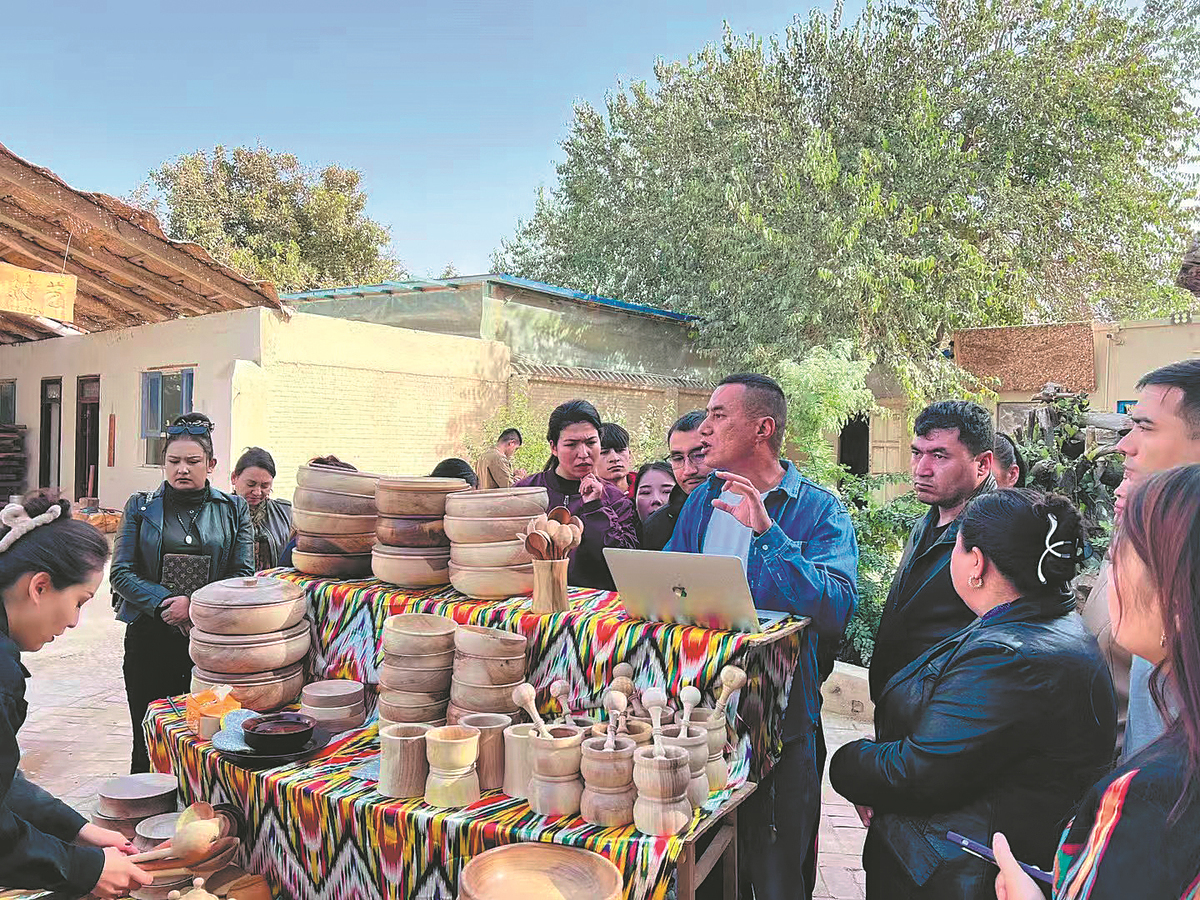
Stepping into the courtyard of Erxat Ibrayim's walnut wood processing workshop in Bageqi town, a group of Uygur women sit at a long table polishing freshly carved walnut wood bowls that give off a faint, resinous scent.
Propped on a stand, a smartphone livestreams the scene to an unseen audience. Behind them, shelves stacked high with wooden pots, ladles and trays form a textured backdrop.
Every few seconds, a message flashes across the screen, inquiring about the size and color of these walnut wood items. The Uygur women answer enthusiastically, lifting each piece toward the lens for closer inspection.
"We have found an unexpected yet devoted audience across the country," said Erxat, who opened the walnut wood processing workshop in Hotan prefecture in the Xinjiang Uygur autonomous region about five years ago.
The products range from small kitchen utensils, such as rolling pins, selling for 19 yuan ($2.66), to large custom cutting boards priced at over 1,000 yuan.
The most popular items are midsized boards, often retailing from 140 to 400 yuan, depending on width.
"Each piece is more than a kitchen tool. They are made from solid, pure, natural wood, free of glue, laminate, paint or chemical coatings," said Erxat, a man in his 30s originally from Urumqi, the region's capital.
"The wider the board, the older the tree, and the harder the wood is to source without flaws," he said, emphasizing the value of the products.
Stepping into the backyard, the air grows heavier with the raw, earthy scent of walnut wood. Towering stacks of thick, rough-hewn planks lean against the walls, their dark grain glinting under the sun.
A few artisans sit cross-legged on low stools, chisels in hand, carving shapes out of the dense wood. The steady tap of mallets echoes like a heartbeat, while walnut shavings curl to the ground, gathering at their feet like scattered petals.
One man bends over a half-finished teapot, rubbing the surface with a cloth until it catches the light to reveal veins of gold within the dark wood.
Their concentration contrasts with the lively chatter from the front courtyard, rendering the workshop both a digital marketplace and ancient stage presenting a centuries-old craft.
Walnut wood carving stands as one of the region's most treasured intangible cultural traditions. For more than 200 years, artisans have shaped this resilient, close-grained wood into bowls, spoons and ornaments, following time-honored methods that rely entirely on hand tools and patience.
"Each piece of walnut wood must dry naturally for one to one-and-a-half years. This slow-aging process allows the wood to release internal stresses, reducing the risk of later warping or cracking," Erxat said.
"There's no technological shortcut to stability, and time is the only thing that makes wood reliable," he added.
After the drying period, only the best pieces are selected for carving. Artisans, many of whom are third- or fourth-generation woodcrafters, shape the products using hand-forged tools — some made from recycled railway springs — because standard equipment won't suffice.
Yet, with the rise of new materials and waning interest from younger generations, this centuries-old craft slipped into decline.
In 2020, Erxat and his wife stepped away from the stability of their lives in Urumqi — where they had steady careers and comfortable salaries — and set out on an entrepreneurial journey across southern Xinjiang.
In Hotan, they stumbled upon workshops that had once buzzed with the rhythm of chisels and carving knives but stood quiet upon their arrival.
"Many of the artisans had given up their benches and tools, taking jobs as security guards or day laborers just to get by," Erxat said.
Struck by both the fragility and the beauty of this fading craft, the couple made the decision to build a career in reviving it.
They began by selling existing inventory through Douyin, the Chinese version of TikTok, while promoting the profound history and culture behind walnut woodcrafting.
The response was overwhelming.
Within months, the local artisans' stock sold out. They decided to open their own workshop, employing more than 20 people, including more than a dozen heritage craftsmen.
In addition to opening online sales channels, the couple hired master wood carvers to refine the craftsmanship and brought in professional designers to infuse walnut wood products with modern elements that appeal to contemporary tastes.
They also established a full production base, giving the intangible heritage a new lease on life.
Four years later, the monthly output value of their production has grown from 30,000 yuan to several hundred thousand, and annual turnover has reached tens of millions of yuan.
Their success created ripple effects. Other workshops have emerged in the region, making the price of walnut wood quadruple.
The craftsmen now earn stable incomes of around 7,000 yuan per month, which has enabled them to buy apartments and cars, Erxat said.
Most importantly, younger generations have joined in carrying the craft forward.
Alim Mamatimin, in his 20s, joined Erxat's workshop in 2021.
He had been learning the traditional walnut wood production process since his childhood from his father and has since mastered the craft.
"I can produce more than 20 handmade walnut wood products every day," he said.
With exquisite craftsmanship and hard work, his monthly income has reached over 15,000 yuan.
"Since working here, our lives are becoming increasingly better," Alim added.
Erxat still remembers how, just a few years ago, walnut wood was considered little more than discarded waste in the surrounding rural areas.
Today, however, as the wood carving industry flourishes, the timber cut from walnut groves has become highly sought-after, with purchasing prices climbing steadily.
"Walnut wood handicrafts are not only of great ornamental value, but they also carry profound cultural significance. They are true treasures of Chinese heritage. Some pieces sell at high prices, bringing artisans considerable incomes and improving their living conditions," Erxat said.
To further boost rural vitalization, Erxat has registered the handicraft brand Hehemumu and established supply-and-sell partnerships with more than a dozen nearby artisan households, coordinating with personnel in townships to collect raw walnut wood.
A new facility is currently under construction at Erxat's workshop.
"We want the production process to be more engaging, something that can be vividly shared through livestreaming," Erxat said.
Looking ahead, he plans to open a craft-themed guesthouse next year, where visitors can immerse themselves in the world of walnut wood carving.
"Imagine making your own cup or a pair of chopsticks by hand. You'd gain a deeper understanding and appreciation of our traditional culture," he said.






- 10 dead and 84 injured in explosion at steel plant
- China unveils flexible urban planning rules to improve lives, foster new industries
- Ex–China Construction Bank executive gets 18 years for bribery, loan violations
- First batch of eco-friendly pioneer zones for construction of beautiful countryside unveiled
- Woodpeckers, finches captured in Jilin winter scenes
- Mainland reiterates 1992 Consensus as foundation for resuming cross-Strait dialogue