



Fair competition urged for food delivery platforms
Authorities view disorderly rivalry as potential hurdle to sustainable development, growth of catering sector







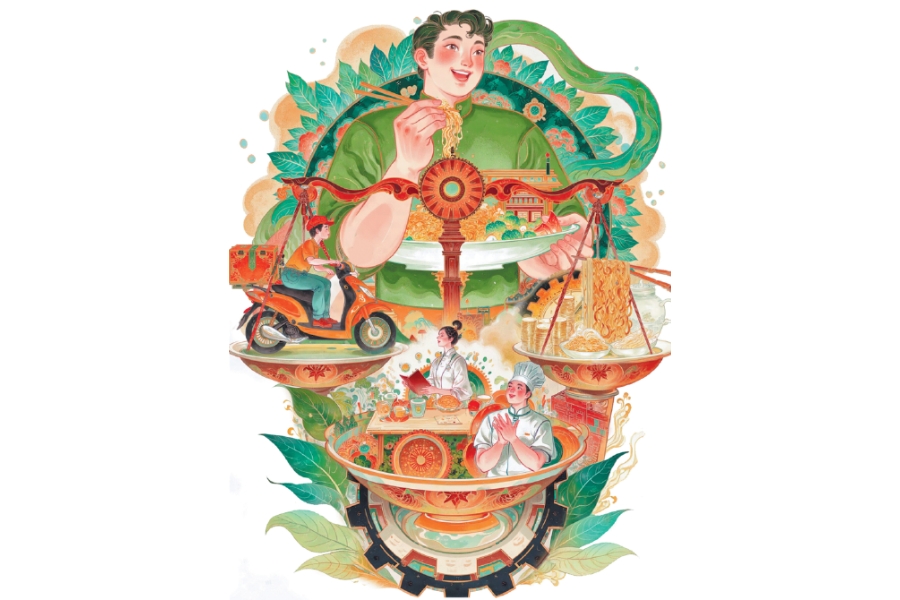
China's latest push to urge rational competition and regulate the promotional activities of major food delivery platforms will help maintain normal market order, ensure fair competition, and promote the healthy, orderly and sustainable development of the platform economy, experts said.
They emphasized that these platforms should shift their focus from providing massive subsidies and huge discounts to improving the quality of services and delivery efficiency, while safeguarding the rights and interests of delivery riders.
"Anti-involution" has become a focus of China's economic policies. Comprehensive measures to address "involution-style" competition will become a priority in economic and social development in the second half of the year, they noted.
A meeting of the Central Commission for Financial and Economic Affairs on July 1 stressed efforts to advance the building of a unified national market, regulate enterprises' disorderly price competition in accordance with laws and regulations, and guide enterprises to improve product quality.
Since May this year, many local catering associations have issued documents calling on food delivery platforms to stop "involution-style" competition.
Chinese leading food delivery platforms — Alibaba Group-backed Ele.me, Meituan, and JD — vowed in August to rein in aggressive discounting practices, resist disorderly and vicious competition and foster a win-win ecosystem.
Ele.me and Alibaba's Taobao Instant Commerce pledged to send out subsidies based on the needs of consumers and merchants in a reasonable manner, promising to eliminate large-scale irrational promotions and improve the quality of services.
JD announced it will regulate subsidy activities, firmly avoid unfair competition and resist the vicious subsidies, such as "zero-yuan purchases", aiming to build a simple and transparent subsidy mechanism.
Meituan emphasized its commitment to firmly regulating promotional activities and eliminating unfair competition, saying that any subsidy activities must strictly comply with laws and regulations, and it will promote the establishment of a fair and orderly industry order.
Their move came after the State Administration for Market Regulation summoned the three leading food delivery platforms on July 18, urging them to regulate their promotional activities and engage in rational competition.
The regulator called on the platform companies to strictly adhere to e-commerce, fair competition and food safety laws, and assume more professional responsibility, while fostering a healthy ecosystem that benefits consumers, merchants, delivery riders and platform operators, so as to promote the regulated, healthy and sustainable development of the catering services sector.
The latest move has demonstrated the government's firm determination to maintain fair market order, signaling its "zero-tolerance" attitude toward disorderly subsidies and vicious competition, said Jiang Han, a senior analyst at market consultancy Pangoal, adding that the regulated and healthy development of the food delivery sector is directly related to consumers' rights and interests.
It is of vital significance to safeguard a fair and orderly market environment and avoid the "involution-style" competition in the food delivery sector, which is experiencing a prolonged price war, Jiang said.
He said the competition in China's instant retail sector is intensifying as these platforms have stepped up subsidies to compete for market share, leading to the compression of merchants' profits and the decline in consumer experience.
"The platform enterprises should provide differentiated innovative services, such as optimizing delivery efficiency, enhancing food safety standards and improving after-sales services, thereby creating a healthy competition environment, and promoting the high-quality and sustained development of the food delivery sector," Jiang said.
The authority's meeting with major food delivery platforms followed the increasingly fierce competition in the country's instant retail sector in recent months, with players offering huge discounts and subsidies to grab a bigger slice of the pie, which triggered a relentless price war.
Alibaba's Taobao Instant Commerce has launched a substantial subsidy program worth 50 billion yuan ($7.01 billion) over the next 12 months for both consumers and merchants, while Meituan issued huge discounts and purchase coupons to attract more consumers.
Chinese e-commerce giant JD entered the highly competitive food delivery sector in February, which is dominated by Meituan and Ele.me. JD promised to provide comprehensive support like low or zero commission fees to catering merchants who register on its platform, and step up the recruitment of full-time delivery riders.
In May, the SAMR and four other government departments summoned major food delivery platforms to address prominent issues related to competition in the food delivery sector and to rectify unfair market practices.
The regulator called on the platforms to comply with laws and regulations, fulfill social responsibilities, strengthen internal management, engage in fair and orderly competition, and better safeguard the rights and interests of consumers, merchants and delivery riders.
According to a report from the Chinese Academy of International Trade and Economic Cooperation, the market scale of China's instant retail sector was 650 billion yuan in 2023, up 28.89 percent year-on-year. The figure is expected to surpass 2 trillion yuan in 2030.
Instant retail refers to a model where shoppers place orders on online trading platforms, followed by retailers from brick-and-mortar stores executing door-to-door deliveries themselves or through third-party delivery platforms. An on-demand delivery order usually requires 30 to 60 minutes to be completed.
Supply chain capabilities, fulfillment efficiency and service quality will be the key factors that determine the future landscape in the food delivery sector, while the platform enterprises should ramp up technological innovation, optimize delivery networks and adopt differentiated strategies to further improve user experience, industry insiders said.
Hong Yong, an associate research fellow at the CAITEC, said: "Instant retail is regarded as an important development direction for the future retail sector as enterprises can expand their scope of services, enhance user stickiness, and leverage their existing logistics and supply chain advantages to explore new growth points through instant retail."
Hong said the key to success is centered on the optimization of user experience, expansion of service scope and improvement of supply chain efficiency.
Cao Lei, director of the Internet Economy Institute, a domestic consultancy, said the continuous steep discounts and price war pose challenges to platform companies' profitability, intensify competition and further squeeze the survival space of small and medium-sized merchants.
Cao said these platforms should increase investments in technologies such as artificial intelligence-powered algorithms and intelligent scheduling to enhance fulfillment efficiency, while optimizing supply chain management, safeguarding the legitimate rights and interests of consumers, and improving the welfare of delivery staff.
To safeguard the rights and interests of delivery riders, Alibaba Group and financial tech company Ant Group have rolled out a plan aimed at providing better benefits guarantees and stimulus measures. The plan includes offering more support to riders and their families, covering special rewards, educational improvement, healthcare assistance and career development.
Ele.me has invested more than 20 million yuan for over 600 family members of riders who have serious illnesses and has provided educational assistance to more than 400 riders and their children.
Meituan announced in July that it will upgrade the benefits guarantee for riders. The pension insurance subsidy will be rolled out nationwide by the end of this year, and it is expected to cover over 1 million riders. Since July 1, the coverage of work-related injury insurance for riders has been expanded to 17 provinces and municipalities, the company said.
JD said it will invest 2 billion yuan to upgrade benefits for its full-time riders. In addition to providing full-time food delivery riders with comprehensive social insurance and housing funds, special allowances will be given to full-time riders each month during summer and winter. By the end of the second quarter, the number of JD's full-time delivery riders exceeded 150,000.
Noting that steep discounts and subsidies cannot continue for extended periods, Guo Tao, deputy head of the China Electronic Commerce Expert Service Center, said the platforms should elevate service quality such as stable fulfillment and after-sales guarantees to enhance customer retention, while expanding the scope of service scenarios, increasing product categories and improving their cost-effectiveness.
Zhu Keli, founding director of the China Institute of New Economy, said it is important that platform enterprises pool more resources into technologies and optimize cost structure through highly efficient inventory management and intelligent warehousing systems.
He stressed the need to establish a stricter merchant access and supervision mechanism to improve the quality of goods, while calling for efforts to strengthen cooperation among different platforms to better integrate resources and further stimulate consumption potential.
fanfeifei@chinadaily.com.cn



















