



SCO Tianjin Summit could improve China-India ties







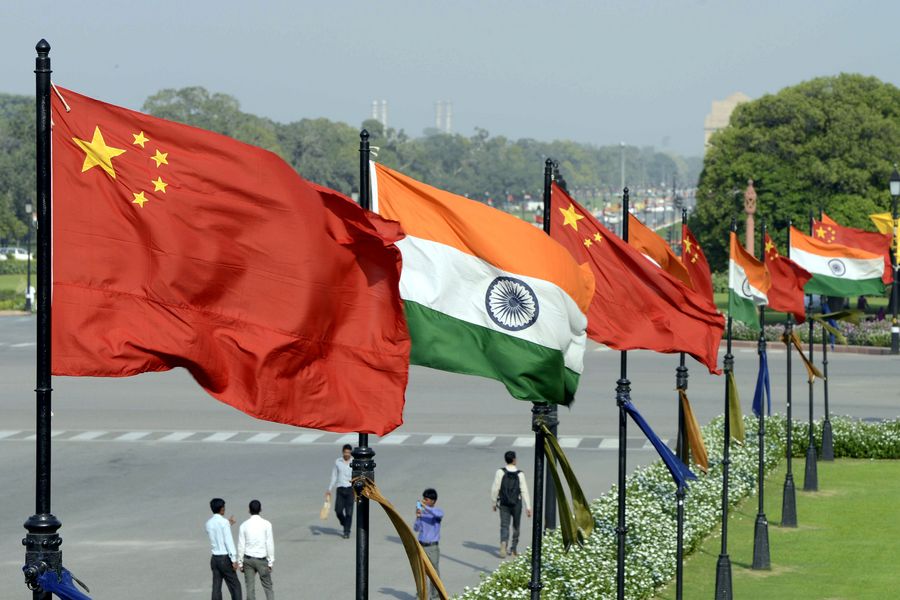
In New Delhi last week, Chinese Foreign Minister Wang Yi met Indian Prime Minister Narendra Modi, National Security Advisor Ajit Doval and External Affairs Minister Subrahmanyam Jaishankar, co-chairing the 24th Round of Talks Between the Special Representatives of China and India on the Boundary Question. From there, attention turned quickly to the Shanghai Cooperation Organization Summit, which China will host in Tianjin from Sunday to Monday.
The context is hard to miss. Washington has imposed tariffs of up to 50 percent on Indian goods-25 percent was already in force, and another 25 percent took effect on Wednesday — with the US citing India's Russian oil purchases and stalled market-access talks. India's Commerce Minister Piyush Goyal said New Delhi will approach the tariff dispute with a "very open mind", even as it safeguards sensitive sectors at home.
Beijing has signaled solidarity. China's Ambassador to India Xu Feihong called Washington's tariff move "bullying", adding: "Silence only emboldens the bully. China will firmly stand with India." The message, amplified across Indian and international media, was unmistakable.
The Wang-Jaishankar meeting produced a cluster of tangible steps. Both sides agreed to resume direct flights "at the earliest" and facilitate visas, and reopen border trade at three designated points, practical measures that lower the political temperature and restore economic contact after years of pandemic- and security-related disruption.
Beijing also agreed this spring to allow Indian pilgrims to resume visits to holy sites in China's Xizang autonomous region after a five-year pause.
Tone matters, too. In his public remarks, Jaishankar set out the now-familiar guardrails: "Differences must not become disputes, nor competition conflict", and lasting border peace is essential for momentum in ties. Those lines are a good proxy for New Delhi's approach: pragmatic engagement with clearly demarcated red lines.
For his part, Modi has framed India's trade stance through a domestic lens. "India will never compromise on the interests of its farmers, fishermen and dairy (sector)… and I know personally I will have to pay a heavy price for it," he said this month, underscoring that any external negotiation must pass the political economy test at home.
If there is one large, non-zero-sum space where India and China can advance fast, it is climate-smart agriculture, especially nitrogen efficiency in cereals. A landmark comparative analysis of wheat, rice and maize in both countries (1961-2013) shows that while fertilizer use surged, nitrogen use efficiency, the share of applied nitrogen recovered in the crop, fell to 20 to 24 percent by 2013(with wheat in India around 32 percent). Excess nitrogen doesn't just waste money; it leaks into the air and water as ammonia and nitrous oxide, a potent greenhouse gas.
The same study notes that China and India together account for more than 40 percent of global fertilizer nitrogen consumption. Nudging NUE upward delivers outsize environmental and economic gains.
For Beijing and New Delhi, co-branding a "green nitrogen partnership" would be a credible, apolitical sort of cooperation that reassures neighbors and markets alike.
Rebuilding trust
Soft infrastructure supports this agenda. The planned resumption of direct flights will shorten supply chains for perishable agri-inputs, allow agronomists and business delegations to move quickly, and restart people-to-people contact.
India's decision to resume issuing tourist visas for Chinese citizens after five years and provide broader facilitation for business travel adds momentum. Combined with Beijing's reopening of pilgrimages to Xizang, these are confidence-building measures with cultural resonance.
Commercially, both sides are exploring the reopening of border trade points and easing of certain import bottlenecks. Indian industry will watch for movement on critical inputs, from specialty chemicals to tunnel-boring equipment and selected rare-earth derivatives, while China is expected to demand predictable market access in electronics and components.
The United States administration's tariff ladder, now at a combined 50 percent rate, has clearly concentrated minds in New Delhi. It also created space for Beijing to position itself as a supporter of India's right to policy autonomy. Ambassador Xu's line, "Silence only emboldens the bully", captured that mood and landed well in India's public discourse.
But tariff politics are volatile; no one in New Delhi or Beijing can bet the relationship on Washington's next move. The smarter bet is to use the window to bank on bilateral deliverables.
Here, too, India has set political trip wires. Modi's public pledge to "never compromise" on the interests of farmers, fisheries and dairy sets a ceiling on concessions that affect rural incomes; any trade "grand bargain" must route around that domestic reality. That is why green-agriculture cooperation, and not tariff-linked market access, is the logical early win.
With Modi expected to attend the SCO Tianjin Summit, the two countries have an opportunity to announce a portfolio of confidence-building measures that are simultaneously substantive and safe, such as those regarding connectivity, people-to-people exchanges, nonagricultural trade facilitation and green nitrogen partnership.
None of this solves the hardest problem, the contested frontier. But it does reduce friction, build habits of cooperation and create constituencies with a stake in stability.
In the coming days, the optics from Tianjin will matter. A relaxed leader-level interaction, a short joint statement that lists concrete timelines for connectivity, and a green-agriculture line item with named pilot districts would signal a relationship landing on practical ground. It would also underscore a larger point: Asia's two largest economies can, when incentives align, find room to cooperate without erasing competition.
That is not rapprochement by romance. It is rapprochement by arithmetic.
The author is an Indian scholar at the Department of Journalism of Hong Kong Baptist University in Hong Kong.
The views do not necessarily reflect those of China Daily.










