Chinese method helps treat burned students
Team of five from Wuhan operate on seven critical victims of air crash in Dhaka, put 22 others also on road to recovery







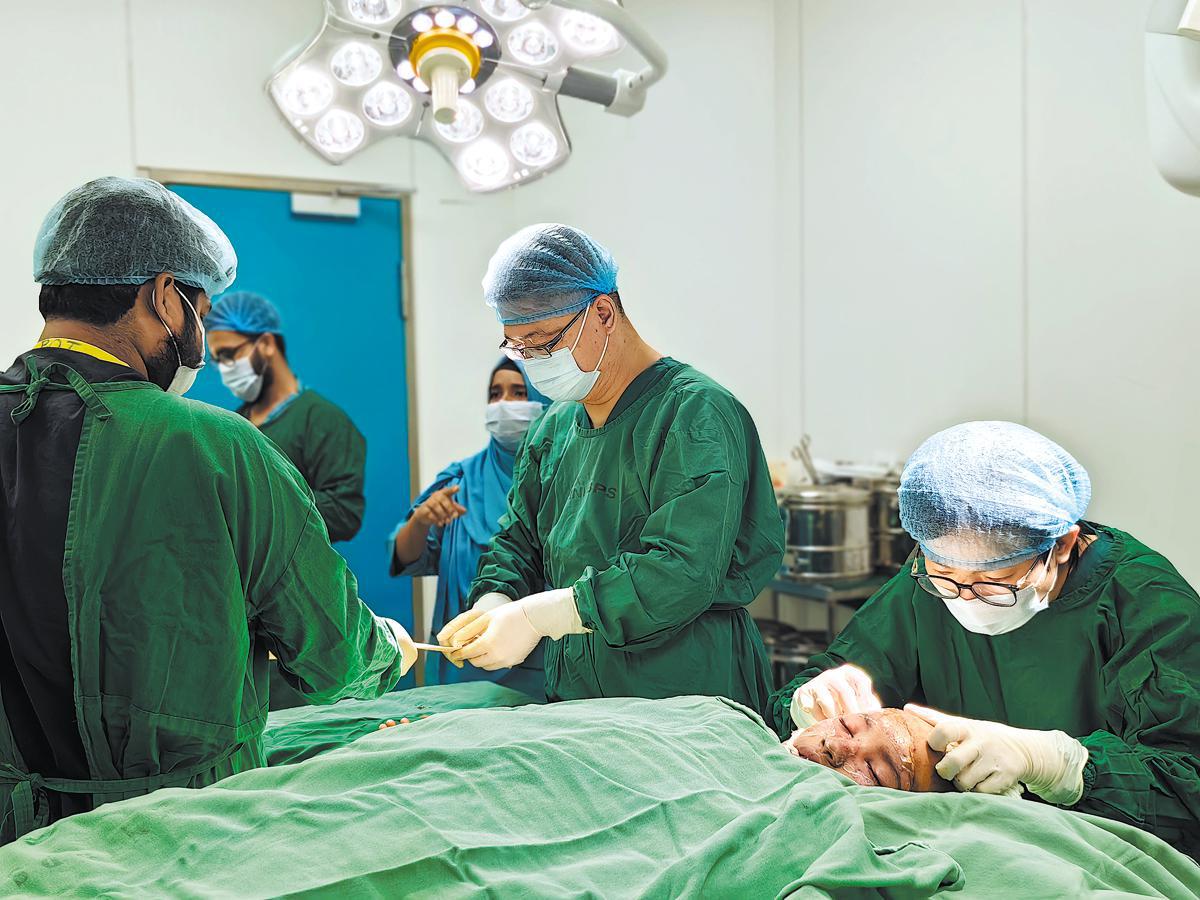
A month after surviving an air crash and suffering serious burns, Luke (not his real name), a 12-year-old boy from Bangladesh, is recovering with a successful skin graft on his left upper limb.
Liu Shuhua, a Chinese doctor who participated in his treatment, said she was happy to hear the news.
On July 21, a Bangladesh Air Force training aircraft crashed on a school and college campus in Dhaka, resulting in 31 deaths and injuries to more than 100 people — mostly students who suffered burns. It drew widespread attention from around the globe. Luke was one of the victims.
Wuhan Third Hospital in Wuhan, Hubei province, famous for treating burns, received a request for drugs, but the hospital decided to rush four doctors and a nurse to help in Dhaka, the national capital.
The team soon acquired emergency medical licenses from Bangladeshi health authorities.
Liu, deputy director of the hospital's burns department, and leader of the Chinese medical team, recalled how bad Luke's condition was, with 45 percent of his body burned.
"He was showing signs of high fever, lung infection and acute respiratory distress syndrome, with the looming risk of sepsis," Liu said. "During the first examination, his condition was already very critical."
However, due to differing treatment philosophies, foreign experts leaned toward conservative treatment, while Liu's team warned that it could lead to systemic infection and other life-threatening consequences.
"He needs immediate surgical debridement!" Liu told doctors at the National Institute of Burn and Plastic Surgery in Dhaka, where the country's top medical experts as well as rescue teams from Singapore and India were gathered to help.
She presented a treatment plan used in Wuhan for similar cases: surgically removing necrotic tissue, applying homemade burn powder from the hospital, and combining it with a prone positioning nursing method — a proven "Chinese protocol" that has succeeded countless times, even for patients with more than 80 percent burns.
On July 26, Chinese and Singaporean doctors performed the surgery. After 48 hours, Luke was weaned off the ventilator. By the fifth day, his vital signs stabilized, and his condition gradually improved.
The rapid and remarkable therapeutic effect won everyone over. Amazed by the results, Bangladeshi doctors began adopting the "Chinese protocol", successfully saving more critically ill patients.
During their eight days in Dhaka, the Chinese medical team operated on seven critical patients and helped 22 injured people.
"We have 60 years of experience in treating burns. The condition Bangladesh faces we've also faced before," Liu said, adding that her team also took into consideration if the methods and drugs were suitable for long-term use locally.
For instance, facing a lack of equipment to dry wounds, Zhang Jinli, a member of the Chinese medical team, creatively used blow-dryers on a low heat setting to solve the problem, which was both low-cost and effective.
"Besides, nurses can easily learn it," Zhang said.
Liu Huan, another member, translated Chinese burn infection-control processes into English diagrams and guided local nurses step-by-step on standardized disinfection. Even the fruit sugars they brought became secret "drugs" — giving a sugar to crying children can ease their anxiety and bring doctors and patients closer.
Further, the China-made nanosilver dressings brought by the Chinese doctors were praised by Bangladeshi doctors for their wide-ranging adaptability and cost-effectiveness.
The team also showed different treatment methods, such as scalp skin grafting, whereas the local method prefers harvesting skin from the thigh.
"Harvesting from the thigh is more convenient, but the supply of skin is limited. Scalp harvesting requires greater technical skill, yet if performed properly, the scalp can regenerate, allowing for more skin to be harvested over time. Additionally, hair growth helps conceal scars, resulting in better cosmetic outcomes," team leader Liu said.
Besides, in care practices for critically ill patients, it is locally common to keep the patients lying supine, whereas the Chinese team recommended prone positioning and regular turning of the patient. For treating moist, pressure-affected wounds, the Chinese approach favors exposed wound care, while local practice often involves tight bandaging.
"The Chinese counterparts have brought not just aid or technology that feels out of reach, but sustainable solutions," said Mohammad Nasir Uddin, director of the institute.
When Liu and her team members returned to China, the Bangladeshi doctors gave each member a painted jute bag embroidered with their name as a farewell gift.
Liu continued to maintain contact via WeChat to remotely exchange diagnosis and treatment recommendations. Bangladeshi doctors proactively shared updates on their patients' conditions and sought further advice.
Recalling the night when they discussed each patient's condition and treatment method on the plane to Dhaka, and the sleepless nights in operating rooms and wards, Liu said the experience was unforgettable.
"We learned from Singaporean teams to have a strong sense of responsibility to the care of patients, as well as Bangladeshi culture, religion, medical conditions and even pronunciation and intonation," she said, adding that it was all meaningful for the expansion of their knowledge and skills when treating patients overseas.
Later this year, doctors from the research institute in Bangladesh will come to Wuhan on a medical exchange. Next year, two of the rescued children will be invited to the "burn-children" summer camp held in Wuhan every year, to see the Yangtze River.
Yang Che contributed to this story.
Contact the writers at chenmeiling@chinadaily.com.cn




- Photographer captures wild mandarin ducks in Guizhou
- Infrared cameras and drones record Tarim red deer in Xinjiang
- Beijing issues alerts for snowstorms and road icing
- Beijing district recovers nearly 100 million yuan in scam losses
- China's immigration hotline adds French language support
- Zootopia 2 fans fuel hazardous trend in online snake purchases