



Tariff pause evidence of the inevitable realities







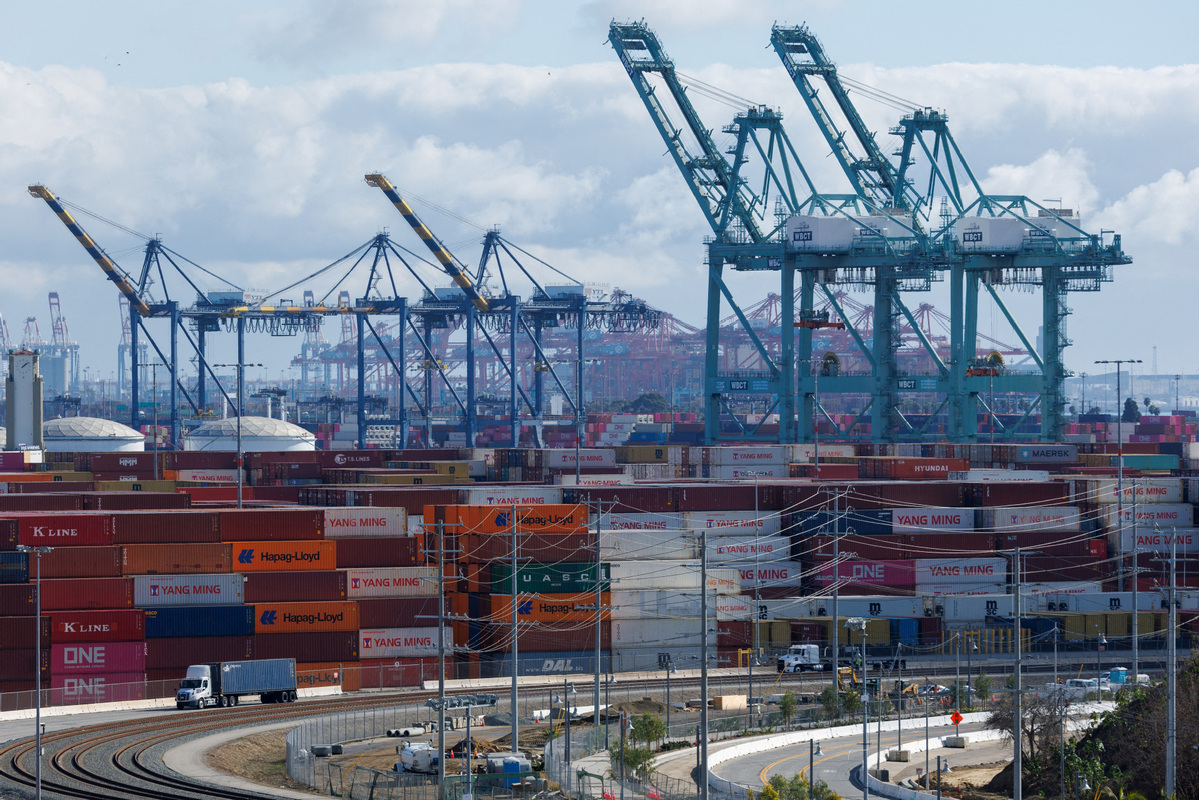
Hours before a fresh barrage of US tariffs on Chinese goods was set to take effect, United States' President Donald Trump signed an executive order granting another 90-day reprieve.
To anyone who has followed the US administration's approach to economic brinkmanship, the choreography felt familiar: drive the confrontation to the cliff's edge, let markets hold their breath, then step back — but only just far enough to claim victory. The goal is not genuine de-escalation, but to extract concessions at minimal political cost, preserve the illusion of domestic economic stability, and reinforce the narrative that America plays by its own rules.
This is tariff diplomacy as political theater. Since April, the US administration has revived its so-called "reciprocal tariff" policy, threatening stratospheric duties on countries accused of having "unfair" trade practices. The tariff numbers are chosen for shock value, designed less to be implemented than to be bargained down. For the European Union, "compromise" came in the form of a promise to buy $750 billion in US energy over three years, plus $600 billion in investment, in exchange for a reduced tariff rate. Japan bought relief with $550 billion in investment.
China, however, is a harder target. The US is no longer its largest trading partner; the Association of Southeast Asian Nations has taken that spot.
Beijing has leaned into the Belt and Road Initiative, regional agreements, and diversification of supply chains. Its export mix has shifted, reducing Washington's leverage. Even the agricultural commodities once used as pressure points — soybeans above all — have been diversified toward South American suppliers.
The US political class, across parties, has embraced the idea of China as a "systemic rival". This is the new orthodoxy: Tariffs and export controls are not temporary bargaining chips but long-term features of the relationship. In the US, anti-China rhetoric sells; in China, the economic system has proved to be resilient enough to absorb the pressure.
Look at the numbers. In the first half of this year, China's foreign trade grew nearly 3 percent year-on-year, despite a plunge in trade with the US. The number of Chinese companies with import-export activity has hit a record high, and high-tech exports have risen for nine consecutive months. This is not an economy brought to its knees — it's one recalibrating for a world where the US market is just one of many.
Which is why the latest 90-day "pause" is an acknowledgment of three unyielding realities.
First, economics: Global supply chains are too interconnected to be severed without collateral damage. Break one node and you bleed across the system.
Second, politics: Unilateralism breeds multilateral pushback. The multiple WTO complaints against US tariff policy are only the beginning.
Third, history: From the Smoot-Hawley Tariff Act of 1930, which helped deepen the Great Depression, to today's inflation squeeze on American households, beggar-thy-neighbor policies eventually come home to roost.
What is striking this time is the side-deal chatter. The Financial Times reports that Washington may ease some semiconductor export restrictions, allowing Nvidia and AMD to sell advanced artificial intelligence chips to China — with the unusual stipulation that 15 percent of sales revenue be handed over to the US government.
Even so, the underlying 30 percent tariff on Chinese goods, imposed at the start of the current US administration, remains in place. Economists warn that such rates will continue to fuel inflation and dampen growth.
And then there's the gold twist. Days after a leaked customs memo suggested tariffs on bullion were coming, Trump announced there would be no such move. Gold futures promptly dropped 2.5 percent.
Whether it was economic sense or political optics driving the reversal is anyone's guess.
For all the bluster, market reaction to the extension was muted. Wall Street's major indices closed slightly down on the day, with investors more interested in upcoming inflation data than in the latest tariff truce. After all, this isn't the first "pause" in the tariff war. It probably won't be the last.
While both economies benefit from the current global framework, Washington sees China's rise as a direct threat to its primacy — the classic "Thucydides Trap" logic. Beijing, for its part, has no illusions about US intentions. It's building alternative trade corridors, investing in self-reliance in critical technologies, and preparing for a future in which strategic competition persists.
In the long run, as "America First" curdles into "America Alone", the laws of economics, politics and history will prove less forgiving than any negotiating partner across the table.
The author is chairman of the Asia MarTech Society and sits on the advisory boards of several professional organizations, including two universities.
The views do not necessarily reflect those of China Daily.










