



Critical focus







Twin prisms of history and present urgency show need to reimagine Sino-US relations
As this year marks the 80th anniversary of the Allied victory in World War II, we are reminded of the extraordinary moments of courage and cooperation that defined the closing chapters of the war.
In 1941, months before the United States formally entered the war, a group of US volunteer pilots known as the Flying Tigers took to the skies over China to help resist Japanese aggression. Officially named the American Volunteer Group, these pilots — working in coordination with Chinese forces — defended strategic supply routes, trained local aviators and carried out daring missions that boosted morale on both sides of the Pacific.
Their bravery in the face of overwhelming odds — and their camaraderie with Chinese allies — remain enduring symbols of trust and shared purpose. Their legacy is more than a footnote in wartime history. It is carved into stone at memorials in Nanjing, Chongqing and Kunming, and retold in museums and at commemorative events. Eight decades later, their story continues to remind us that China and the US, despite different cultures and political systems, have demonstrated the capacity for important cooperation in times of crisis. It is also a powerful reminder that historical memory should not merely be respected — it should be activated.
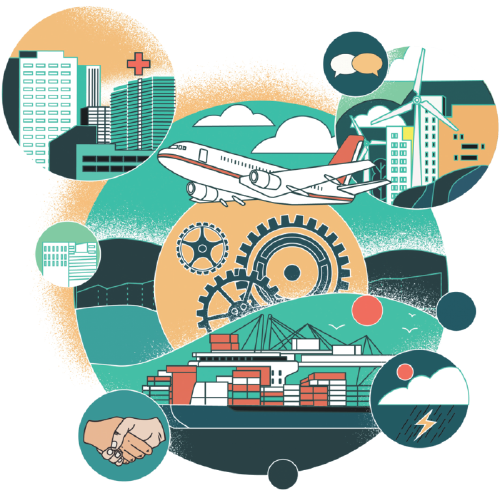
Today, that sense of history must be paired with a clear-eyed view of the present to reimagine a constructive path forward for Sino-US relations. In the 21st century, the world's two most influential nations must either find a way to work together or risk ushering in a period of prolonged uncertainty. Challenges, such as climate change, public health threats, food security, artificial intelligence governance and nuclear non-proliferation, know no national borders. They cannot be solved through rivalry. They demand leadership, cooperation and mutual understanding.
And cooperation is not without precedent. During World War II, China's Eastern Front tied down millions of Japanese troops, helping to relieve pressure on Allied forces in other theaters. Meanwhile, courageous Chinese civilians rescued and protected US airmen — such as those from the Doolittle Raid — at great personal risk. These acts of courage laid the groundwork for the diplomatic breakthroughs of the 1970s, including President Richard Nixon's historic 1972 visit, which re-opened dialogue and paved the way for the normalization of bilateral relations.
In 2001, the US supported China's entry into the World Trade Organization, helping catalyze a period of rapid development and global integration. US companies gained new market access, supply chain efficiencies and lower prices for consumers, while Chinese workers and consumers experienced rising incomes and improved living standards. Later, in 2008, China's measured response to the global financial crisis helped stabilize world markets.
Academic and cultural exchanges also blossomed. Since the 1980s, more than 3 million Chinese nationals have studied in the US, contributing to breakthroughs in science, medicine and the arts. Many returned to China with new perspectives and networks. Others remained, making lasting contributions to US society. In both directions, they have acted as informal ambassadors of cross-cultural understanding.
Despite this rich history of engagement, today's relationship is strained. Strategic mistrust has grown on both sides. Economic priorities have shifted. Political rhetoric — especially during US election cycles — often amplifies divisions rather than builds bridges.
There are, of course, legitimate concerns. US stakeholders point to issues such as market access, regulatory opacity and intellectual property rights enforcement. Chinese policymakers, meanwhile, express unease about perceived containment efforts, technology restrictions and the weaponization of economic interdependence. These concerns must be acknowledged — but they must also be addressed through principled dialogue rather than zero-sum confrontation.
The recent trend toward decoupling, particularly in technology and supply chains, reflects a deeper anxiety about dependence and vulnerability. But we must not lose sight of the broader truth: China and the US remain deeply intertwined. Total disengagement is not only impractical — it would be economically damaging and strategically destabilizing for the world at large.
Instead, we must search for a new equilibrium — one that balances competition with cooperation, and national interest with global responsibility. This will not be easy. It will require skillful diplomacy, mutual respect and the ability to see the other side not as an adversary, but as a necessary partner in managing shared challenges.
Education remains one of the best starting points. The vast network of alumni, scholars and institutions that bind our two countries weathered political storms in the past. It must be preserved and expanded — not only in elite universities but also through vocational partnerships, joint research and student exchanges that reach deeper into both societies.
Equally important is our shared interest in global stability. From climate negotiations to pandemic preparedness, from regulating emerging technologies to maintaining peace in maritime and space domains, the world depends on the willingness of China and the US to lead — together.
As we reflect on the legacy of the Flying Tigers and the civilians who risked their lives to aid US airmen, we are reminded that the strength of Sino-US relations has often come from the contributions of individuals — acting with courage, empathy and vision.
In his 1949 memoir, General Claire Chennault, best known for his leadership of the Flying Tigers, wrote: "It is my fondest hope that the sign of the Flying Tigers will remain aloft just as long as it is needed… to show two great peoples working toward a common goal in war and peace." That hope is just as vital today.
From the Chinese side, that sentiment is echoed by voices such as Sha Hailin, president of the Shanghai Public Relations Association and director of the Academic Committee of the Shanghai Institute of American Studies, who recently remarked: "We commemorate victory not to perpetuate hatred, but to safeguard peace; we remember history not to return to the past, but to move forward together."
As we look to that future, let us do so not through the lens of rivalry, but through the twin prisms of history and present urgency. The path ahead will be complex, but the stakes are too high to abandon the possibility of partnership. History shows us what is possible. The present demands that we act.
The author is executive vice-chancellor, American president and distinguished professor of social science at Duke Kunshan University in China and the John deButts professor of practice at Duke University's Fuqua School of Business in the United States. The author contributed this article to China Watch, a think tank powered by China Daily.
The views do not necessarily reflect those of China Daily.
Contact the editor at editor@chinawatch.cn.





