



Beijing leads global energy transition







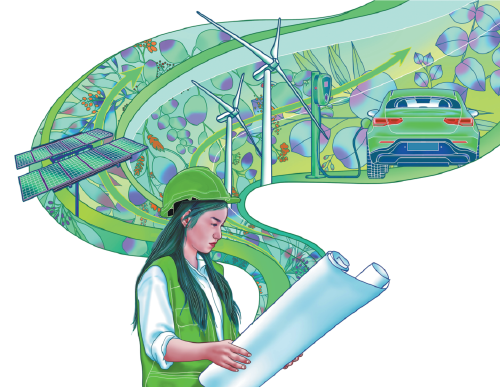
While China's economic miracle is well-known, what is less recognized is its remarkable advance in many scientific and technological fields, especially in renewable energy, since 2000.
A pivotal point came in 2003, when the Chinese government realized the country's growing dependency on imported oil and gas. Since then China's investment in clean energy has continued to be significant.
Because of such a remarkable policy environment, by 2023, more than 95 percent of new utility-scale solar PV panel installations and onshore wind turbines had lower electricity generation costs than new coal and gas plants. Current trends indicate the cost of innovation in the energy sector will continue in the coming decades, further consolidating China's premier global position.
Apart from the reduction in the cost of energy transition, there have been two beneficial side effects. First, China's energy security has significantly strengthened. And second, air pollution levels in Chinese cities have steadily decreased over the past decade. For instance, Beijing witnessed 290 blue sky days in 2024, which was unthinkable a decade ago.
When China started investing heavily in clean energy R&D in 2003, climate change was a matter of concern, but it was not as serious an issue as it is today. Due to rising carbon emissions, global climatic patterns are changing much faster than the forecasts made even five years ago. The world has been trying to reduce emissions so that the increase in global temperatures can be kept below 1.5 degrees Celsius of the preindustrial levels, with many countries committing to achieve carbon neutrality between 2050 and 2060.
But the breakneck speed with which China has built its solar, wind, hydro and nuclear power infrastructure, and mastered the technologies of EVs and high-speed trains suggests the country could peak its emissions around 2026, four years ahead of the target it announced only five years ago.
China's installed solar PV capacity now exceeds 1,000 GW, equivalent to half of the world's total. And between January and May 2025, China added 198 GW of solar and 46 GW of wind energy, equivalent to the total of Indonesia or Turkiye.
As noted earlier, in 2000, China generated a little more than 1,300 TWh of electricity, much less than the US(3,800 TWh) at that time. Since then, China has added more than 8,700 TWh, whereas the US has added only 500 TWh. China is now, by far, the largest producer of electricity in the world, generating 2.32 times that of the US, becoming the world's first "electrostate".
China has redefined the future of global energy thanks to its remarkable advances in the generation and use of all forms of clean energy. Importantly, Chinese companies are building EV plants in Thailand, Cambodia, Indonesia, Hungary, Spain, Turkiye, Russia and Brazil, while manufacturing solar PV panels in Malaysia, Vietnam, Portugal and South Africa. In addition, they have become the preferred choice of many developing countries as dam builders.
The availability of proper financing for timely transition to renewable energy is now a serious global challenge. Accordingly, China has granted energy-related funds worth $48 billion each to the China Development Bank and the Export-Import Bank of China, for "small yet smart" and "small yet beautiful" projects. Also, at the 2024 Summit of the Forum on China-Africa Cooperation, China committed to providing $51 billion for African countries over the next three years to build, among other things, 30 clean energy facilities.
In contrast, Washington has not only withdrawn from the Paris Agreement but also stopped funding US Agency for International Development (USAID), and the United Kingdom has drastically reduced its aid budget.
But despite China's recent financial support, developing countries need much more funds to ensure global energy transition. China is making serious efforts within multilateral frameworks such as Shanghai Cooperation Organization to promote modernization in developing countries and help maintain regional peace, as well as facilitate South-South knowledge and technology transfer, including renewable energy technology transfer.
As global energy dynamics and leadership change, SCO member states are providing a viable platform for shaping new paradigms of energy cooperation and transition. Amid the continuing uncertainties due to climate change, and widespread technological disruptions and geopolitical tensions, SCO member states are engaging in energy collaboration with developing countries and helping them achieve energy transition. Central to these developments is China's continuing leadership in clean energy technologies, and its support to other countries.
Asit K. Biswas is director of Water Management International, Singapore, and distinguished visiting professor at the University of Glasgow, UK; and Cecilia Tortajada is an honorary professor at the University of Glasgow, UK.
The views don't necessarily reflect those of China Daily.
If you have a specific expertise, or would like to share your thought about our stories, then send us your writings at opinion@chinadaily.com.cn, and comment@chinadaily.com.cn.





