



Modern ports expected to offer end-to-end services







Editor's Note: China has the largest port infrastructure in the world. Su Fengming, a researcher at the Chinese Academy of Macroeconomic Research, spoke to People's Daily Overseas Edition about the measures needed to meet evolving trade and logistics demands. Below are excerpts from the interview. The views don't necessarily represent those of China Daily.
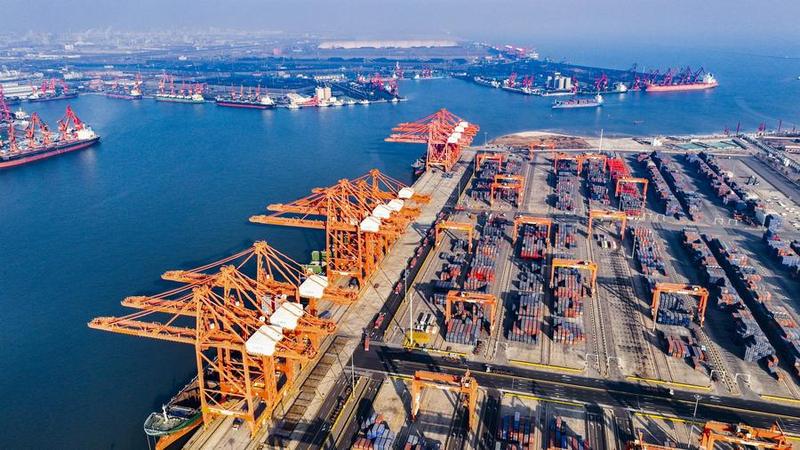
During the 14th Five-Year Plan (2021-25) period, China's ports registered impressive growth, with throughput hitting record highs and handling capacity further enhanced. Service levels also steadily improved with an increase in the number of large-scale and specialized berths. In 2024, the number of operational berths reached 22,219, of which 2,971 berths had a capacity of 10,000 tons or more, a 14.62 percent increase compared with 2020. The construction of port cluster systems has also begun to show results.
The smart and green transformation of China's ports is in the fast lane. Technologies such as big data, artificial intelligence, the internet of things and cloud computing are being used for remote port control, unmanned container truck scheduling, dynamic yard optimization and berth plan optimization. These measures have helped to significantly improve operational efficiency. China ranks first in the world in both the existing and under-construction scale of automated container and dry bulk terminals, while the creation of a number of near zero carbon ports is being expedited.
China's integration and optimization of port resources is also deepening, and multimodal transport is rapidly expanding. Currently, 10 coastal provinces and seven provinces along the Yangtze River have established provincial-level port groups and commenced integrated port operations.
China has also formed world-class port clusters that span provincial-level administrative regions and have been elevated to national-level regional coordinated development. These include the Bohai Rim, the Yangtze River Delta and the Guangdong-Hong Kong-Macao Greater Bay Area.
In the next stage, China's ports will need to play a key role in the country's development. Given the complex and changing international landscape, they must enhance their functions, widen their coverage and diversify their supply chain services to meet the country's complex production, trade and logistics needs.
First, efforts should be made to strengthen resource integration and leverage cluster effects. Inland ports should strengthen their strategic cooperation with seaports, link domestic and foreign trade routes and make transit logistics more efficient.
Second, the government needs to build water-land interchange hubs to optimize the logistics networks. It must vigorously develop multimodal transport, connect water and land transport systems, develop warehousing and other supporting logistics facilities and expand the two-way service capacity. Ports should become logistics hubs that connect various related entities.
Third, it is necessary to develop hub economies and promote the deep integration of ports, industries and cities. Modern ports should have comprehensive service platforms that link all related industries and provide services in trade, finance, insurance and production. This would enhance the ability of ports to control supply chains, pool resources from industries and towns, and promote mutual prosperity.
Fourth, the authorities should adapt to changes in international trade flows and shifts in the industry and supply chains, strengthen linkages between domestic and overseas ports, support the construction of route networks centered on Chinese ports, and further open up land-sea transport channels.





