More grads chart career paths in west of China







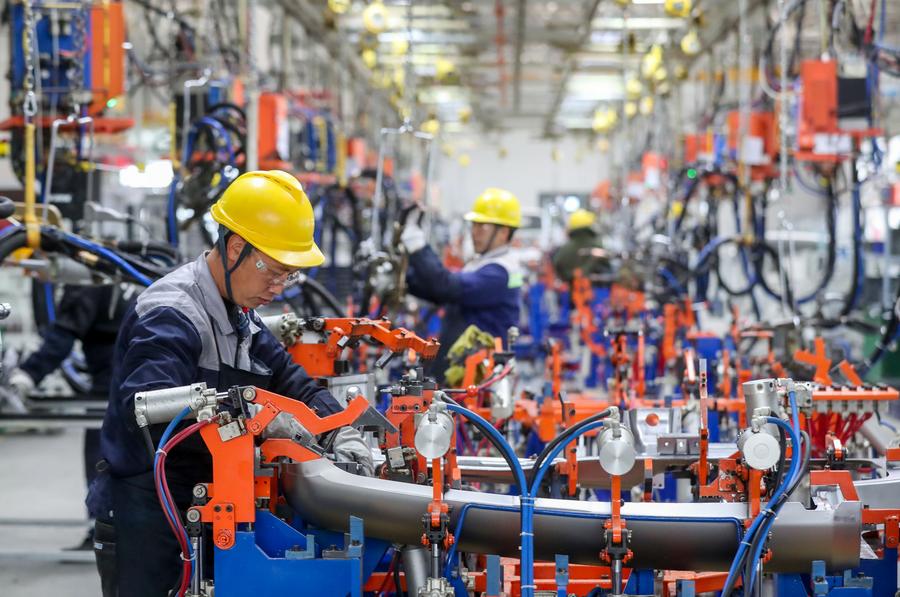
Hu Yun's journey from the corridors of Beijing Jiaotong University to the rail yards of Guiyang South Railway Station in Guizhou province captures a rising trend of more and more graduates answering the country's call to contribute their youth and talent to the development of the vast and underdeveloped western region.
The 25-year-old, who has a master's degree in transportation planning and management, ignored opportunities and his family's wish that he work in a big city and chose to operate trains in his native Guizhou instead — a decision shaped by witnessing closely the changes brought about by the transportation revolution.
"As a native of Zunyi, I've seen firsthand how the development of transportation has transformed my hometown," Hu said.
The Chongqing-Guiyang High-speed Railway has reduced a six-hour journey to 90 minutes, while China-Europe freight trains carry prickly pears, pepper and tea from Guizhou overseas and bring back European timber and lubricants, he said.
"Returning to contribute to Guizhou's railway development is not just a career choice — it's a fulfillment of my university's motto, 'Knowledge and Action', and a way to honor my roots," Hu explained. "When personal growth synchronizes with national strategy, the youth shines brightest."
President Xi Jinping has on many occasions called on the young people to closely link their personal endeavors with the undertakings of the Party and the country.
In a reply letter to a group of volunteer teachers working at a remote border school in the Xinjiang Uygur autonomous region ahead of this year's Youth Day on May 4, Xi noted that more young people have chosen to serve as volunteers in the country's western region and rural areas over the years, demonstrating their spirit of dedication and sense of responsibility.
He urged young people to stand firm in their ideals and convictions, cultivate patriotism, develop outstanding skills and work hard to contribute to Chinese modernization.
Hu's choice aligns with the findings of a recent China Youth Daily survey, involving 1,251 students. It showed that over 97 percent of the respondents viewed the country's western region as a prime ground for career growth, while 95 percent believed they can realize their career goals there.
About 16 percent expressed strong willingness to work in western China, with another 38 percent actively considering it. Personal ideals drove nearly 65 percent of the respondents, while 65 percent credited national policy support. Other motivators included university career guidance (41 percent), the region's development potential (36 percent) and reduced job competition (31 percent).
According to Guangming Daily, seeking employment in the west of the country has become a growing trend among college graduates. Over the last few years, over 300 graduates from Tongji University in Shanghai have chosen to seek employment in the western region annually.
Since 2019, a total of 1,559 graduates from China University of Political Science and Law in Beijing have landed jobs in the western region, while more than 60 percent of graduates from Southwest University of Political Science and Law in Chongqing have chosen to work at the grassroots levels in the region over the past three years.
According to the Communist Youth League of China Central Committee, so far this year, more than 48,000 college graduates have participated in a national program to work at the grassroots level in the western region. Launched in 2003, the program has sent over 590,000 college graduates to work in more than 2,000 counties in the region, contributing to rural vitalization, grassroots governance, livelihood improvement and border security.
Youth passion
Hu's choice also follows national strategies. The Guiyang South Railway Station is a critical hub in the Western Land-Sea New Corridor, a key regional development initiative. "Working here means standing at the forefront of China's efforts to bridge regional disparities," Hu said. "The west of the country is a land of rapid development, where we can tackle real challenges with innovation and breakthroughs and grow alongside the region."
Hu faced hurdles along the way. Like many graduates, he faced pressure from family to stay in big cities, where salaries are higher and opportunities more abundant. He had even secured job offers in Beijing, Shanghai and Guangzhou in Guangdong province. But when the chance to work in Guizhou arose, he knew what he would choose. "I want to dedicate my youth to building this land."
Du Xinyuan, a 22-year-old English graduate of Beijing International Studies University, has started working in Kunyu, Xinjiang Uygur autonomous region.
"I'm driven to experience grassroots governance and understand its pain points," Du said.
As the county is located on the southern edge of the Taklimakan Desert and has an average annual precipitation of only 34 millimeters, the Beijing native said he is prepared for the harsh environment, while brushing off sandstorm concerns. "Repeated exposure will ease adaptation," he said.
Du has deferred his master's in Marxist philosophy for a year to work in the western region, and considers the mission as embodying national unity ideals.
China is a country with vast territories and there are development gaps among different regions, and as a young man, he said he hopes to answer the country's call and do the right thing to work in the western region.
While both eager for and worried about his new life and challenges ahead, Du said he is physically and mentally prepared for his future work.
As an English major student, he believes he can help promote the region to other countries and hopefully attract foreign investments.




- Anti-corruption efforts focus more on work conduct issues
- Deeper reflections on 'cave-dwelling conversation'
- Fudan University sets AI education guidelines
- Haier ranks first in global sales for 17th consecutive year
- Norway's seafood exports hit record in 2025, China emerges as top three market
- Crucial tower of Shenzhen-Jiangmen Railway completed, marking significant milestone