


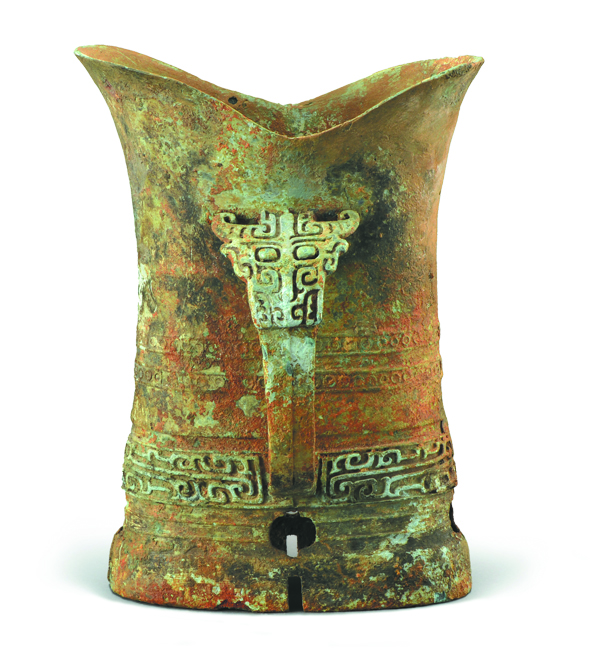
The discovery of bronze workshops at the Panlongcheng site suggests that metalworking skills spread from the Yellow River basin to the Yangtze, starting the Bronze Age there. These discoveries have changed what people previously thought.
There has long been a debate over how bronze artifacts were introduced to the Yangtze River basin from the Yellow River basin. The question remains: Were these artifacts produced locally using available materials, or were they distributed by the ruling class from the Central Plains?
In 2015, a significant discovery at Panlongcheng provided new insights. Sun Zhuo and his team uncovered a complete bronze casting workshop, featuring a full "industrial chain" of mold-making, casting and smelting. This marked the first discovery of a bronze casting workshop outside the capital city of the Xia and Shang dynasties.
"The bronzeware from Panlongcheng are consistent in both function and manufacturing techniques with those unearthed from the same period in the Shang Dynasty. We speculate that a group of craftsmen may have migrated directly from nowadays Zhengzhou in Henan province, where the capital city was located at that time," says Sun, who leads the archaeological team at Panlongcheng.
These bronze casting techniques also influenced settlements and ancient civilizations along the Yangtze River during the same period through Panlongcheng, such as the Sanxingdui culture located upstream in Sichuan province.
Over 3,000 years ago, during the peak of the Sanxingdui culture, a large number of exquisite bronze artifacts were unearthed. They are notable for their unique and intricate designs, particularly the masks with exaggerated facial features, such as large eyes and ears.
The Panlongcheng site is located in the Panlongcheng National Archaeological Site Park in Wuhan. The area is surrounded by water on three sides. Twenty kilometers to the east is a tributary of the Yangtze River. This geographical location made it a transportation hub at the time.
"We discovered that certain items and resources, such as pottery, were transported through Panlongcheng to the Yangtze and Yellow River basins, facilitating cultural exchanges between these regions," says Sun.
He adds that when changes occurred in the pottery of the Central Plains region, corresponding changes would also be seen in the pottery of Panlongcheng. This indicates that the Central Plains authorities maintained lasting control over the Yangtze River basin through Panlongcheng.
The city of Panlongcheng existed from 1600 BC to 1250 BC. Interestingly, for the following one thousand years, there was little evidence of human activity in this area. This suggests that Panlongcheng was abandoned after being established for over 300 years, says Sun.
He explains that the evidence suggests Panlongcheng was established primarily for political purpose, rather than as a city or settlement rooted in agriculture, as was traditionally the case. This discovery positions Panlongcheng as one of the earliest known examples of the relationship between central and local governance.
"As the archaeological research at Panlongcheng deepens, we find more and more interactions between the Yellow River and Yangtze River cultures. This has resulted in the formation of a long-term relationship of central control over local regions," says Sun.
A student of Zhang, Sun graduated from the School of History at Wuhan University. Since starting his graduate studies in 2013, he has been conducting archaeological research at Panlongcheng alongside Zhang.
As a new generation archaeologist, the 37-year-old Sun has devoted a significant amount of his time and effort to archaeological work at Panlongcheng, aiming to continue exploring new avenues based on the achievements of his predecessors.








