Why US tariffs could backfire







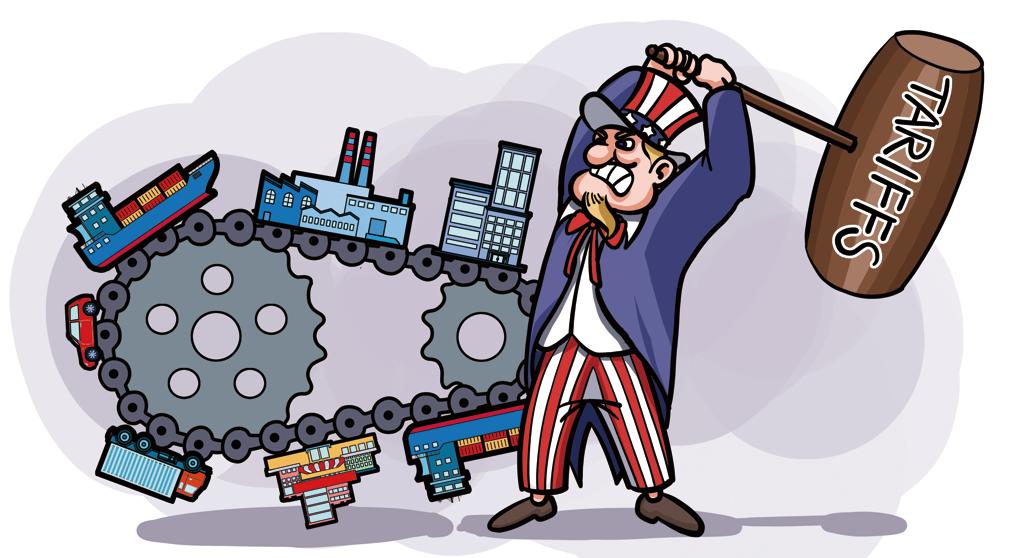
International trade is a complex system, like a living ecosystem. It is made up of many parts that are connected to each other, and even small changes can have a huge impact on them. Many people think tariffs are a simple tool. If you add a tax on imported goods, you protect your local industries. But trade does not work that way. It is not just about countries trading one-to-one. It is a network of choices made by enterprises and governments that react to each other. Change one part, and the whole system can shift.
Economists often use basic models of supply and demand, or focus on trade between a couple of countries at a time. These tools help us understand certain things, but they often miss the bigger picture. Today’s world is deeply interconnected. A small change in one country’s tariff can lead to a chain of reactions that will hurt the very people the tariff policy is meant to help. This is already happening, or could happen soon, to many US businesses and their customers. It is a clear example of how some policies can have unexpected results.
Let me explain with an example from my own region: Tuscany in Italy. Tuscany is known for its art treasures from the Renaissance as well as for its wine. Imagine three players: the European Union (which produces wine, like Tuscany), the United States (which also produces and consumes wine), and China (which is becoming an increasingly big wine market).
In the first scenario, trade works smoothly. The EU produces wine at a lower cost and sells it to the US. The US, too, sells wine to China. Each region focuses on what it does best. Prices are fair. Everyone gains something. Even US wine producers do fine, because they can still sell wine to China. There is a balance in the system.
Now imagine that the US imposes a new tariff on the wine imported from Europe, in order to help US wine producers. What happens next? As expected, European wine exports to the US decline. But that is not the end of the story. European producers, shut out of the US market, start selling more wine to China, offering high-quality products at lower prices. American wine exporters now face more competition in China. They even lose some of their customers.
Back in the US, prices go up for both local and imported wine, because there is less competition. US producers do not benefit much. They’ve lost access to China’s market, and the local market is not big enough to make up for it. Also, the US administration earns no tariff money, since European wine is no longer coming in. The outcome is paradoxical: the country that introduced the tariff ultimately is worse off.
Of course, this is just a simple story. In reality, trade involves thousands of interconnected products. If farmers produce more wine, they might produce less of something else. If consumers spend more on wine, they may cut back on other purchases. That is precisely the point: if such problems can arise in a basic example, they’re even more likely to occur in the complex, real world. Policymakers should take these risks seriously.
In fact, something like this has already happened. After the US first raised tariffs on Chinese goods in 2018, China responded by shifting some of its agricultural imports from the US to other countries, such as Brazil. As a result, US farmers had fewer buyers, leading to a decline in prices. The US administration offered support payments, but it did not make up for the losses. The effects spread across the economy and became hard to predict.
Why does this happen?
In a recent study, I built a model to study how countries respond to tariffs. In the simplified model, companies in every country sell a single good and choose where to sell it based on profit margins. The pattern of trade that emerges is not simple. These trade flows form a network. In this network, every trade connection depends on many others. If one connection breaks because of punitive tariffs, others too can break or change. And the whole network adjusts.
Even small changes in tariffs can cause big shifts. If one trade route becomes unprofitable, producers look for new customers, consumers have to pay higher prices. Meanwhile, other competitors move in. So in trying to help local enterprises, you could end up hurting them.
That’s why trade policy is so tricky. It should not be treated like a basic arithmetic problem. It is more like working with a complex system. One change can affect many others in ways that are hard to see at first. When enterprises lose out even under policies designed to help them, it is time to rethink those policies. Sometimes, letting trade move freely is better than trying to control it.
So next time when there is a debate on tariffs — on products such as cars, wine or steel — it is worth remembering that trade is not governed by simple rules. It is more like making good wine: many factors must come together in the right balance, and one misstep can spoil the whole process.
The author is a professor of Economics in the Department of Economics and Statistics, Università di Siena.
The views don’t necessarily reflect those of China Daily.