Western region rewriting story of migration







Not long ago, the story of western China was told in the rattle of green-hulled trains carrying young men and women eastward. They left behind the aged and children in villages in search of factory work in cities and towns. Theirs was a one-way journey, etched into the social landscape as a fact of life: if you wanted a future, you had to leave home.
That story is changing.
According to the National Bureau of Statistics, 66 million migrant workers found jobs or returned to their hometown with employment in the western region last year, half a million more than the previous year. This is not a statistical blip. Instead, it signals something larger: a turning tide in China's internal migration, driven by industrial shifts, digital innovations and a deeper yearning for home.
At the heart of this story lies a simple but powerful idea: what if the good life didn't require leaving home?
For decades, the economic hubs of coastal China drew workers toward the Pearl and Yangtze River Delta regions. Now, the center of gravity is shifting. As land prices and labor costs surge in eastern and southern China, industries — textiles, electronics, auto parts — are quietly moving inland. In Sichuan province's Yilong county, a precision manufacturing enterprise based in Zhejiang province has invested 120 million yuan ($16.77 million) in a new smart factory, which is expected to employ about 500 local residents. CATL, China's battery giant, on the other hand, has created more than 30,000 jobs in Yibin, Sichuan, converting former assembly-line workers into homegrown technicians.
In Guizhou province's Congjiang county, the rise of the "Congjiang medicinal bath" labor brand — born out of local culture and eastern industrial collaboration — has anchored stable jobs for 160,000 rural workers, attracting more than 20 enterprises from the east. When industry comes to town, so do options, and the idea of a job no longer means a train ticket to a place far away from hometown.
This is not only about jobs; it's also about how people want to live. An increasing number of new-generation migrant workers are rejecting long-distance separation from their family. This shift is already changing people's daily life. Farmers-turned-techies now carry skills back to their hometown. The definition of a "good job" no longer excludes family dinners or weekend reunions.
Incidentally, western China's development story is becoming increasingly digital, apart from being industrial. For example, Guian New Area in Guizhou has emerged as a national computing powerhouse — home to 20 large-scale data centers and more than 1,000 big data firms. Under the "eastern data, western computing" policy, algorithms now help farmers produce faster, more efficiently, and with fewer losses.
The impact has been tangible. In the first half of 2025, a livestreaming e-commerce hub in Nanchong, Sichuan, racked up 560 million yuan in sales. A jar of pickled cabbage, a bag of peanuts or a crate of mandarins is turned into online hits by savvy "livestreamers", who are often family members. Rural e-commerce has become a new sales channel, as well as a new language of aspiration.
Western China isn't rising by accident; it is being "wired" to seize opportunities.
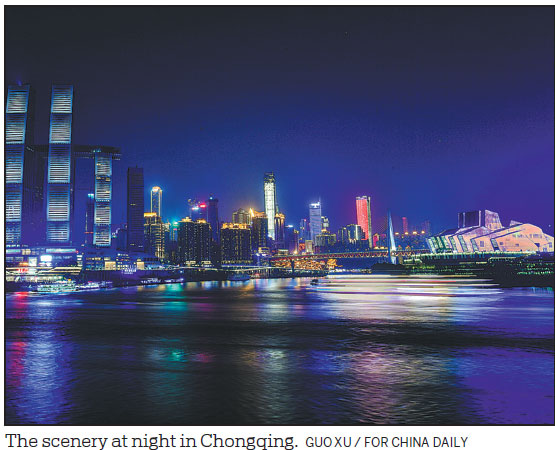
The new western land-sea corridor, a key node of the Belt and Road Initiative, now hums with daily China-Europe Railway Express freight trains. Chongqing's international airport operates flights on 43 international routes, while ships from the Guoyuan port in Chongqing transport everything from laptops to EVs to Southeast Asia.
The corridor has reduced logistics costs, created jobs, and improved connectivity. In fact, it directly supports 43,000 jobs, and indirectly sustains 85,000 more. For instance, in 2024, the Chongqing International Talent Exchange Conference published a catalogue of more than 2,100 vacancies in industries along the corridor, helping maintain not just infrastructure, but also the human capital to match it.
Besides, local authorities are writing their own playbooks: Sichuan has introduced 15 targeted measures to support rural entrepreneurship, Xining in Qinghai province is fine-tuning public employment services, and Chongqing has launched a campaign to "bring people back, and build hometowns" to help about 300,000 migrant workers find jobs where they live.
However, the most profound change may be a redefinition of ambition. Once "success" meant surviving in Beijing or Shanghai, but today workers are recalibrating their goals. Family, dignity, stability — these are no longer seen as trade-offs of ambition, but its core.
This shift will have consequences, as it is powering nine strategic emerging industries and five advanced manufacturing clusters in the region, transforming former "left-behind" children into second-generation technologists, allowing people not only to earn a living, but also build a life.
Western China is not merely catching up; it's also forging a new path, a path on which prosperity and proximity are no longer mutually exclusive. The real miracle is not in the macro data, but in the everyday lives of millions of people who no longer have to choose between work and home.
The author is director of the Center for Public Economics and Public Policy at Chongqing University. The views don't necessarily reflect those of China Daily.
If you have a specific expertise, or would like to share your thought about our stories, then send us your writings at opinion@chinadaily.com.cn, and comment@chinadaily.com.cn.