


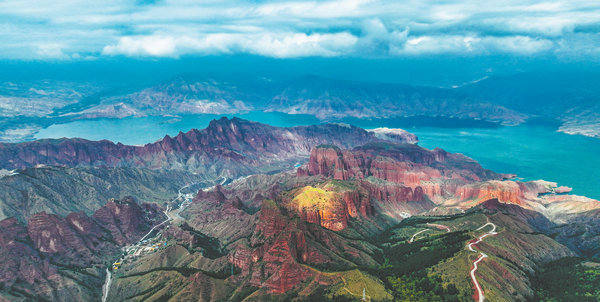
When the world's highest plateau collides with the Yellow River, the planet's fifth-longest waterway, the result is dramatic yet delicate.
In Kanbula, a remote corner of Northwest China's Qinghai province, nature has sculpted a masterpiece — vivid Danxia cliffs, red sandstone landforms sculpted by erosion into cliffs and gorges; jewel-toned lakes cradled by sheer gorges; and forests that appear untouched by time.
This is a place where basins and gorges alternate, forming a typical yet unique Danxia landform, says Hou Guangliang, a geographer at Qinghai Normal University. "And it's a place where you can read a million years of Earth's history in the rocks."
Kanbula, part of the Huangnan Tibetan autonomous prefecture, was officially named a UNESCO Global Geopark in April, a recognition that has turned this once-obscure region into a new beacon for travelers and scientists alike.
Spanning 217 square kilometers and soaring from 2,100 to over 4,600 meters above sea level, the park is a tapestry of geological and ecological marvels. The Danxia landforms surround primeval forests and glassy plateau lakes.
The park is more than a geological showcase; it's also a national forest park, a national geopark, and a water conservancy scenic area rolled into one. Visitors can explore its core attractions, from the Sacred Mountains and Waters to the famed Danxia Eighteen Peaks, by tracing a water-and-land loop route weaving through a highland paradise.
Yet Kanbula's story is not only about stone and water; it's also about people. For generations, villagers here eked out a living through subsistence farming and herding. Now, as eco-tourism gains momentum, locals are discovering new livelihoods as guides, innkeepers and artisans.
"The designation as a Global Geopark is like handing Qinghai a new calling card to the world," Hou says. "It's attracting more visitors who bring opportunities that lift the communities here."
For Hou and other scientists, Kanbula is a living laboratory. Its cliffs and canyons hold clues to the rise of the Qinghai-Tibet Plateau, a tectonic upheaval that shaped Asia's climate and rivers. "This landscape tells the story of millions of years of evolution," he says.
As infrastructure like roads, electricity and clean water improves, the villages within the park are seeing transformation too. "Life is better now," Hou notes. "Villagers can participate in the tourism industry to increase their incomes. Some work as guides introducing travelers to unique local experiences."
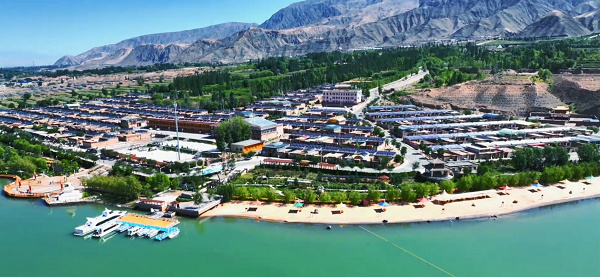
Within the scenic area lies Deji Village, a vivid example of how cultural and tourism integration is transforming communities. Unlike the centuries-old Tibetan settlements scattered across Qinghai, Deji is a newly built village of relocated residents.
In 2016, Jianzha county invested 77.7 million yuan ($10.8 million) in a targeted poverty alleviation and relocation project, resettling 946 people from 30 villages across seven townships. By November 2017, these families, predominantly Tibetan herders and farmers, had moved into their new homes, leaving behind the harsh environment of their original settlements at an elevation of above 3,000 meters.
"The villagers lived in tough conditions at a high altitude with limited access to water, healthcare, schools and roads," says Chang Yali, deputy township head of Angla township. "At 1,960 meters, they now enjoy mountains, water, and fully developed infrastructure that has brought enormous convenience, which has significantly improved their lives."
The village boasts reliable water, electricity, roads, and a dedicated sewage treatment plant to protect the nearby Yellow River. Public buses run regularly.
Tourism drives prosperity. The Jianzha Deji tourism development company has invested tens of millions of yuan in facilities such as a tourist pier, sightseeing boats, a playground, a food court, a water park, kayaking facilities, guesthouses, restaurants, and other attractions.
Since launching operations in July 2019, the company has distributed 3.35 million yuan in dividends: 2.6 million yuan directly to the villagers and 720,000 yuan to the village collective.
Chang explains that every household is encouraged to learn Mandarin and receive hospitality training: "We teach them step by step how to serve visitors."
During peak periods like May Day, National Day, and weekends, the village attracts many tourists. The main tourism season runs from April to October, with most coming from nearby areas. International tourists on group tours also visit.
"In the past two years, visitor numbers have risen significantly compared to the pandemic years," Chang notes.
Unlike typical businesses, there are no rental costs for guesthouses since they are operated out of villagers' own homes. All income from accommodations and dining goes directly into residents' pockets.
Beyond tourism, villagers also benefit from solar energy projects. "With ample sunshine and support from China Huaneng Group, we developed rooftop photovoltaic systems for every relocated household," Chang says.
Each installation has a capacity of 8.4 kilowatts. "Residents don't pay for electricity and surplus power is fed into the national grid. We call it the 'green bank'. Using a 'self-use plus surplus-to-grid' model, each household earns a stable annual income of 4,000 to 5,000 yuan."
Thanks to these combined efforts, Deji's per capita income reached 17,600 yuan in 2024, more than triple the 4,000-5,000 yuan level of 2017 before the relocation.
"'Deji' means 'happiness' in Tibetan," Chang says. "It reflects not only the villagers' aspirations for a better life but also their gratitude to the Party and government for making today's happiness possible."
Inside Deji village, Jiao Baji's home serves as both a private residence and a thriving guesthouse. The two-story building reflects how relocation and tourism have reshaped her family's life.
She recalls the house originally being built as part of the government's relocation program: "The government contributed 80,000 yuan, and each household only needed to raise 10,000 yuan to move in. Bathrooms and kitchens came fully equipped."
With earnings from running the guesthouse, Jiao later added a small second floor to expand her business.
Before moving to Deji village, Jiao, her husband, and their three children lived a precarious life farming barley and wheat at high altitudes. Their income was at the mercy of the weather and far from guaranteed.
Today, at 50, she runs the guesthouse while caring for her young granddaughter. Though she only understands basic Mandarin, she manages simple conversations with guests.
This year, Jiao applied for a government subsidy to upgrade part of her home from a guesthouse into a small restaurant, hoping to create another income stream.
"Since moving to the village, everything is much more convenient, like schooling for the children and access to healthcare. Life has improved greatly," she says.








