



Taking a stand







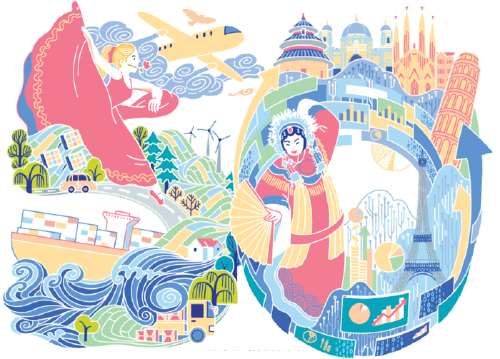
EU-China relations are a strategic partnership that can oppose unilateralism and protectionism
Five decades have passed since the then European Economic Community and People's Republic of China established diplomatic relations. This anniversary not only invites reflection on the path taken but also offers an opportunity to envision the future of a relationship that has evolved from basic trade exchanges into a comprehensive strategic partnership, with global economic, political, technological and cultural implications. At a time when unilateralism and protectionism are resurging, driven in particular by the United States, cooperation between the European Union and China is of great strategic importance.
EU-China relations have progressed both quantitatively and qualitatively. China is the EU's second-largest trading partner, and the EU holds the same position for China. In 2024, bilateral trade exceeded $785.8 billion. Beyond the numbers, the relationship has diversified over time, encompassing areas such as investment, climate change, health, food security, renewable energy, education and culture.
This evolution has been steady, though not without its challenges. The Comprehensive Agreement on Investment, still pending EU ratification, reflects efforts to establish a fairer and more transparent framework. Likewise, the shared commitment to the Paris Agreement and the fight against climate change has brought both parties closer, even as the US distances itself from such multilateral solutions.
The current international landscape is marked by a reconfiguration of geopolitical balances. US protectionism, manifested in trade wars, technological sanctions and diplomatic pressure on third countries, seeks to reinforce the confrontational logic of blocs. In contrast, China and the EU have chosen to uphold dialogue and cooperation as fundamental pillars of their relations.
In his message relating to the 50th anniversary of relations, President Xi Jinping emphasized that China and Europe are two major forces advancing multipolarity, two major markets in support of globalization, and two major civilizations championing diversity. This vision is built on the concept of building a community with a shared future for mankind, unlike the confrontational narrative driven by the US, which seeks to divide the world by oversimplifying the complexity of the international system.
The EU has committed to strategic autonomy, a stance aimed at strengthening its independent decision-making capacity without automatically aligning with the US. As European Commission President Ursula von der Leyen has stated, Europe does not seek to decouple from China but to establish a more balanced, diversified and rules-based relationship.
On July 2, China's Foreign Minister Wang Yi visited Brussels to meet with top EU leaders. In his meetings with European Council President Antonio Costa and European Commission President Von der Leyen, both sides reaffirmed their commitment to dialogue and cooperation. Two days later, French President Emmanuel Macron and Wang pledged to jointly promote multilateralism and enhance coordination against bloc confrontation. On the same day, German Chancellor Friedrich Merz informed Wang that "Germany is willing to cooperate with China to uphold openness and mutual benefit, promote fair trade, and jointly address crises and challenges" — actions that serve both parties.
Wang highlighted that both China and Europe must act as "forces of stability". He also reiterated China's commitment to maintaining "high-standard opening up", moving toward "high-quality development", and working with the EU to "uphold the positioning as partners" and "deepen economic and trade cooperation".
These statements are part of a broader strategy by China, which has expressed concern over increasing European restrictions on Chi-nese companies in key sectors such as medical devices.
Within this transitional context, Spain-China relations are gaining new prominence. With diplomatic ties established in 1973, Spain has steadily increased its cooperation with China, both bilaterally and within the broader European framework. In 2024, bilateral trade surpassed $50 billion, with food, automotive, renewable energy and technology among the key sectors. Spain also represents a significant cultural and linguistic bridge. The Cervantes Institute in Beijing, along with the growing presence of Spanish universities in academic partnerships with China, has strengthened cultural and linguistic ties, fostering essential people-to-people diplomacy for sustainable cooperation. Strategically, Spain is well-positioned to act as a mediator between the EU and China, leveraging its deep understanding of both sides.
Climate change, health security, digitization and the stability of supply chains are global challenges that require joint responses. In this regard, scientific and technological collaboration between the EU and China must be intensified, particularly in sectors such as the energy transition, artificial intelligence and biotechnology.
The European Green Deal could align with China's Belt and Road Initiative if both parties can agree on standards for sustainability, transparency and responsible financing. At the same time, digital regulatory frameworks — such as the EU's General Data Protection Regulation and China's Cybersecurity Law — could form the basis for technical dialogue aimed at preventing fragmentation of global cyberspace.
It is expected that the EU will act sincerely, rejecting policies driven by external pressures or short-term geopolitical calculations. The relationship between the EU and China should be built on mutual trust, respect for differences and a willingness to reach lasting agreements.
Far from being merely symbolic, the 50th anniversary of EU-China diplomatic relations offers a platform for the future. The EU-China leaders' meeting is an opportunity to redefine shared priorities, correct imbalances, and strengthen a more just and effective international governance architecture.
The world stands at a crossroad. One path leads to confrontation, decoupling and protectionism; the other to cooperation, regulated openness and the shared management of global goals. The EU and China, as ancient civilizations with a global vocation, bear the responsibility of choosing the latter.
Spain, for its part, has much to gain and much to contribute: an active diplomacy, a mature business ecosystem, and an open, pluralistic society as a catalyst for more inclusive and sustainable Eurasian cooperation.
The 50th anniversary of EU-China relations coincides with a pivotal moment in the reformation of the global order. The recent statements from Brussels and Beijing reflect a strategic consensus to reinforce multilateralism, promote joint growth and project stability from two essential civilizations. Spain, with its well-established ties and active role within the EU, can help facilitate this transition.
The 50th year of EU-China diplomatic relations is not merely an anniversary, but a turning point. In a polarized global context marked by the return of bloc dynamics and trade tensions, this relationship can offer an alternative grounded in cooperation, strategic autonomy and mutual respect. Europe does not need to choose between Washington and Beijing; it needs to assert itself as an independent actor, capable of engaging with all sides and promoting a more balanced world order. On this path, the relationship with China will be key.
The author is an economist and advisor at the Cátedra China Foundation, Spain. The author contributed this article to China Watch, a think tank powered by China Daily. The views do not necessarily reflect those of China Daily.
Contact the editor at editor@chinawatch.cn.





