Chang'e 6 samples show moon's asymmetry
Moon: Study helps to decode early Earth







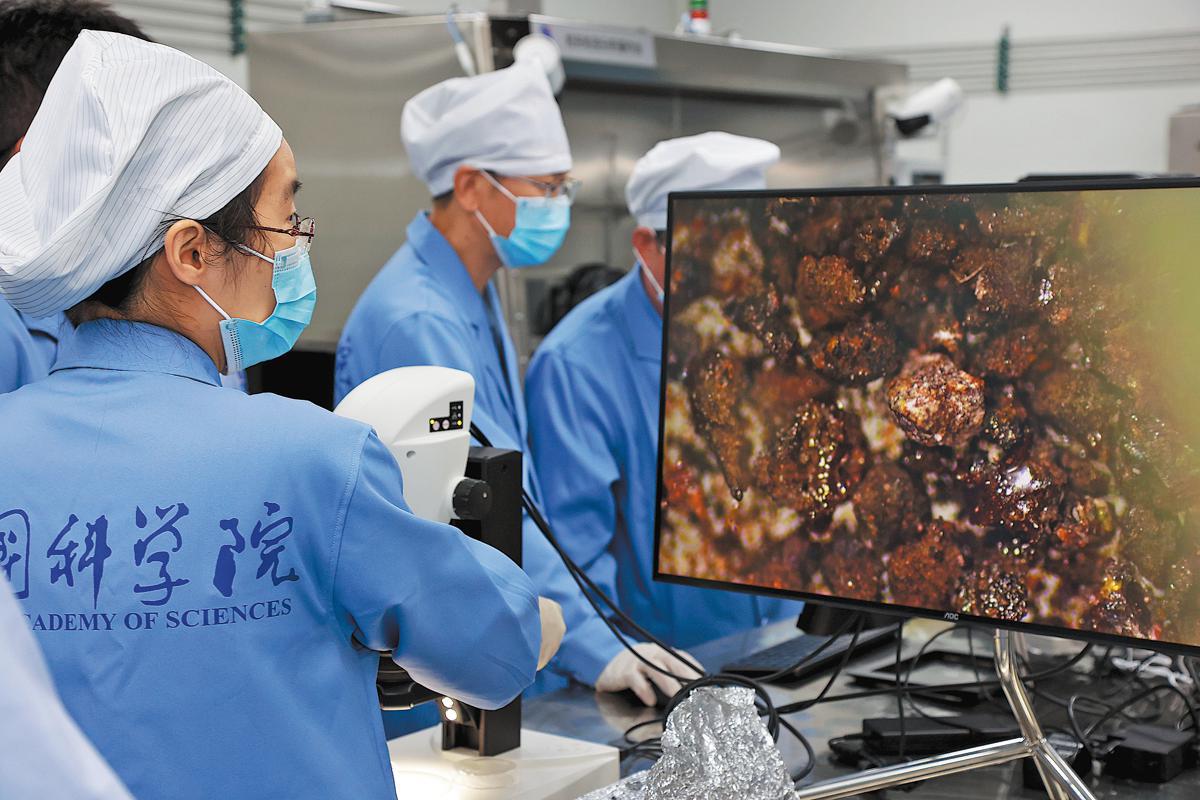
Chinese scientists have shed light on the geochemical characteristics of the basalt samples from the lunar far side brought back by the Chang'e 6 robotic probe last year, providing crucial insights into the early crust-mantle evolutionary history of the moon.
The study, led by the National Astronomical Observatories and the Institute of Geology and Geophysics of the Chinese Academy of Sciences, was published in Nature journal on Wednesday.
Wu Fuyuan, an academician of the CAS and a corresponding author of the study, said the moon displays an asymmetry between its near and far sides, characterized by pronounced differences in topography, composition, crustal thickness and volcanic activity.
However, due to the lack of samples from the far side until the mission, the origin of this asymmetry and the history of the far side remained poorly understood and was the central unresolved question in lunar science, he said.
Wu emphasized the groundbreaking achievement of the Chang'e 6 mission in successfully returning with 1,935.3 grams of samples from the lunar far side — the first time such materials were brought back to Earth.
The samples, which were collected from the South Pole-Aitken Basin, the moon's largest, deepest and oldest impact structure, presented an unprecedented opportunity to analyze compositional differences between the two hemispheres, he said.
The research team conducted a thorough analysis of the 2.8-billion-year-old basalt samples from the lunar far side, which involved examining rock texture and mineral compositions, as well as investigating strontium and neodymium isotopes.
"The geochemistry of the basalt samples indicates that they originated from an ultra-depleted mantle source, which suggests a lack of easily meltable elements that would rise with magma," Wu said.
The research team has put forward two potential models to explain the ultra-depleted characteristics.
One model suggests a highly depleted primordial mantle. In the initial phases of lunar formation, the moon existed as a vast magma ocean, where dense minerals sank to form the mantle while lighter minerals rose to create the crust. During the process, easily meltable elements were extracted, leaving behind only ultra-depleted elements in the deep mantle.
If this model proves to be accurate, the basalt samples could have originated from the deep mantle and should exhibit similar characteristics to deep mantle substances from the near side of the moon. The asymmetry observed may arise from surface manifestations of subsequent lunar processes, according to the study.
The other model suggests substantial melt extraction caused from large-scale impact events.
The South Pole-Aitken Basin, which is around 2,500 kilometers in diameter, was formed by an impact that unleashed a staggering amount of energy, estimated to be about 1 trillion times greater than that of an atomic bomb explosion.
Subsequently, intense volcanic activities further reshaped the region. These led to the remodeling of the shallow mantle, where a large amount of magma was extracted and it reached the surface or intruded the crust, leaving behind the incompatible and ultra-depleted elements in the mantle source.
If this model proves to be valid, it signifies how large-scale impact events not only reshaped the moon's surface but also altered its internal composition, resulting in the depletion of volatile elements such as water.
The study also offers new insights into the early crust-mantle evolutionary history of other terrestrial bodies within the solar system.
Zhu Rixiang, an academician of CAS, said that as Earth is a very active planet, it is difficult to "determine the characteristics of the early Earth, whether it was ultradry or depleted".
"However, since Earth and the moon share a common origin, we can speculate about the early Earth by studying the mantle conditions of the comparatively inactive moon 4.2 billion years ago," Zhu said.
Mahesh Anand, a professor of planetary science and exploration at The Open University in the United Kingdom, congratulated the research team for the first results from the analysis being published in Nature.
"We have had samples from the moon for over 50 years, samples collected by the Apollo and Luna missions ... but the Chang'e 6 samples are actually revealing many new things and forcing us to rethink the theories that we have developed over the past 50 to 60 years about the origin of the moon, the evolution of the moon, and the history of water inside the moon," he said.
Anand added that this study has provided valuable insights into the asymmetry of the moon and voiced his expectations for more discoveries.