Finding common ground in Hongshan civilization
Young scholars from across the globe find resonance in ancient Chinese relics — and in one another — through a shared journey into Hongshan's legacy.







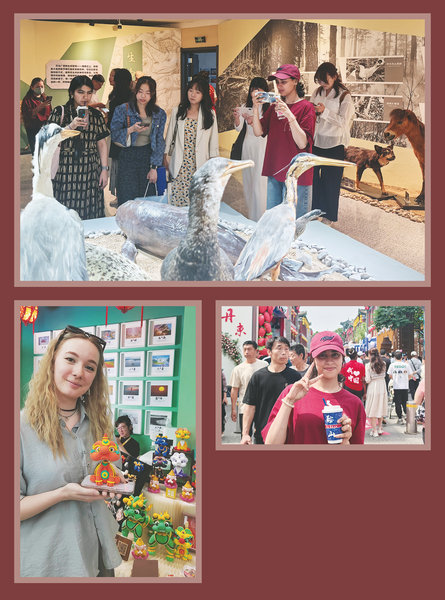
"The Chinese people from 5,000 years ago had such similar aesthetics to our ancestors," said Anda Risa, a Japanese student at Dongbei University of Finance and Economics, as she stood before the C-shaped jade dragon on display at the Hongshan Culture Museum of Chaoyang Normal University in Chaoyang, Liaoning province.
The jade artifact, a hallmark of the Neolithic Hongshan culture, reminded her of ancient Japanese magatama beads and similar curved motifs found in early Celtic and Mayan cultures.
"It seems humanity has had a common aesthetic understanding of dynamic curves from very early times," Anda said. "This makes me wonder if there exists some kind of aesthetic gene that transcends geography and time."
Anda was one of 18 international students — along with 15 university faculty members — from 14 countries who explored the roots of Chinese civilization through the lens of Hongshan culture in Liaoning last month.
The event, titled "China Amazes Me: Telling Hongshan Stories", was part of the First International Communication Conference of Hongshan Culture and the New Era forum. It aimed to promote global understanding of one of China's earliest Neolithic civilizations.
Their visit included panel discussions, museum tours, and cultural exhibitions — all designed to deepen participants' appreciation of Hongshan culture and its far-reaching influence.
Like Anda, many were particularly inspired by the iconic jade dragon. Pisarev Maxim, a Russian student majoring in Chinese language and literature at Shenyang University of Chemical Technology, approached it from a literary perspective: "From jade craftsmanship 5,000 years ago to phrases like 'gentle as jade' still used in Chinese today, the cultural continuity is striking."
"In Russian literature, we often say that 'language is the soul of a nation', and Chinese jade culture perfectly exemplifies this — it's not only a product of material civilization but also a carrier of spiritual civilization," he added.
Another highlight of the site was the Hongshan goddess figurine, a renowned relic known for its detailed representation of the female form.
Jiang Ping, a Pakistani student at Shenyang Medical University, was struck by how the sculpture reflected an early understanding of human anatomy.
"Her facial features and body proportions are highly realistic, which was very advanced for 5,000 years ago," he said.
"From a medical standpoint, the maternal characteristics emphasized in the figurine are all related to the physiological needs of reproduction. It shows that early humans already had a scientific awareness of vitality and continuity."
Looking at the figurine from a sociological perspective, Niyomuco Aline, a student from Burundi studying at Bohai University, reflected on the role of women in early societies.
"In my homeland, Burundi, we also have traditions of matrilineal clans where women hold important social positions," he said.
"The lofty status of goddesses in Hongshan culture suggests that women were not only seen as creators of life but also endowed with sacred spiritual power. This early recognition of female power remains relevant to today's conversations about gender equality."
The group also visited the Natural History Museum of Chaoyang Normal University, where participants were impressed by 125-million-year-old fossilized fruits from Liaoning — remarkable for both their state of preservation and scientific significance.
"From the first flower that bloomed 125 million years ago, to the Hongshan culture 5,000 years ago, to the civilization we live in today — this is a grand narrative about time, life, and cultural evolution," said Krishala Tamang, a medical student from Nepal.
"These fossils and artifacts remind us that we are just a fleeting moment in Earth's long history — yet within this moment, humanity has created such a brilliant civilization."
At the New Era forum, archaeologist Guo Dashun delivered a keynote speech highlighting the open and inclusive spirit of the Hongshan people, who absorbed influences from neighboring cultures to shape their own.
His message struck a chord with Le Thi Thuong, a Vietnamese graduate student at Liaoning University. "Isn't this the same openness China shows toward the world today?" she said. "This cultural inclusiveness really moves me."
Living traditions
Alongside the forum, the Liaoning Culture, Sports and Tourism Conference took place on Murong Street in Chaoyang.
Various cities set up exhibition booths to showcase local cultural practices, offering participants a hands-on way to experience China's living traditions.
At the Benxi booth, Abbasi Yasir Faraz, a Pakistani doctoral student in pharmacy at Shenyang Pharmaceutical University, studied displays of traditional Chinese medicine, including wuweizi (Schisandra chinensis) and wild ginseng — both local specialties of Benxi.
Holding a 15-year-old wild ginseng root in his hand, Abbasi reflected on how time shapes both medicine and culture.
"Wild ginseng takes years to mature. This philosophy of 'slow cultivation' stands in stark contrast to the fast pace of modern life," he said. "Yet it embodies a key aspect of Chinese cultural wisdom — that truly valuable things require time to develop. It makes me think: in our rush for efficiency, have we lost something even more precious?"
At the Shenyang exhibition hall, students sampled local foods, such as sweet and sour pork, jianbing guozi (Chinese pancake wrap), and douhua (tofu pudding).
"What touches me most is the warmth of the people here," said Le, who was reminded of the morning markets in Hanoi. "The food may be different, but that sense of community is the same. A morning market isn't just about buying and selling — it feels more like a big living room for neighbors, bringing people closer together."
As the activities came to an end, many students took time to reflect on the deeper meaning of the experience.
Maxim said the journey challenged the idea that civilizations are destined to clash.
"If we look at ancient times, what we often see is not conflict, but exchange and integration," he said. "Hongshan culture offers valuable historical insight for today's world — it shows that the strength of a civilization lies not in excluding others, but in bettering itself through dialogue and exchange."
Alkawmani Mohammed Talib Farhood, an Iraqi clinical medicine student at Dalian Medical University, was similarly inspired to reconsider what civilization truly means.
"The Hongshan people, 5,000 years ago, already had such high spiritual pursuits, which shows that civilization is not just about technological progress, but spiritual growth," he said. "In today's materialistic era, Hongshan culture reminds us that true civilization should be the harmonious unity of both material and spiritual development."
The event brought together students from diverse academic backgrounds — from architecture and medicine to language, education, and anthropology — encouraging them to view ancient Chinese culture from a global perspective. Despite cultural and geographic differences, participants found common ground in shared values, aesthetics, and philosophies.
As Niyomuco observed, "What stands out is not how different we are, but how much we have in common. That's the real value of exploring ancient cultures together."
Liu Shicheng contributed to this story.
wuyong@chinadaily.com.cn