



Asian companies seek new markets amid tariff shock
Era of US-led neoliberal trade giving way to multipolar framework: Experts







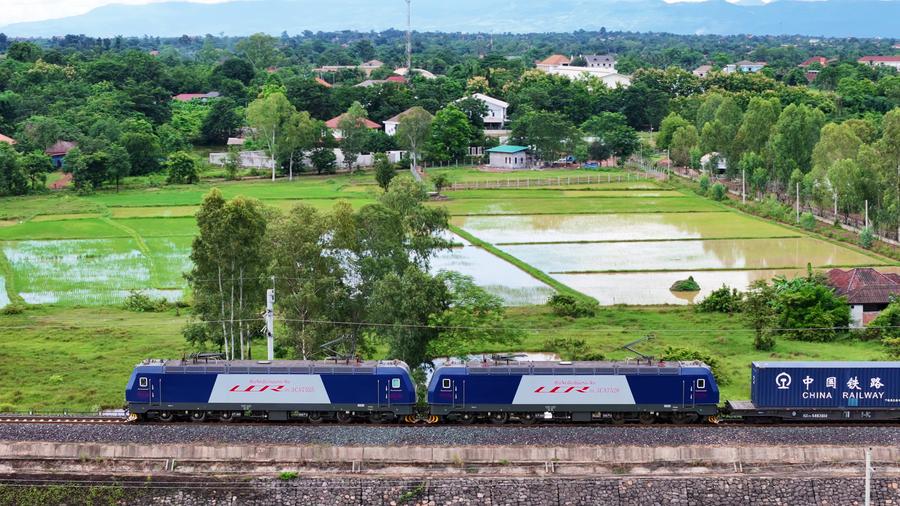
Facing fresh US tariff hikes, a logistics hub in Laos is turning challenge into opportunity by leveraging Asia's enhanced connectivity to expand trade and access new markets.
"We are looking for other alternative markets we have never thought about before," said Tee Chee Seng, executive director of the Savan Park Special Economic Zone in southern Laos' Savannakhet Province.
The zone hosts 48 factories that are mainly from France, Italy, Japan, the United States and China. About 10 companies export goods to the US, Tee said. Although the rising tariffs threaten Laos' exports to the US, they are also encouraging a pivot toward new markets, such as Central Asia and the Middle East, he said.
Tee, who also serves as executive director of Savan Logistics, the operator of the Savannakhet Dry Port, said the company is already facilitating trade with Germany via the China-Laos Railway. The route connects with China's rail network through Yunnan province and continues westward via Chongqing on the China-Europe freight train.
Since the start of this year, the US has launched a series of aggressive trade measures against Asian countries. Some member states of the Association of Southeast Asian Nations have been especially hit hard.
As country-specific tariffs are set to resume on July 9, many Asian governments are racing to negotiate with Washington amid mounting concerns over the potential blow to trade and economic growth.
On Monday, Thailand said its Finance Minister Pichai Chunhavajira will hold trade talks with the US in Washington on Thursday, as the country faces a 36 percent tariff on its exports — a key growth driver.
Vietnamese Prime Minister Pham Minh Chinh said on Wednesday that he expected a trade deal with the US before the July 9 expiration of a pause on a 46 percent "reciprocal tariff" on Vietnamese goods.
US President Donald Trump hinted at a news conference on Friday that the deadline could be extended.
"No, we can do whatever we want," he said at the White House when asked if his deadline was set in stone, CNBC reported.
However, in an interview with Fox News on Sunday, he said there is no need to extend the deadline.
Under a country-specific tariff list unveiled on April 9, Cambodia faces one of the highest tariffs of 49 percent, followed by Laos (48 percent), Vietnam (46 percent) and Myanmar (44 percent). Singapore, despite a free trade agreement and a trade deficit with the US, is subject to a 10 percent tariff.
Other ASEAN members face rates between 17 and 36 percent.
US allies in Asia — Japan and South Korea — have also been hit with tariffs of 24 and 25 percent, respectively. India faces a 26 percent levy, while Sri Lanka was handed a 44 percent tariff.
There are also a 10 percent baseline tariff and sector-specific levies on items such as steel and aluminum.
Michael Ricafort, chief economist of the Rizal Commercial Banking Corporation in Manila, said the US tariff and trade wars would slow global economic growth, posing particular challenges for export-oriented Asian economies.
Exports to the US are crucial for some countries. In Vietnam, for example, they account for 23 percent of GDP, making the country especially vulnerable, according to a report published by J.P. Morgan Asset Management.
High-tech exports
For countries such as Japan and South Korea, the situation is more complex because of their high-tech exports. These products are more difficult for US producers to replace, and the tariff costs can be passed on to buyers more easily, the report said. It added that Australian and Indonesian commodity exporters are also finding it harder to seek alternative sources.
A report published on Wednesday by the Korea Economic Institute of America, a Washington-based policy think tank, said that last year, South Korea's effective weighted average tariff on US imports ranged between 0.19 and 2.87 percent.
The report found "no compelling economic rationale" for the US "reciprocal tariffs" on South Korea, suggesting the measures serve more as political tools than policies grounded in sound analysis.
Ricafort said these trade tensions, coupled with instability in the Middle East, volatile oil prices and inflation, mean heightened uncertainties to Asia.
While some major Asian exporters have adopted a wait-and-see attitude, Ricafort said this can restrain new investment and business expansion.
"How can (we invest when the future) is uncertain?" he said. "Exporters (in Asia) have to be prepared to diversify and reduce their reliance on the US."
'Fatal' policy
Henry Chan, a distinguished visiting fellow at the Cambodian Center for Regional Studies, said such a high tariff policy would "kill exports if implemented, so all countries are working to avoid it".
However, he said there are also problems with bilateral negotiations because, without a single guideline, the US might demand varying terms from different counterparties and create uneven playing fields.
The diverse strategies of Asian countries also make their negotiating positions more complex, he said, pointing to reports that Japan wants to include an investment target while India is pushing for a phased implementation.
"If negotiations touch outside the realm of trade, then talks can be tough," Chan said, adding that he believes the chance of extending the July 9 deadline is "very high".
Even if trade agreements are reached, enforcing them will remain difficult, he said, because if one country secures a better deal, its neighbors can simply move factories there.
The unilateral nature of both the tariffs and the negotiations means the US-led neoliberal order is ending, he said. "Like it or not, the world must look for new rules to govern the global order."
Htin Lynn, a former Myanmar ambassador and executive board member of the Myanmar Institute of Strategic and International Studies, said cooperation frameworks, such as the Regional Comprehensive Economic Partnership and the Lancang-Mekong Cooperation, can help regional countries better cope with the tariff challenges.
Myanmar's structural dependence on foreign trade makes its economy more vulnerable, especially in light of the 44 percent US tariff hike, Lynn said. "Only through partnership and cooperation will Myanmar be able to cope with it.
The RCEP, comprising 15 Asia-Pacific countries, simplifies trade by offering a unified set of rules and reducing export compliance costs, he said. The LMC, jointly established by China and five Southeast Asian countries, benefits livelihoods and promotes cross-border trade, he added.
Chan said the US domestic economic and political situation will greatly affect its tariff policies, and Washington might soften its stance if there is anything wrong with its economy — because prolonged trade talks would deepen the threat to the US economy.
"Tariff is a tax and is going to push up inflation," he said.
Collaboration urged
Oudet Souvannavong, president of the Lao National Chamber of Commerce and Industry, said China and Laos should join hands to explore new trade opportunities.
"China and Laos can work together in productivity, production and industrial development, as well as high-tech investment, to jointly get into the new markets."
Southeast Asia, with its increasingly mature markets and expanding middle class, can become a market to focus on, Oudet said.
From the logistics sector, Tee of the Savan Park Special Economic Zone in Laos said what he can only do now is wait and see how things develop while continuing to issue Certificates of Origin for qualified products, which helps the local economy.
"The market is there," he said. "But the game has changed based on the policies (a country adopts). Policy will decide the way to go, not the market.
"When we have good networks to connect to the world … that is how we help logistics and trade move forward."
Prime Sarmiento in Hong Kong contributed to this story.
kelly@chinadailyapac.com










