Digital tax sparks breakdown in US-Canada trade talks







Canada is facing renewed trade tensions with the United States after US President Donald Trump abruptly cut off all trade negotiations with Canada, citing Ottawa's digital services tax (DST) as the reason.
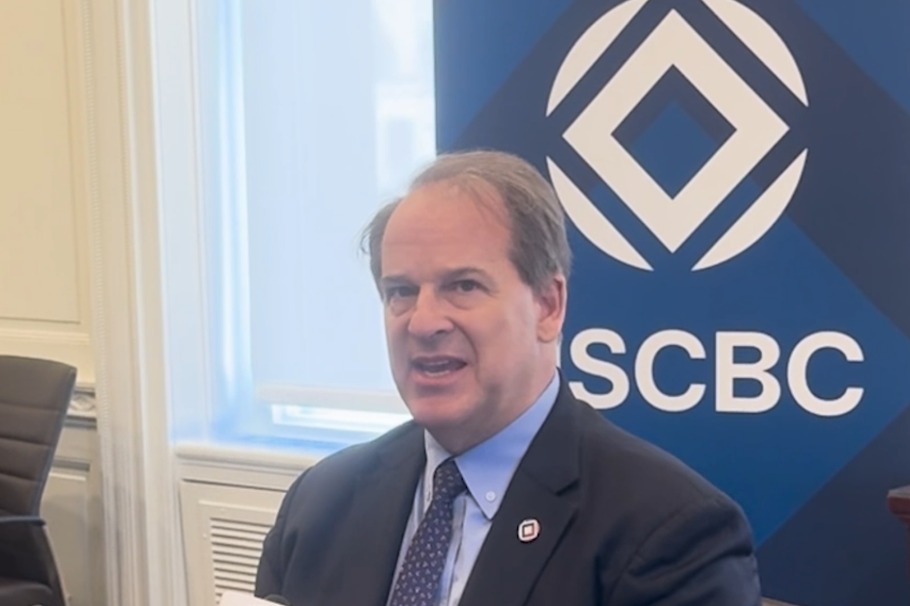
"I just don't know exactly how Carney was going to react, but I was surprised he hadn't done anything yet," said Julian Karaguesian, an economics professor at McGill University.
Trump announced on Friday that the United States would immediately halt all trade talks with Canada, calling Ottawa's DST a "direct and blatant attack" on the country.
Karaguesian, who served as a special adviser in the international trade and finance branch at the Canadian Ministry of Finance, dismissed Trump's characterization. "No, I don't think it's fair," he told China Daily.
"From a neutral perspective, the digital services tax, like a goods and services tax, is a domestic policy," he said. "It treats domestic and foreign companies equally. It's a matter of tax policy, not trade policy."
Canada's digital services tax imposes a 3 percent levy on revenue earned from Canadian users by large tech firms. It applies to companies generating more than C$20 million ($14.6 million) annually from digital services in Canada.
The first payments of this tax are due on Monday. US companies such as Amazon, Meta, Google and Uber face an estimated $2 billion in bills under the new tax.
Karaguesian said both Trump and Carney may be using the dispute as a negotiation tactic.
"There's no way that Carney and his team did not know that Trump was going to react to this.
"We could have pulled this off the table or said we're going to delay it. But here we were, letting it go into effect on Monday," he said.
In a statement released Friday, the Business Council of Canada said that the dispute risked damaging ties with the country's most important trading partner.
"That unfortunate development has now come to pass," the council said, referring to the breakdown in trade talks.
To defuse tensions, the council urged Ottawa to offer a proposal to eliminate the digital services tax in exchange for the removal of US tariffs. "Canada should put forward an immediate proposal to eliminate the DST," it said.
Karaguesian said that Canada's move may have been intentional — to create a bargaining chip.
"We've created a card for ourselves that we can now give as a concession and say, 'OK, we'll take it off. What are you going to give us?'" he said.
But he acknowledged the power imbalance in the bilateral relationship.
"The Americans have more cards than we do. We are more dependent on them than they are on us, and they can continue to use their vast market size to squeeze concessions out of us," he said.
Trump has threatened to impose new tariffs on Canadian goods within seven days unless Canada backs down on the DST. Karaguesian said he believes the threat is credible.
"I think he will pull the trigger on another tariff if we don't remove it," he said. "We have to find a way to save face," he said.
He pointed to recent remarks by Canadian Finance Minister Fran?ois-Philippe Champagne, who said the DST could be part of broader negotiations. "That may be the way out," Karaguesian said.
Still, he said that more demands are likely to follow. "You could see that let's say we give this concession on the digital services tax.
"We don't know what Trump could do next week. He could say, 'I want your protections off dairy or I'm walking away,'" he said.
He also raised concerns about broader strategic pressures from Washington. "It's becoming clear that for President Trump, he only has vassal states and adversaries," Karaguesian said. "They're not treating us like an ally."
Looking ahead, he argued that Canada must reduce its reliance on the US and pursue deeper trade ties with Asia. "Really, the only thing we can do is reduce our dependence on the United States," he said.
"We need to trade more with China, India, and the rest of Asia. That's where a good part of our economic future lies," he said.
Citing World Bank and IMF data, he added, "China and India alone are going to account for 40 percent of global economic growth over the next five years. This is where we need to be putting our efforts."
Trump's abrupt termination of trade talks with Canada over the country's DST reflects a familiar and deliberate negotiation style, according to Ron Stagg, a professor at Toronto Metropolitan University, who focuses on Canada-US relationship.
"This is typical of Trump's bargaining style: take an extreme position, with no room for bargaining, and then see what your opponent will do," Stagg told China Daily.
"If Canada will not budge, such as delaying implementation or reducing the amount of the tax, Trump may increase the tariffs on Canadian goods," he said.
"He believes that there is no downside to imposing tariffs on other countries," Stagg added. "What he does is very fluid, and can change at any time."
Although digital taxation had not been a high-profile dispute in Canada-US relations before, Stagg said the issue has now taken center stage in Trump's worldview.
"Few would have predicted that the issue would become the central one, in Trump's view, in relations between Canada and the United States," he said.
He attributed Trump's stance to successful lobbying by American tech giants. "Obviously the big social media companies have been successful in convincing President Trump that in taxing them Canada is hurting American business," he said.
The Canadian government, he said, now faces a dilemma.
"If it capitulates, it will be attacked by its political rivals in Canada, and by Canadian media companies, which have been greatly injured by the flight of advertisers to companies like Google and Meta.
"If it stands up to Trump, Canada will face additional trade penalties," he said.