



Birth pangs of a new world order







Countries of the Global South are standing together to uphold the principles of the UN Charter
Editor's note: The world has undergone many changes and shocks in recent years. Enhanced dialogue between scholars from China and overseas is needed to build mutual understanding on many problems the world faces. For this purpose, the China Watch Institute of China Daily and the National Institute for Global Strategy, Chinese Academy of Social Sciences, jointly present this special column: The Global Strategic Dialogue, in which experts from China and abroad will offer insightful views, analysis and fresh perspectives on long-term strategic issues of global importance.
On June 26, the United Nations Charter celebrated its 80th anniversary. The current international order is based on its principles, which stand out in its preamble: the prevention of war, equal rights of peoples and nations, justice, social progress and a better life for all.
All multilateral institutions subsumed under its creation since 1945, such as the United Nations Educational, Scientific and Cultural Organization, the Food and Agriculture Organization and the UN Refugee Agency, etc. But unfortunately, we are seeing the principles of the UN Charter being disrespected in various parts of the world, precisely by the powers that considered themselves the creators and pillars of this order.
Today, we live in a very complex international context marked by instability, regional wars, nuclear threats, attacks on the sovereignty of sovereign countries, and the exacerbation of unilateralism.
The current global order is undergoing a profound stress test, which is producing challenges and many opportunities.
Western powers claim to be the creators and defenders of the rules that govern the coexistence between nations. This stance is reflected in the preponderance of a Western logic, which seeks to impose its political, economic and ideological models on the rest of the world as if they were universal. The history of European imperialism and colonialism in the 19th and 20th centuries contains an enormous list of atrocities committed in the name of a "civilizing "and "evangelizing" mission. In addition to military, political and economic domination, Western nations have developed an extensive theoretical and ideological apparatus, especially with regard to international relations. In this field, there is a large concentration of Anglo-American voices, while few voices have been heard from countries of the Global South as if non-Western peoples cannot have their own perspectives on the essence of international politics. In undergraduate courses worldwide, international relations manuals naturalize the Western view as if it were the only truly valid analytical perspective.
Realistic theorists of international relations, such as Samuel Huntington, with his theses on modernization and the clash of civilizations; Francis Fukuyama, who argued that the Western liberal model would be the end of history; and Graham Allison, who deals with the inevitability of a clash between the great powers in "Thucydides Trap", receive an amplified audience by arguing that the international order is a zero-sum game and that the security and well-being of a nation can only be sustained at the expense of the interests of other countries. In essence, realism brings with it the values of individualism and the idea that human beings are merely a rational maximizer of petty interests. From there, realist political scientists extrapolate experience at the individual level to the behavior of nation-states, postulating hegemony as the only acceptable condition for a great power.
There are other Western theories of international relations, such as liberalism, which postulates the universalization of its own notion of democracy and human rights, which has often served as a pretext for interventions and regime changes around the world. Even the constructivist theory, which appears to be more progressive by incorporating non-state agents such as nongovernmental organizations, social movements, trade union federations and churches, etc, into the decision-making process, is used as an instrument of destabilization via so-called color revolutions, which are instruments of hybrid wars. At this point, it is worth highlighting that the three Anglo-American theories are used to maintain the status quo in the international order, in which the hegemony of the United States prevails. In this context, the ideas of Amitav Acharya are conducive to reflecting on the role of countries in the Global South in this process, as they can contribute new concepts about the relationship between civilizations, nations and people that do not mean hegemonism, supremacism, unilateralism or zero-sum logic.
To this end, we could incorporate into the debate on the creation of a new international institutional framework concepts and philosophies from outside the Western world, such as the African concept of Ubuntu, which assumes that human beings are part of a broader and more meaningful relational community. According to this philosophy, people must be open and available to others, support those close to them, not feel threatened when others are capable and good, join forces to achieve better results, and understand that the differences between people are what generate growth.
Likewise, we could mention the Taoist principle of Yin and Yang, in which opposites complement each other, the Confucian moral authority, and the umbilical relationship between man and nature expressed in the Inca concept of Pachamama.
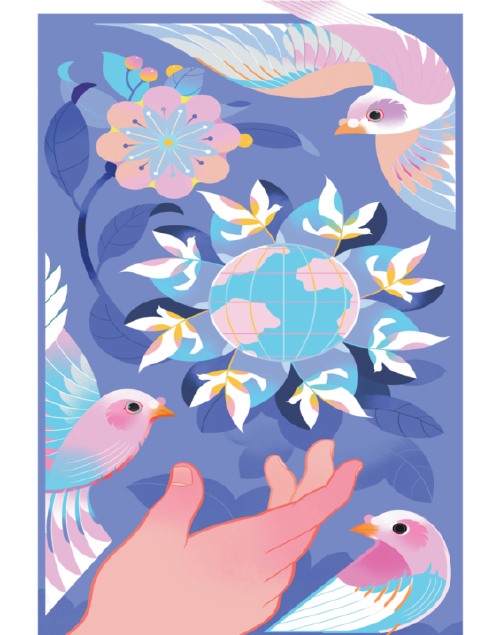
In conclusion, humanity should be viewed as a large garden, not a vast eucalyptus plantation. Civilizations, cultures and ethnic groups are flowers that contribute to the beauty of this garden. Humanity is facing a challenging crisis. It is necessary to strive for the birth of a new world order that guarantees all people enjoy the realization of all the promises made 80 years ago when the UN was created. Peace, security and prosperity will be the collective fruits.
The author is a professor of international political economy at Sao Paulo State University in Brazil. The author contributed this article to China Watch, a think tank powered by China Daily. The views do not necessarily reflect those of China Daily.
Contact the editor at editor@chinawatch.cn.





