



NATO agrees to 5% defense spending goal
Experts say bloc should be stabilizing force instead of war-fighting alliance







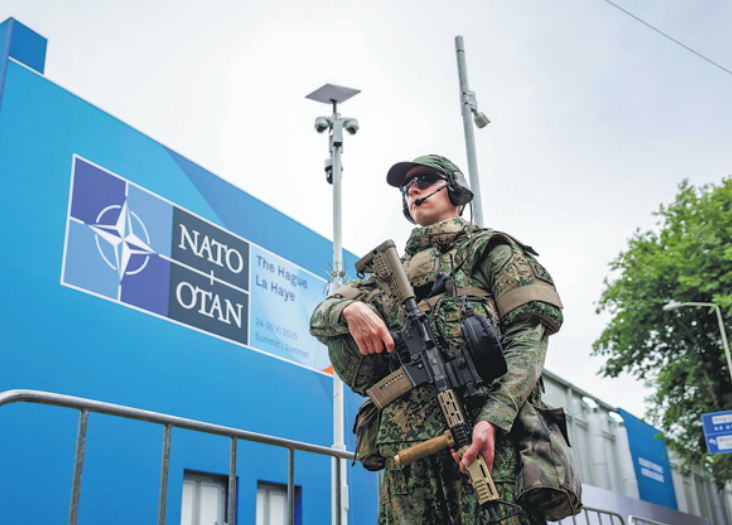
Leaders of the NATO western defensive alliance approved an ambitious target to increase defense spending by the end of their summit in The Hague, the Netherlands, on Wednesday.
In a short statement, NATO endorsed a higher defense spending goal of 5 percent of GDP by 2035.
The figure includes both direct military spending, with a 3.5 percent core benchmark, and an additional 1.5 percent for strategic resilience, cybersecurity and industrial readiness.
The spending plan marks a dramatic shift from the long-standing NATO goal of 2 percent of GDP, which many allies have struggled to meet.
While some countries, such as Poland and the United States, already exceed the new targets, others, including Spain, Italy and Belgium, have expressed concern over the financial and political feasibility of such increases.
Italy's Defense Minister Guido Crosetto has previously described the 5 percent target as "unthinkable", warning sharply that any increase beyond 2 percent could threaten crucial social services.
Belgium's Foreign Minister Maxime Prevot labeled the 5 percent ambition "excessive", saying that even a 3.5 percent target was "not feasible in the short to medium term" given current budget constraints and public welfare considerations.
Spain will meet the new capabilities targets agreed upon by NATO members but it considers its current defense spending of 2 percent of GDP as "sufficient, realistic and compatible with the welfare state", Spanish Prime Minister Pedro Sanchez said after the meeting.
Ahead of the summit, NATO Secretary-General Mark Rutte warned the alliance's 32 member states they have "no alternative "but to increase defense spending, citing growing global security challenges.
In his opening remarks on Wednesday, Rutte, who took over the role of secretary-general earlier this year, highlighted the significance of the new 5 percent spending target and plans to ramp up defense production.
He said: "Allies will also agree to further increase defense production so that our armed forces have everything they need. That means a huge expansion of our defense industrial base on both sides of the Atlantic. That's good for our security, it's good for our economies and good for our jobs."
Inflation feared
Stefan Wolff, a professor of international security at the University of Birmingham, warned before the summit that even if NATO members meet the 5 percent target, without prioritization and coordinated defense-industrial development, such spending risks becoming "financial inflation without strategic output".
John Bryson, chair of Enterprise and Economic Geography at Birmingham Business School, emphasized that NATO should be a stabilizing force.
"It is not a war-fighting alliance, but a war-prevention structure. The moment it loses its cohesion, it loses its meaning," he said.
Ahead of the summit, thousands of anti-war protesters have expressed their anger at the NATO military expansion and increasing defense spending.
"Let's invest in peace and sustainable energy," Belgian politician Jos d'Haese told the crowd gathered in a park near the summit venue on Sunday.
Theo Roncken, a Dutch psychologist, echoed the critique, pointing to the arms industry as the true beneficiary of NATO's policies.
"It's the arms industry that is promoting the wars. So NATO is today a promoter of the arms industry," he said.
Roncken warned that increased military budgets would inevitably mean deeper cuts to public services. "We do not have enough money to give good care. And I think if arms go up … expenses for care will go down."
Xinhua and agencies contributed to the story.










