



Marx's legacy still relevant in Europe







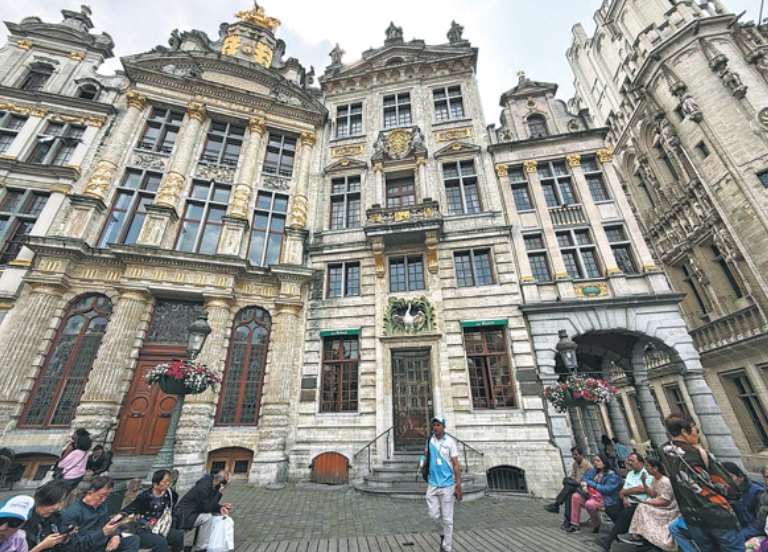
The Grand Place is the most famous and photographed tourist attraction in Brussels and was described by Victor Hugo as the most beautiful in the world. Encircled by buildings of Baroque, Gothic and Louis XIV architectural styles and gilded with gold detailing, it is known to Chinese tourists as Golden Grand Square or huangjin da guangchang.
Chinese tourists are especially drawn to a Louis XIV building from 1698, now known as La Maison du Cygne — the Swan House, a high-end event and banquet venue. In 1848, it was the location where Karl Marx and Friedrich Engels met every week and wrote the Communist Manifesto. This book inspired revolutionaries in China and around the world.
On Tuesday afternoon, two Chinese tourists from Shanghai pushed its door open, trying to have a peek inside, only to be told that it was closed. Not far in front of the building, a young woman tour guide was introducing the place to a group of Chinese tourists. To their right, a Belgian tour guide was explaining to a dozen English-speaking tourists that Marx lived in exile in Brussels.
I was fortunate to take my friends from Shanghai to lunch at the Swan House in early 2019 when it was still a regular restaurant open to the public. Marx's portrait was hanging on the wall and a small plaque indicated where Marx and Engels sat to discuss their revolutionary ideas.
After being expelled from Germany and later France due to his political views, Marx and his family moved to Brussels in 1845, when it was a haven for many revolutionaries. Marx was then granted a residence permit in Brussels, subject to the condition that he would not publish any writings on the current political situation.
Marx lived in several different places in Brussels. I have visited the one at 42 Rue d'Orleans, now 50 Rue Jean d'Ardenne. It is the only place with a commemorative plaque, which indicates that the family lived here from 1846 to 1848. It was in Brussels that Marx's wife, Jenny von Westphalen, Marx's childhood sweetheart and lifelong companion, gave birth to their son Edgar and daughter Laura.
By accident, during a recent visit to Paris' Pere Lachaise Cemetery, I came across the tombstone of Laura and her husband, Paul Lafargue, not far from the Communards' Wall.
Belgian historian Edward de Maesschalck, who wrote a book on Marx in Brussels, said that Brussels marked a turning point in Marx's life and from there, he initiated a revolution that would radically transform the world.
Brussels was then a city with a rich upper class and a large number of poor people. There was the Potato Famine of 1846 and grain shortages in 1847. Poverty in Belgium reached an all-time high, reinforcing Marx's belief that revolution could not be long in coming.
Marx's life was hard, too, and he received occasional financial support from Engels.
The two wrote several books in Brussels, including The German Ideology. Yet, the Communist Manifesto was the most influential of all. It was also in Brussels that Marx and Engels established the Communist Correspondence Committee, which would communicate by letter with people throughout Europe.
In 1847, Marx became the editor of the Deutsche-Brusseler-Zeitung, a German newspaper in Brussels. It was not the first time Marx had been in journalism. He had worked as a journalist a few years earlier and served as editor-in-chief of the Rheinische Zeitung, a daily paper for progressive liberal readers.
When the Brussels-based Democratic Association, of which Marx was the vice-president, issued a statement endorsing the French revolution in February 1848, the Belgian security service ordered him to leave the country within 24 hours on March 3. The Central Committee, which met that night and declared that the Communist League would move to Paris, resulted in the arrest of Marx and his wife.
It was the end of their three-year stay in Brussels. Maesschalck wrote that Marx arrived as a socially committed scholar, seeking clarity and finding the key to a better understanding of human history. In Brussels, Marx emerged as a revolutionary with a mission. It was in Brussels, too, that his views of materialist historiography were formed, and in Brussels it was there that Marx wrote the Communist Manifesto, a landmark and monument in a changing world.
Marx has been a household name in China. He is not particularly popular in Europe today, even among social democratic parties, which were founded as Marxist parties. Still, suppose people look at the workers' movements and strikes in Europe over the past few years for better pay, welfare and working conditions. In that case, they reflect the working-class struggle described by Marx.
Bart Peeters of the Workers' Party of Belgium, or PTB-PVDA, told me that Marx and Engels remain as relevant today as they were in the past.
He said the government austerity policies have begun to hurt people and neoliberal politicians have systematically eroded workers' rights. He expressed that the current attack on wages, social security and public services is linked with a push for massive defense spending, the militarization of society and reckless warmongering.
"Marx's analysis has come back to the forefront," he said.
The PTB-PVDA, a national communist party in Belgium, has more than doubled its membership in the past decade.
"Without a thorough scientific understanding of the mechanics of capitalism and its domination of the state apparatus, the struggle cannot be successful. Fortunately, more and more workers are beginning to understand this," Peeters said.
Contact the writer at chenweihua@chinadaily.com.cn.
The author is chief of China Daily EU Bureau based in Brussels.










