



IOMed to peacefully resolve intl disputes







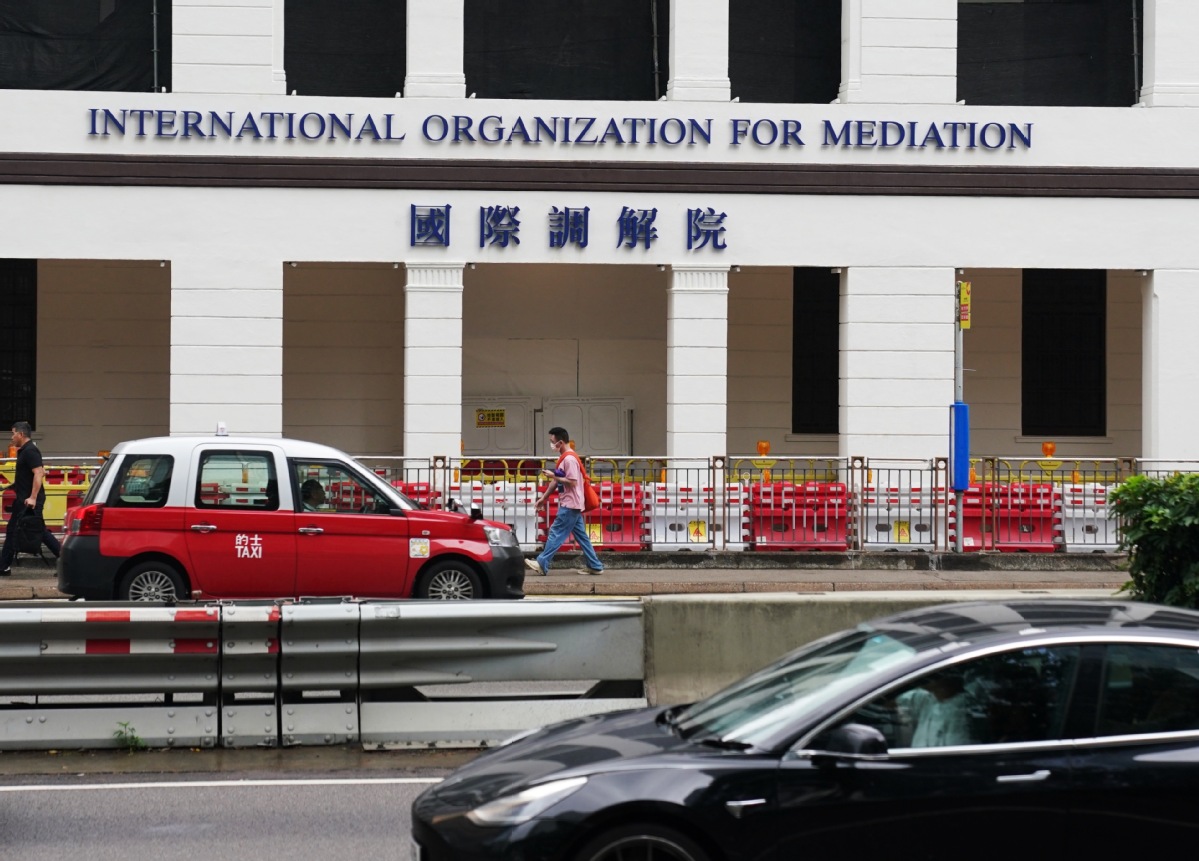
In an international environment marred by deepening fissures and geopolitical fault lines, the idea of resolving disputes through dialogue rather than domination has become more precious. On May 30 in Hong Kong, a gathering of around 400 representatives from 85 countries and regions and nearly 20 international organizations ushered in what could prove to be a transformative experiment in conflict resolution: the establishment of the International Organization for Mediation.
With 33 nations signing on as founding members, IOMed becomes the first intergovernmental organization exclusively dedicated to resolving international disputes through mediation.
Institutionally pivoting away from the binaries of battlefield victories or courtroom edicts, it leans into the potential of dialogue, compromise and mutual respect — concepts not always popular in a world dominated by zero-sum thinking and power politics.
In a global order increasingly paralyzed by gridlock, inertia and the fraying of long-held norms, any genuine attempt to reimagine and redesign dispute resolution deserves more than a casual dismissal.
For decades, the dominant frameworks of international dispute settlement have been litigation or arbitration — each replete with legalism, procedural rigidity, and often, the implicit hegemony of Western jurisprudence.
Mediation, by contrast, hinges not on verdicts imposed from above but on outcomes mutually shaped by the disputing parties, with the help of a neutral intermediary.
It is a process that privileges consensus over coercion. In a fractured world teetering on the edge of multipolar disorder, that in itself is no small virtue.
Hong Kong, the designated headquarters of IOMed, is itself a symbolic anchor as the establishment of the Hong Kong Special Administrative Region was a resounding fruition of settling international disputes by peaceful means. Given its mixed legal heritage that bridges common and civil law traditions, along with a well-established infrastructure for arbitration and commercial resolution, Hong Kong offers fertile ground for a new chapter in multilateralism. The choice also reflects China's growing confidence in presenting the SAR not just as a financial hub, but also as a legal base.
Some may balk at drawing too bold a contrast between IOMed and other long-standing existing institutions. The comparison, however, is not without basis. While some international institutions issue binding rulings that require both parties' consent to jurisdiction, IOMed's charter embraces a more inclusive and flexible architecture — welcoming not just states, but individuals and commercial entities embroiled in crossborder conflict. This adaptability could well prove a strength in today's fluid, decentralized world.
It also offers a meaningful corrective to the inadequacies of existing legal orders, particularly for developing nations. The hurdles they face — high legal costs, unfamiliar procedural codes and a paucity of representation in global judicial forums — are well documented. In theory, IOMed's mediation-first model could democratize access to justice and dilute the asymmetries of power that often skew arbitration outcomes in favor of wealthier nations or corporate entities.
There is, of course, an undeniable strategic dimension to all of this. The establishment of IOMed contributes to improving global governance and supplementing it with a distinctly Asian sensibility. The emphasis on harmony, win-win cooperation and consultation are not just diplomatic tropes; they represent a philosophical departure from the adversarial norms that have governed international relations for much of the post-World War II era.
The recent history lends some credence to this approach. From the landmark reconciliation between Saudi Arabia and Iran through China's mediation, to intra-Palestinian dialogue that culminated in the Beijing Declaration, China has shown both an attitude and capability for mediation that transcends traditional alliances. IOMed institutionalizes this approach, offering a forum where conversation might prevail over confrontation.
Skeptics will argue that mediation is toothless, that it lacks the gravitas or coercive authority of judicial rulings. But that is precisely the point. At a time when laws have become a proxy for geopolitical skirmishes, and when compliance with international rulings is increasingly selective, perhaps soft power mechanisms rooted in mutual consent have more to offer than we've been willing to admit.
Furthermore, the notion that mediation cannot produce concrete outcomes is belied by data. In Hong Kong's own judicial practice, courtlinked mediation boasts a settlement rate of nearly 50 percent — a statistic that underlines both the process's viability and its resonance in culturally diverse, politically complex settings.
As the IOMed prepares to open its headquarters in Wan Chai of Hong Kong — revitalizing a former police station into a hub of peaceful arbitration — it also carries with it the burden of expectation. The organization must prove that it can operate with independence and transparency. And it must deliver results in an international environment that is skeptical, if not outright hostile, to new multilateral projects.
Nurtured wisely, IOMed could well chart a new path for diplomacy in the 21st century, one not constrained by the binaries of East versus West, or state versus nonstate, but rather one that relishes the rational idea that talking is better than fighting, and that consensus is more enduring than coercion. In a world where the instruments of peace often feel dull against the sharpened blades of war, IOMed might just be the unexpected whetstone. Let the skeptics watch — and let the mediators get to work.
The views do not necessarily reflect those of China Daily.
The author is an international affairs commentator and freelancer based in Karachi, Pakistan.










