Is a war in the Middle East imminent?







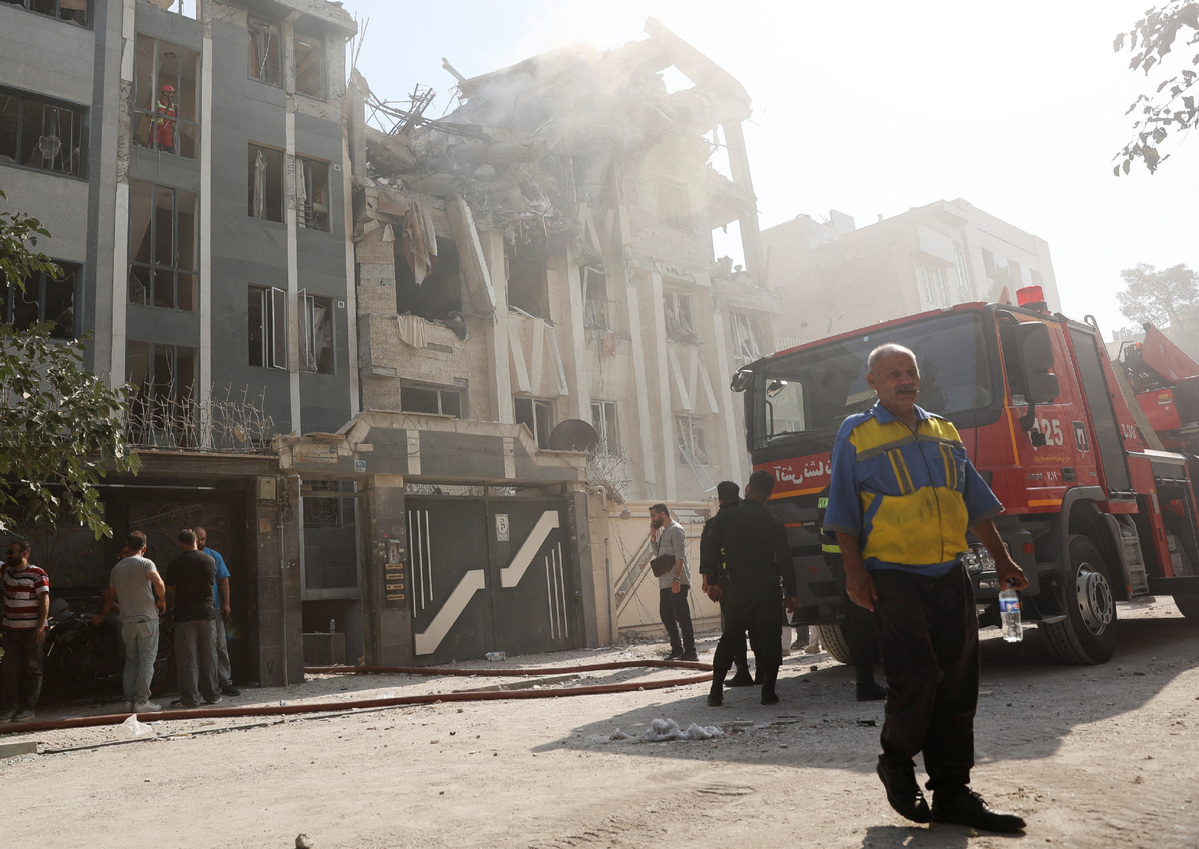
Editor's note: In the early hours of Friday, Israel launched a sweeping airstrike on Iranian territory under the codename Rising Lion, targeting military sites including missile bases and nuclear facilities. Iranian state television reports that General Hossein Salami, commander-in-chief of the Islamic Revolutionary Guard Corps, was killed in the Israeli strikes. Two experts share their views on the situation. The following are excerpts from their interview with China Daily's Liu Jianna.
Risk of escalation high
By Tang Zhichao
Prior to this latest operation, Israel had repeatedly issued military threats against Iran. Coincidentally, Iran and the United States were scheduled to hold their sixth round of nuclear negotiations in Oman this Sunday. Israel's decision to launch a military strike just before the talks appears to be a calculated move to derail US–Iran diplomacy and prevent the possibility of a renewed nuclear deal.
While Israel has publicly argued that Iran is on the verge of developing nuclear weapons — and that failure to act now would mean missing the last chance to stop it — this narrative largely serves as a pretext for military action. In fact, Israel has been warning for over two decades that Iran was close to crossing the nuclear threshold.
Behind this assault lies a dual objective: first, to neutralize what it sees as the Iranian nuclear threat; and second, to escalate the conflict in hopes of fueling domestic unrest in Iran and ultimately toppling the government. From Tel Aviv's perspective, this is a rare historical window. Since last year, Iran and its "Axis of Resistance" have suffered significant setbacks, and Israel sees an opportunity to deal a decisive blow.
If the US and Iran were to reach a new agreement allowing uranium enrichment and easing sanctions, Israel believes the long-term threat to its national security would only grow. In its view, the current moment — with the Trump administration more amenable to Israeli military actions — is the optimal time to strike.
Israel's strikes have already caused considerable damage to Iranian infrastructure. In retaliation, Iran has launched over 100 drones toward Israel. The risk of further escalation is now high.
Unlike the two brief Israel–Iran confrontations in 2024, this operation clearly signals an escalation. The extent of Iranian retaliation remains uncertain. Given the physical distance between the two nations and the US' reluctance to become directly involved, the likelihood of a full-scale regional war remains low — though not impossible.
From a strategic standpoint, Israel's assault at such a critical moment in US–Iran nuclear talks is not something Washington welcomes. The move clearly undermines US diplomatic efforts and regional strategy. Yet the United States is far from an innocent bystander.
First, the US was informed in advance. Israeli officials reportedly notified their US counterparts before the operation. In response, Washington began evacuating non-essential personnel from regional posts, including in Iraq and Bahrain, signaling preparedness for potential Iranian retaliation.
Second, President Trump has not condemned the strikes. On the contrary, he has tacitly endorsed them, arguing that the attack may either derail the nuclear talks or pressure Iran into making concessions.
Third, while US forces did not take part directly, they are reported to have supported the operation by opening airspace and providing intelligence. As the conflict develops, American forces in the region are expected to become increasingly involved, especially in defensive roles after Iran began its retaliation.
Tang Zhichao, a researcher at the Institute of West-Asian and African Studies. The views don't necessarily reflect those of China Daily.