EU and UK should reject Trump's 'reciprocal tariffs'







Lately, I have been saddened and distressed by two developments on the trade front concerning the UK and the EU. My sorrow stems from their stance on US President Donald Trump's "reciprocal tariffs".
In a trade deal struck with the US in early May, the UK endorsed Trump's baseline 10 per cent tariff, a crucial part of his "reciprocal tariffs". It is now pushing Washington to implement its promised tariff cuts on UK car and steel exports to America.
Meanwhile, the EU is reportedly inclined to accept, albeit rather grudgingly, Trump's minimum tariff on all imports to the US, reversing Brussels' approach to its trade negotiations with Washington. According to the Financial Times, the commission told member states that the 10 percent tariff was likely to stay in any agreement with the US.
Trump's "reciprocal tariffs" are a game changer for the global trading order. Under rules of the World Trade Organization, an increase in a member's "bound rate" or ceilings on its customer tariff rates requires the agreement of all its 166 members. Trump's "liberation day" tariffs will see US-bound rate soaring to over 10 percent from its current rate of 3.4 percent, but without the consent of other members. In so doing, Trump trashes the constraints the WTO places on its members, renounces US's obligations to the organization, and deprives other WTO members' right to collectively determine the tariff rate for each other.
Trump's "reciprocal tariffs" also undermine WTO's most-favoured nation principle. The tenet requires all members to treat each other equally, e.g., to charge all members the same tariff rate, so as to create a level-playing field. However, Trump's tariff policy leads to various rates for members, which amounts to discrimination between US's trading partners.
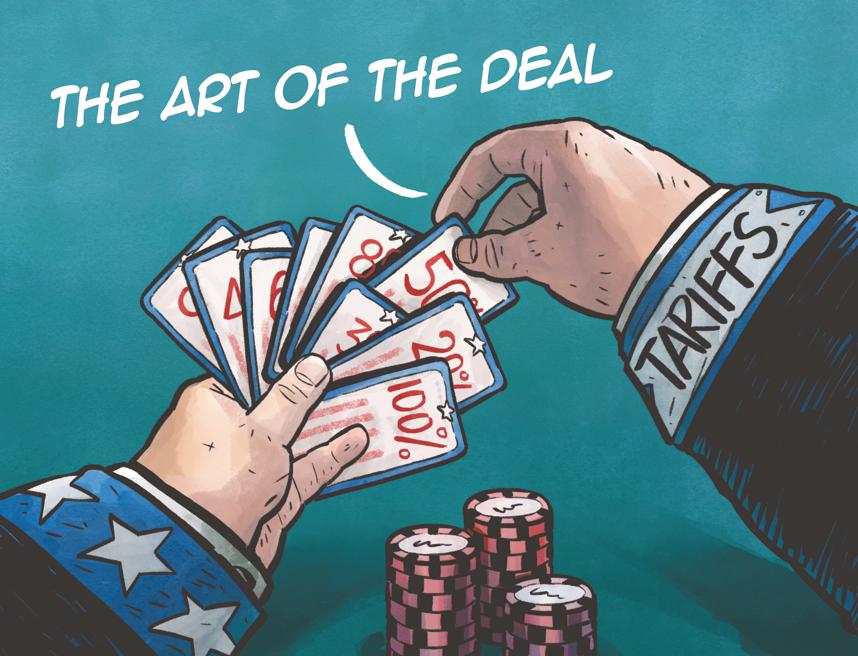
The pushing through of the "reciprocal tariffs" signifies the onset of a new era. Other countries' trade relations with the US would no longer be governed by globally agreed-upon rules, but by power. It would resemble, in the words of former Singaporean Prime Minister Lee Hsien Loong, an arm wrestling, the winner of which depends on "who's got more biceps, who's got stronger arms". In the wake of Trump's announcement of the"liberation day" tariffs, countries rushed to engage the Trump administration, "kissing my ass" to make trade deals, as Trump put it. The scene can hardly be described as pretty, but may recur.
Rather than being set in Geneva through intensive consultations and haggling, the US's tariff rate would be entirely subject to Trump's ambitions or whims. As shown by his doubling of tariffs on steel, changes in tariffs could be erratic and capricious. They are also to become a handy tool for Washington to extract concessions or suppress its adversaries.
Clearly, Trump's "reciprocal tariffs" pose an existential threat to the global trading system, and thus necessitate the strongest opposition from all caring for the survival of the WTO. The idea of accepting the noxious and devastating scheme, therefore, should never be entertained. I expected both the UK and the EU, which had long claimed to be champions of the multilateral trading system, to stand their ground. What transpired, however, has shaken, if not shattered, my great respect for them.
The UK was the first country to accept Trump's reciprocal tariffs. Its trade deal with the US, concluded when other US trading partners were holding out, marks a critical breakthrough in Trump's effort to reshape the global trading order. And by lending some legitimacy to his scheme, it has emboldened the president to force through his "reciprocal tariffs". Touted by Trump as the template for other countries, the precedent the UK set ratchets up pressure for other countries to fall into line.
However, I was elevated by the EU's initial response to Trump's "liberation day" tariffs. The bloc lambasted them as "unjustified and harmful," stressing that "it is the unequivocal view of the EU that these tariffs blatantly violate fundamental WTO rules", and reaffirming that "internationally agreed rules matter and these cannot be unilaterally disregarded by any WTO member, including the US". Further, while preparing a list of US goods for retaliation, the bloc launched a WTO dispute against the US by formally filing a request for consultations.
The EU did the right things, such as earning a great deal of plaudits from other countries.
However, when Trump threatened to double his tariff on the EU to 50 per cent, the bloc found it extremely difficult to maintain its stance. At stake was $578 billion a year in export to the US, or 20.6 per cent of the bloc's overall exports in 2024.
While the need to avoid Trump's excruciating import levy was understandable, at a time of his lethal attack on the WTO, it was all the more important for the EU to join forces with China and other countries in saying no to Trump's destruction of the world's top trade body. EU's concession to Trump's baseline tariff would mean abandoning the cornerstone of the global trading system, and it also suggests that the bloc prioritizes its short-term economic interest over the survival of the WTO. Such an action, together with UK's trade pact with the US, threatens to push the WTO to the brink of collapse.
The UK and the EU are likely to pay a heavy price for agreeing to Trump's "reciprocal tariffs". The move is akin to killing the goose that lays the golden eggs. Both of them risk being discredited as champions of free trade and multilateralism, an image they have for decades been at pains to nurture. Instead, they would likely be remembered as the US's accomplices in destroying the global trading system.
Moreover, they will suffer long-term economic losses. Both the UK and the EU depend heavily on trade for growth and prosperity. When the world body that provides the stability and predictability for trade expansion and economic growth is dismantled, their future prosperity would be put in peril.
Now the UK and the EU have a chance to recalibrate their positions on Trump's reciprocal tariffs.
Amid strong opposition from around the world, the US Court of International Trade ruled on May 28 that Trump did not have the authority to use the emergency economic powers to impose sweeping global tariffs. Although a US federal appeal court has temporarily halted the ruling, Trump's tariffs remain in legal limbo. Consequently, the White House's negotiating position has been weakened. Under these circumstances, for the common good of the world as well as their own long-term and strategic interests, the EU and the UK should reject categorically Trump's "reciprocal tariffs" and continue to play a key role in safeguarding the multilateral trading system.
Zhou Xiaoming is senior fellow at Center for China and Globalizaion and the former deputy permanent representative of China's Mission to the UN Office in Geneva.
The views don't necessarily reflect those of China Daily.
If you have a specific expertise, or would like to share your thought about our stories, then send us your writings at opinion@chinadaily.com.cn, and comment@chinadaily.com.cn.