


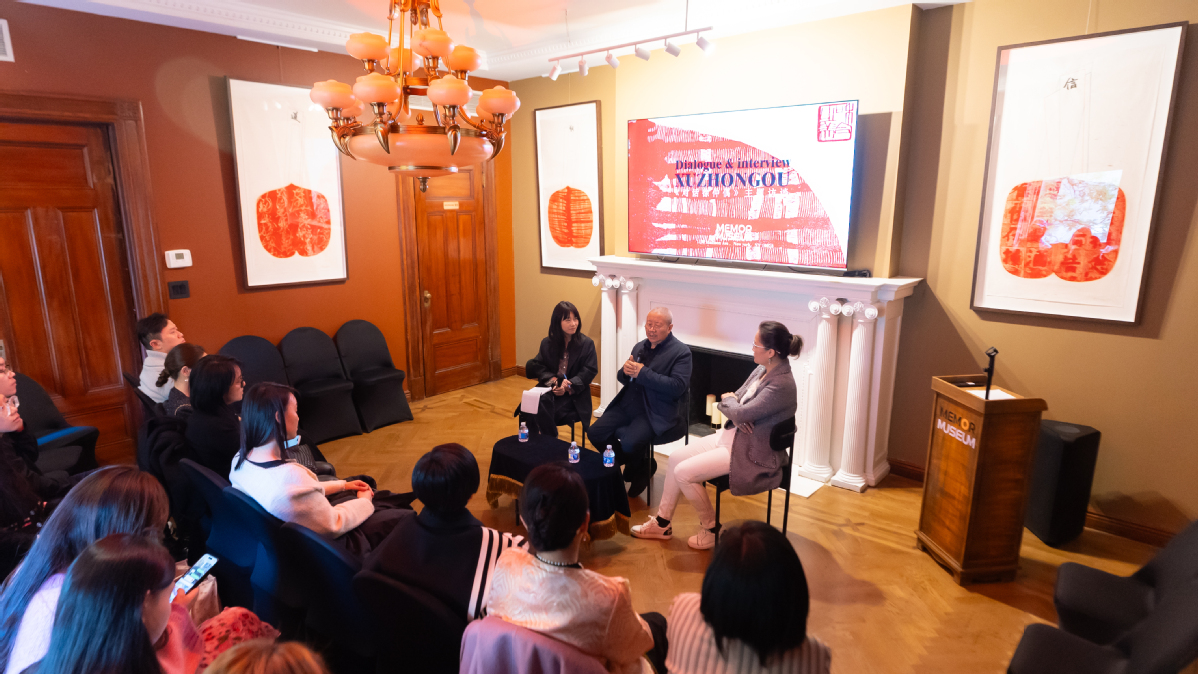
A quietness fills the room. Only the occasional creak of footsteps on the wooden stairs breaks the silence in the century-old townhouse on Madison Avenue, New York. Inside, its interior preserved much as it was 100 years ago, the stillness greets visitors as they stand before the works of Xu Zhongou.
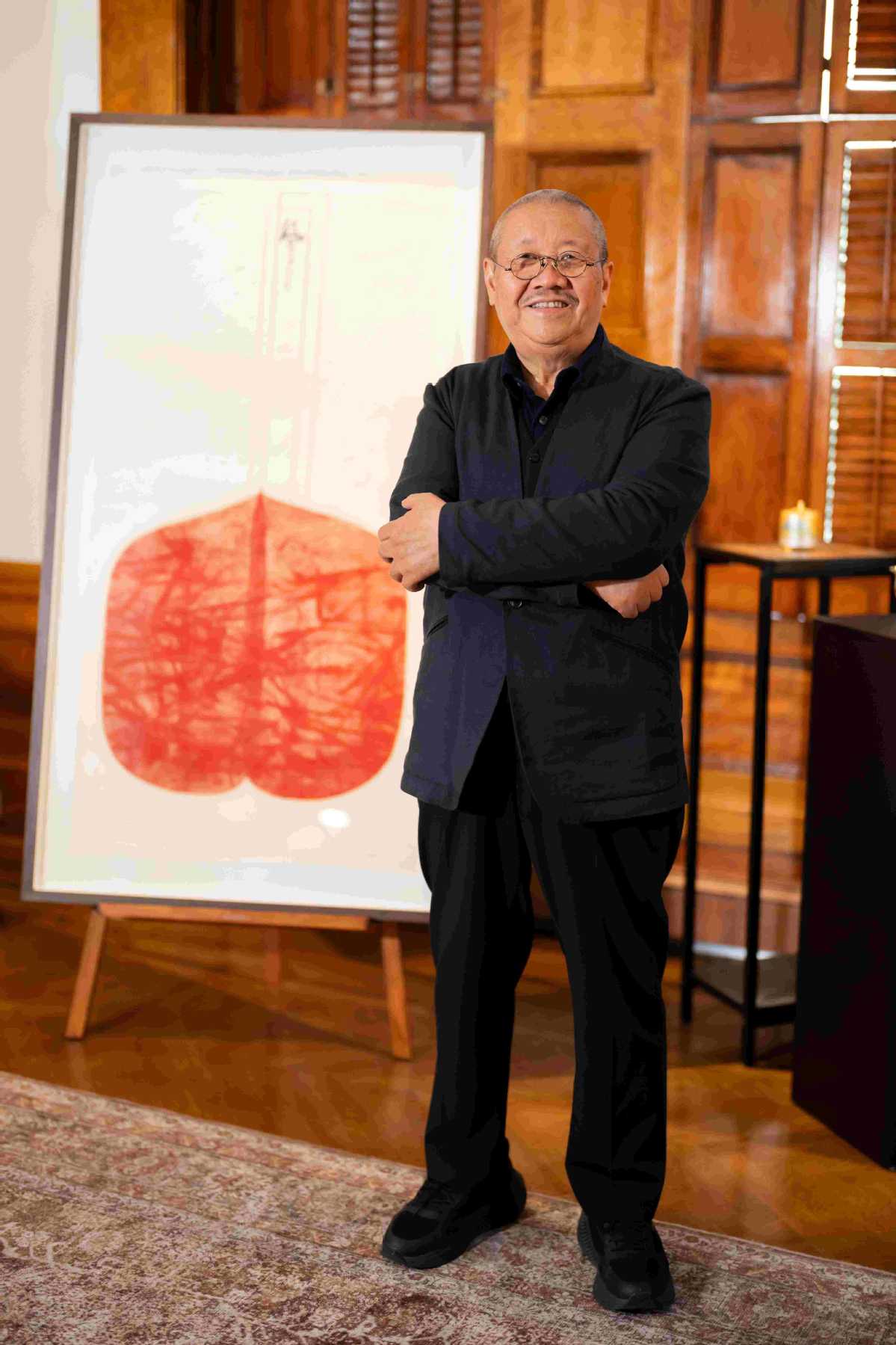
The exhibition features pieces from Xu's long-running Walnut series, which he describes as an exploration of what it means to be human.
"In those earlier years, there was a kind of silence around the human, around individuality, around inner life. It wasn't so much suppressed as it was undefined, unspoken," said Xu, a leading figure in contemporary Chinese printmaking and art education. "But when reform and opening-up began, what struck me most was something very simple and powerful: a recognition of the human being, a respect for creativity, for initiative.
"As I moved through my own process — thinking, creating, trying to find form for these ideas — I kept coming back to one title: Me and My Times," Xu told China Daily.
"I've never seen my work as just a private monologue. And I don't really think of myself as a solitary artist speaking only for myself. My work has always been in conversation with the times I've lived through. It's a form of relationship, of inquiry, of expression," he said.
"So the Walnut series, really, is my way of asking one persistent question: Where is the human being in all this?" he said.
Xu's solo exhibition The Beauty of Harmony and Unity — Walnut will open at Memor Museum in Manhattan on June 3 and run through July 3.
The show explores themes of personal identity, creative agency and the evolving relationship between the individual and society. The exhibition examines how art can serve as a space for reflecting on spiritual unity across time and cultural change.
The Memor Museum is one of the few institutions on Manhattan's Upper East Side focused exclusively on Asian cultures. The exhibition reflects the museum's ongoing commitment to international cultural exchange and the global presentation of contemporary Chinese art.
"The walnut, as the central motif of this exhibition, carries rich layers of life metaphor and philosophical significance in traditional Chinese culture," said Wei Mengying, the exhibition's executive curator.
"In Professor Xu's more than 30 years of creative practice, the walnut has been transformed from a natural object into a spiritual medium that connects tradition and modernity, the individual and the world. Its form symbolizes motherhood; its meaning echoes the cosmos. Through this small walnut, we glimpse an artist's ongoing inquiry into the origins of life and the formation of culture," said Wei.
Xu was born in Chengdu, China, in 1952 and is widely recognized for his contributions to both contemporary art and arts education in China. He graduated from the Printmaking Department at the Sichuan Academy of Fine Arts in 1982 and is a member of the China Artists Association, China Printmaker Association, and China Arts and Crafts Association.
Xu has held several leadership roles, including former president of the School of Urban Design at the Central Academy of Fine Arts in Beijing and former vice-president of the China Printmaking Institute of the Chinese Academy of Arts. He currently serves as the president of the Pan Tianshou School of Architecture and Art Design at Ningbo University.
"The expression of something deeply rooted in Chinese sensibility, which is something essential, is always present in his work," said Willa Ao, director of the Memor Museum and the curator of the exhibition.
"And yet, even in this historic New York building, more than a century old, his pieces feel completely at home. That is the beauty of harmony and unity," Ao said. "Not just from the museum's perspective, but as a personal viewer, I found the experience calming. It invites you to slow down and truly feel."
Since the 1980s, Xu has been developing his In the Name of Walnut series. In his work, the walnut is more than an object. It symbolizes maternal energy, fertility and Eastern wisdom. It becomes a layered symbolic system that reflects on life, gender and belief.
The exhibition at Memor marks the first time the long-running series will be presented in New York.
There are black walnuts, red walnuts, green walnuts, calligraphy-shaped walnuts, walnuts that evoke motherhood, walnuts infused with Confucian, Buddhist and Daoist thought, and so on. Xu's long-running Walnut series draws upon a rich tapestry of folk tradition, religious symbolism, philosophy, and metaphors of life.
In his hands, the walnut becomes a visual prototype within the language of printmaking, a central vessel for expressing his vision of harmony and unity. The form of his walnut suggests the maternal and the cosmic origin of life.
"The theme of this exhibition, The Beauty of Harmony and Unity, is not a modern invention. It stems from the deep-rooted philosophy at the heart of Chinese culture," said Xu. "Throughout its long history, Chinese civilization has been shaped by this ideal of balance, interconnection and peaceful coexistence.
"When this spirit enters the global artistic language," Xu continued, "it is as if China is opening its arms to embrace the world. With both hands extended, we welcome and engage with others.
"As artists, we do not create in isolation or for pleasure alone. We walk a step ahead, because we are tasked with creating spiritual wealth, a kind of inner light that offers direction, courage, and clarity when society faces uncertainty," he said.
"That is why I see this exhibition in New York not just as an artistic event, but as something that brings warmth, a quiet insistence that we can understand one another, respect one another, work together. What the world needs now," he added, "is not hardness, but softness; not sharp edges, but roundness."
In Xu's works like Rhythm of Red and the In the Name of Writing series, writing becomes a visual gesture rather than a form of language. The lines shift, pause, and accelerate across the canvas, creating a choreography of movement and emotion. Using a minimal palette, Xu explores how mark-making can carry spatial tension and personal resonance, often without recognizable symbols or forms.
Xu's work has also received broad recognition from the international art community. In 1994, he was invited to serve as a visiting professor at the Maryland Institute College of Art and was named an honorary citizen by the City of Baltimore. The following year, he was invited to complete a portrait of former US president George W. Bush, which was collected by the George H.W. Bush Presidential Library and Museum in Texas.
His works The Green Dragon Town series and the Mortise and Tenon series are in the permanent collections of the British Museum and the British Plank Foundation, marking his contributions to cross-cultural dialogue through art.
In 1994, Xu went to the University of Maryland in Baltimore for academic exchange. The experience led him to reflect deeply on the cultural differences between China and the West.
He said that Chinese culture is fundamentally a "culture of relational order", where relationships define social order, and that order determines how people interact. For example, in China, even the closest relationships, like between husband and wife, are governed by respect and boundaries. Intimacy doesn't erase formality, he said.
Xu said he believes that Chinese culture's core, which is its relational order, measurement and structure, still holds value in the modern world. "This core isn't outdated; rather, it continues to offer a framework for navigating relationships, even among nations," said Xu, adding that Chinese modern art should grow organically from Chinese traditions.
Xu has spent more than 30 years pursuing this path: building modern Chinese art grounded in native cultural logic. Even when exposed to Western modern art during his time in the US, he chose not to follow it blindly. "Each nation and culture must participate in modernity on its own terms," said Xu.
Xu said he sees the idea of "between" (jian) as rooted in Chinese relational thinking. That aesthetic is experimental but grounded in deep cultural traditions, including not only Confucianism but also a synthesis of all five classical schools of Chinese thought.
He said that modern Chinese aesthetics should embrace this internal diversity rather than fragment into isolated schools. His Walnut series embodies this concept of "between".
Xu said he views that broader vision of art as a force that transcends borders. In his view, Chinese creativity offers not only a distinct mode of expression but also a universal language that resonates beyond its origins. At a time when global discourse is often polarized, Xu called for cultural exchange grounded in mutual respect and openness.
"China is inherently more creative. Our artists, as I mentioned earlier, often create from nothing. Their works don't arise from a specific landscape or scene but are entirely conceived within their own minds," said Xu.
"It also explains why a Chinese artist, working from within the roots of Chinese culture, can still produce work that is understood, appreciated and recognized by so many influential people in the West," he added.
"Cultural exchange must take place in a multilateral context, rather than being reduced to questions of who is right or wrong. The true value of artistic dialogue lies in its ability to transcend power structures and hierarchies, creating a space for free and equal exchange. It is this openness that gives art its greatest significance," said Xu.
Xu's exhibition is among the latest to be hosted by the Memor Museum as part of its ongoing efforts to highlight Asian cultural narratives. Housed in a 19th-century landmark within the Metropolitan Museum Historic District, the Memor Museum extends its legacy through exhibitions and events that spotlight Asian cultures.
Xu's exhibition embodies the idea of the beauty of harmony and unity, or harmony in diversity, through three key themes, said Ao, the museum's director.
She said the first is cultural dialogue between China and the West, echoing the museum's core mission. The second is the beauty of sound and life, expressed through Xu's long-standing use of walnuts: simple on the outside, but rich in symbolism, representing vitality, reproduction and continuity. The third is rooted in the Chinese character jian, symbolizing inclusiveness and interconnectedness.
"Working alongside Professor Xu over the past few days has been both a powerful and nourishing experience for me," said Wei, the exhibition's curator.
"He is not the kind of 'authority' who speaks from above, but a gentle, humble educator who remains endlessly curious. Every piece of his work, every story he tells, is filled with deep emotion. His commitment to creation, his reverence for thought, and his attention to the finest details have all deeply moved and inspired me," she added.
minluzhang@chinadailyusa.com








