


Tianwen 2 mission to retrieve asteroid samples, explore comet
Project to develop key technologies, obtain data to study origins, evolution







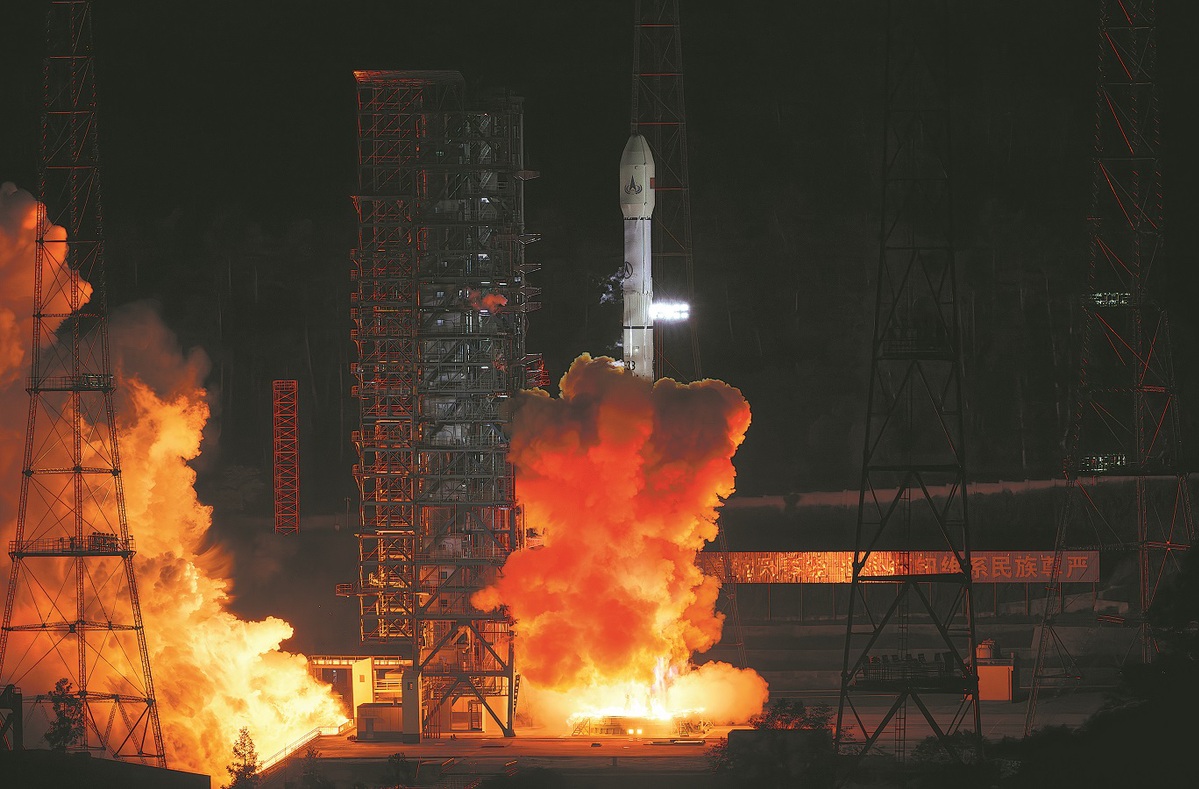
China launched its first asteroid sampling mission early on Thursday morning, aiming to explore a small, near-Earth asteroid and retrieve samples from it for scientists.
Carrying the Tianwen 2 robotic probe, a Long March 3B rocket blasted off at 1:31 am from the Xichang Satellite Launch Center in Sichuan province.
After flying for about 18 minutes, the rocket successfully deployed the Tianwen 2 into a transfer trajectory toward its destination, an asteroid called 2016 HO3.
The probe's solar arrays then unfolded smoothly, marking the launch phase's success, according to the China National Space Administration.
Shan Zhongde, director of the CNSA and head of the Tianwen 2 mission headquarters, said after the launch that Tianwen 2 is opening a new chapter in China's interplanetary exploration endeavors.
"This is a lengthy, complex and challenging expedition. We hope it can fulfill each and every task in accordance with our plan, so it will bring about scientific feats, help us unravel more mysteries about the universe and enrich humanity's knowledge," he said.
The CNSA said the Tianwen 2 mission is expected to accomplish multiple objectives through a single expedition, including the collection of samples from 2016 HO3 and flyby exploration of the main-belt comet 311P. Main-belt comets exhibit comet-like activity and asteroid-like orbits within the asteroid belt.
The administration said that mission planners want to accomplish two major engineering goals through the Tianwen 2 project. The first is to develop and demonstrate key technologies needed for gathering samples from weak-gravity celestial bodies, and for making high-precision autonomous navigation and control, as well as other crucial maneuvers. The second is to obtain data and samples to facilitate studies about the origins and evolution of asteroids.
Planners hope the spacecraft can measure the multiple physical parameters of both 2016 HO3 and 311P, covering their size and shape, orbital traits, rotation patterns and thermal radiation characteristics, which will allow for research on their orbital dynamics. Researchers will also analyze their external features, material compositions, internal structures and possible ejecta, which is the material thrown out from a crater during an impact event.
After the samples are sent back to Earth, they will be distributed to scientists, who will examine their physical properties, chemical and mineralogical content and isotopic composition, contributing to studies on the formation and evolution of asteroids and the early solar system, according to the CNSA.
The asteroid 2016 HO3, also known as 469219 Kamo'oalewa, was first spotted in April 2016 by an asteroid survey telescope at the Haleakala High Altitude Observatory in Hawaii.
The celestial body orbits the sun, so it remains a constant companion of Earth. It is too distant to be considered a true satellite of Earth, but it is the best and most stable example to date of a quasi-satellite.
The analyses of 2016 HO3's reflectance spectrum and other physical characteristics have led to a hypothesis that this asteroid may be a boulder that was blasted off the surface of the moon following an impact with another space object.
China's first excursion to an asteroid was a flyby of the elongated, irregularly shaped near-Earth asteroid named 4179 Toutatis in 2012, when the Chang'e 2 lunar orbiter made the pass as part of its extended mission.
As China's first attempt to retrieve asteroid samples, the Tianwen 2 mission is characterized by a succession of sophisticated and challenging maneuvers that demand the highest level of planning, calculation and implementation.
The spacecraft, which was designed and built by the China Academy of Space Technology, is programmed to carry out several trajectory maneuvers in the following year to fly toward 2016 HO3. After that, it is set to orbit the asteroid to perform remote observation and obtain data to enable scientists and ground controllers to analyze and determine suitable locations for the mission's most critical part — the sampling operation.
After all preparations are completed, the probe will approach the asteroid to gather samples.
If everything goes according to schedule, at the end of 2027, Tianwen 2 will fly back to Earth's orbit and release its reentry module, which will return to the ground with the samples.
After dropping off the precious asteroid substances, the probe will use Earth's gravity as a slingshot to boost itself toward 311P. It is expected to arrive at the comet several years later to conduct a detailed remote-sensing survey.
Han Siyuan, a senior planner at the CNSA and spokesman for the Tianwen 2 mission, said that 2016 HO3 is a "quasi-satellite" of Earth that travels in a stable manner near Earth's orbit with a rotation period similar to that of Earth.
"According to previous scientific studies, the asteroid likely preserves primordial information from the birth of the solar system, holding immense scientific value for investigating the material composition, formation processes and evolutionary history of the early solar system," he said.
The comet 311P moves within the asteroid belt between the orbits of Mars and Jupiter.
"Exploring it could significantly advance our understanding of small celestial bodies' material composition, structural characteristics and evolutionary mechanisms," Han said.
Liu Jianjun, a researcher at the National Astronomical Observatories of the Chinese Academy of Sciences and deputy chief designer of the Tianwen 2 project, said that asteroids are unique celestial bodies in the solar system, and some scientists believe they brought water molecules and organic substances to Earth billions of years ago.
"Small celestial bodies in the solar system have not undergone the physical and chemical evolutionary processes of planets and other large celestial bodies, preserving the most primitive material compositions from the early formation of the solar system," he said.
"During the long history of Earth, asteroids played a significant role. The extinction of dinosaurs is believed to be closely connected with them. Therefore, studying asteroids not only helps us expand our knowledge about the solar system, but also promises deeper understanding of our mother planet's history."





