Green efforts
Investment in clean energy gains momentum in Southeast Asia







Editor's note: In this weekly feature China Daily gives voice to Asia and its people. The stories presented come mainly from the Asia News Network (ANN), of which China Daily is among its 20 leading titles.
Private green investment in SEA-6 jumped 43 percent to $8 billion in 2024, led by solar and waste management. SEA-6 refers to Indonesia, Malaysia, the Philippines, Singapore, Thailand and Vietnam.
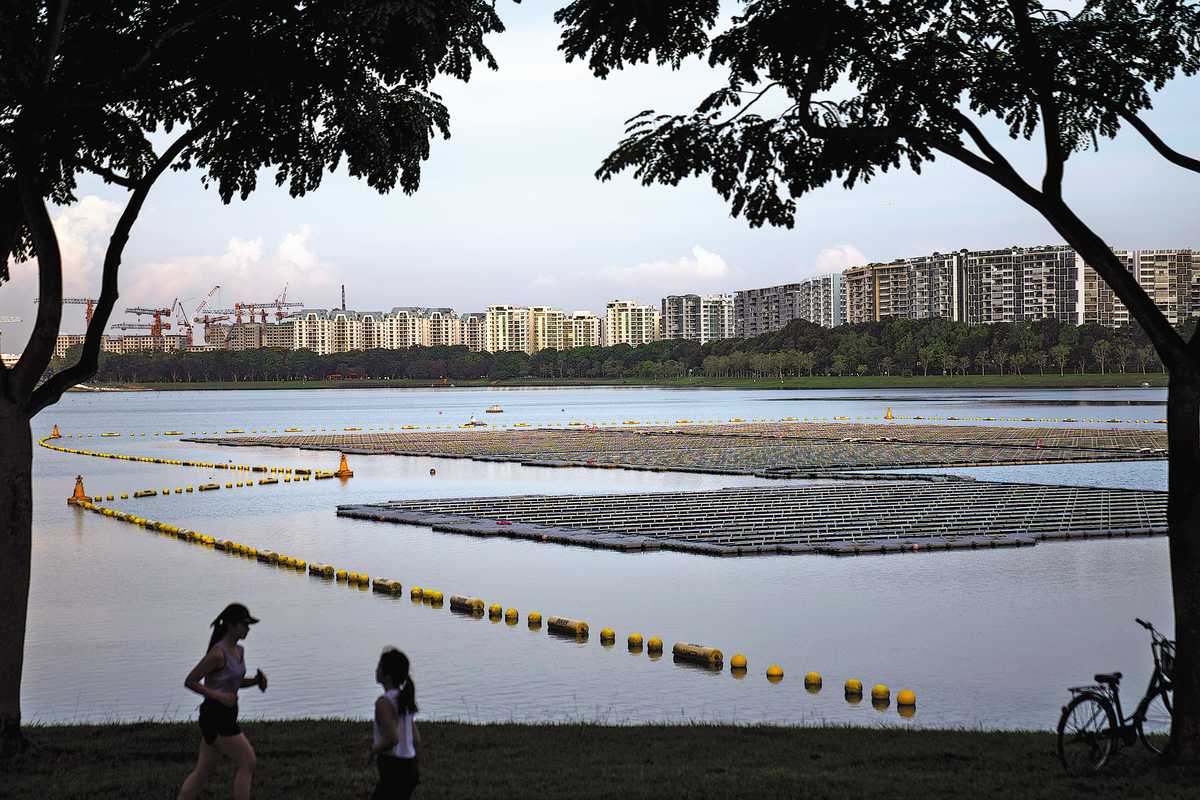
Most investors are drawn to solar projects in Southeast Asia, with more than 30 percent of 2024's green investments in the region in solar energy, according to the Southeast Asia's Green Economy 2025 Report, released on May 6 by Bain & Company in collaboration with GenZero, Google, Standard Chartered and Temasek.
Corporations and climate funds are leading the charge, with infrastructure fund participation rising 14-fold.
Malaysia and Singapore accounted for over 60 percent of deal activity. Foreign investment into SEA-6 tripled, especially from outside Asia-Pacific region, or APAC.
However, domestic investments in Southeast Asia declined by 40 percent — a trend that needs urgent reversal. Yet, sustained momentum requires all stakeholders — governments, investors, and businesses — to collaborate and drive practical, scalable outcomes.
Call for cooperation
While green investments may be growing, current projections show Southeast Asian nations are not on track to meet their 2030 targets, with the gaps between actual emissions and targets expected to widen by 2040 and 2050.
The report noted that Southeast Asia remains particularly vulnerable, as its emissions have yet to peak.
According to the report, Southeast Asia must pursue a systemic approach to unlock green growth that strengthens economic resilience, narrows up to 50 percent of the region's emissions gap by 2030, and potentially adds $120 billion to regional GDP.
The report stressed the importance of deepening APAC-SEA ties, to build a thriving green economy.
Shared concerns — such as energy security, strong trade relations, and growing foreign direct investment — make the case for closer cooperation. This alignment is even more critical in today's volatile political and economic climate.
SEA and APAC are key players in the global decarbonization journey, jointly accounting for a significant share of global emissions — APAC at 50 percent, and SEA at 7.5 percent.
Both regions remain highly reliant on fossil fuels, and most countries are not on track to meet the 2030 targets. Without urgent interventions, the emissions gap could widen dramatically by 2040 and 2050, the report said.
"With only five years left to 2030, the time for bold, pragmatic action is now," said Franziska Zimmermann, managing director of sustainability at Temasek. "SEA has a unique opportunity to lead systems-level transformation that balances climate goals with energy security and economic priorities."
The report identifies systemic barriers to green development, such as underdeveloped infrastructure, regulatory fragmentation, limited access to finance and reliance on fossil fuels.
Addressing these barriers requires coordinated actions across energy, transport, land use, and industry. According to the report, key regional opportunities lie in transforming agriculture and land use (sustainable bioeconomy), modernizing electricity grids, and expanding electric vehicle ecosystems.