



Washington's levies harmful, studies warn
Tariffs to result in revenue shortfalls due to retaliation from trade partners







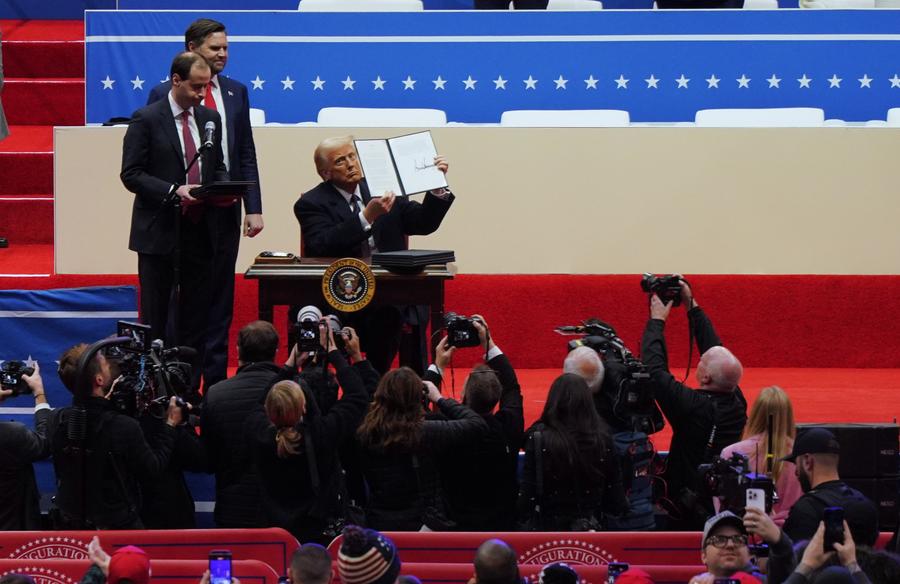
Two independent studies concluded that the universal tariffs proposed by President Donald Trump would fail to deliver promised revenue while damaging the US economy, businesses, and global trade.
"Universal tariffs are a highly inefficient and distortionary way to raise revenue," said Warwick McKibbin, a nonresident senior fellow at the Peterson Institute for International Economics, or PIIE, during a recent joint event with the Tax Foundation. "They will do harm to growth, investment, and employment in the US economy."
The analyses of the two studies presented at the event, conducted separately but with aligned assumptions, project higher consumer prices, reduced economic growth, and significant revenue shortfalls due to behavioral shifts and retaliation from trading partners.
The PIIE study, led by McKibbin, utilized the G-Cubed model, a global economic simulation tool, to evaluate tariffs of 10 percent, 15 percent, and 20 percent on all US imports. It found that a 15 percent tariff would generate more than $3 trillion over ten years without retaliation, but this drops to $1.5 trillion when countries like China reciprocate with equivalent tariffs. A 20 percent tariff yields just $791 billion, reflecting a Laffer Curve effect where higher rates reduce trade volume and revenue.
"If you have a very high tariff and eliminate trade, you have no revenue," McKibbin said.
The Tax Foundation's study, presented by Erica York, vice-president of federal tax policy, used a neoclassical macroeconomic model. It estimates a 10 percent tariff would raise $2.2 trillion conventionally over ten years, falling to $1.7 trillion with dynamic effects and retaliation. Higher tariffs exacerbate the damage, shrinking the economy by lowering real after-tax wages and investment returns. "Tariffs will shrink the long-run size of the US economy by reducing both the real after-tax wage rate and after-tax return on investment," York said. "Revenue from tariffs is significantly less than a simple analysis would suggest."
Both studies underscore the Laffer Curve's relevance: beyond a certain point, higher tariffs reduce revenue by stifling trade. Maurice Obstfeld, a PIIE senior fellow, modeled this with a quadratic function, finding revenue peaks at 22 percent to 24 percent tariff rates, yielding $3.65 trillion over ten years, then declines. "At very high tariff rates, you'll lose a lot of revenue because you hurt the economy a lot. It makes you lose revenue overall," he said.
Experts mentioned that retaliation amplifies the damage. China, as one of the major US trading partners, has historically responded to tariffs with countermeasures, as seen in 2018 and 2019. The PIIE study shows that reciprocal tariffs from 75 percent of the global economy could erase initial trade balance gains, hitting sectors like agriculture and manufacturing hardest due to their reliance on exports and imported inputs.
Alan Cole, a Tax Foundation senior economist, highlighted the challenges for small and medium-sized enterprises. "The on-again, off-again nature of policy makes it extremely difficult for businesses to plan. A lot of industrial investment is built with a 50-year timeline, but current tariff policies are highly uncertain," Cole said.
Consumers to feel pinch
The Tax Foundation's study notes that tariffs on capital goods and inputs raise production costs, undermining Trump's reindustrialization goals. Retaliation targeting US exports, particularly from China, could further erode competitiveness. So, consumers will feel the pinch through higher prices and reduced purchasing power.
Trump's latest tariff plans, announced in April 2025, include a 10 percent universal tariff on all imports, with exemptions for some allies, and a total 54 percent rate on Chinese goods. Before the recent agreement, some Chinese exports to the US faced tariffs exceeding 100 percent after several rounds of Chinese countermeasures and further US tariff increases.
Following high-stakes talks in Geneva, Switzerland, on May 11-12, the US and China agreed to a 90-day tariff truce, reducing US tariffs on Chinese goods from 145 percent to 30 percent and Chinese tariffs on US goods from 125 percent to 10 percent, effective Wednesday, to continue negotiations and de-escalate trade tensions. This truce could temporarily mitigate some of the economic damages projected by the studies, though its long-term impact depends on further negotiations.
The studies also warn of broader implications. PIIE President Adam Posen criticized the fiscal context at the event. "Structurally eroding the competitiveness of the US economy and further decreasing the tax base is further irresponsibility, which we can ill afford," he said. Posen mentioned that with a US budget deficit exceeding 6 percent of GDP, reliance on tariffs could deepen economic woes.
The studies also mention that uncertainty compounds the problem, saying that frequent policy shifts disrupt supply chains and investment, particularly for small businesses lacking lobbying power. Obstfeld said that differential tariffs across countries create inefficiencies, driving trade diversion and raising costs.
Meanwhile, experts from the PIIE and the Tax Foundation agreed that universal tariffs are an inefficient, destructive fiscal strategy.
yifanxu@chinadailyusa.com










