


Ancient silk manuscript at long last back in China
Relics: Manuscript ‘rich in myth, numerology’







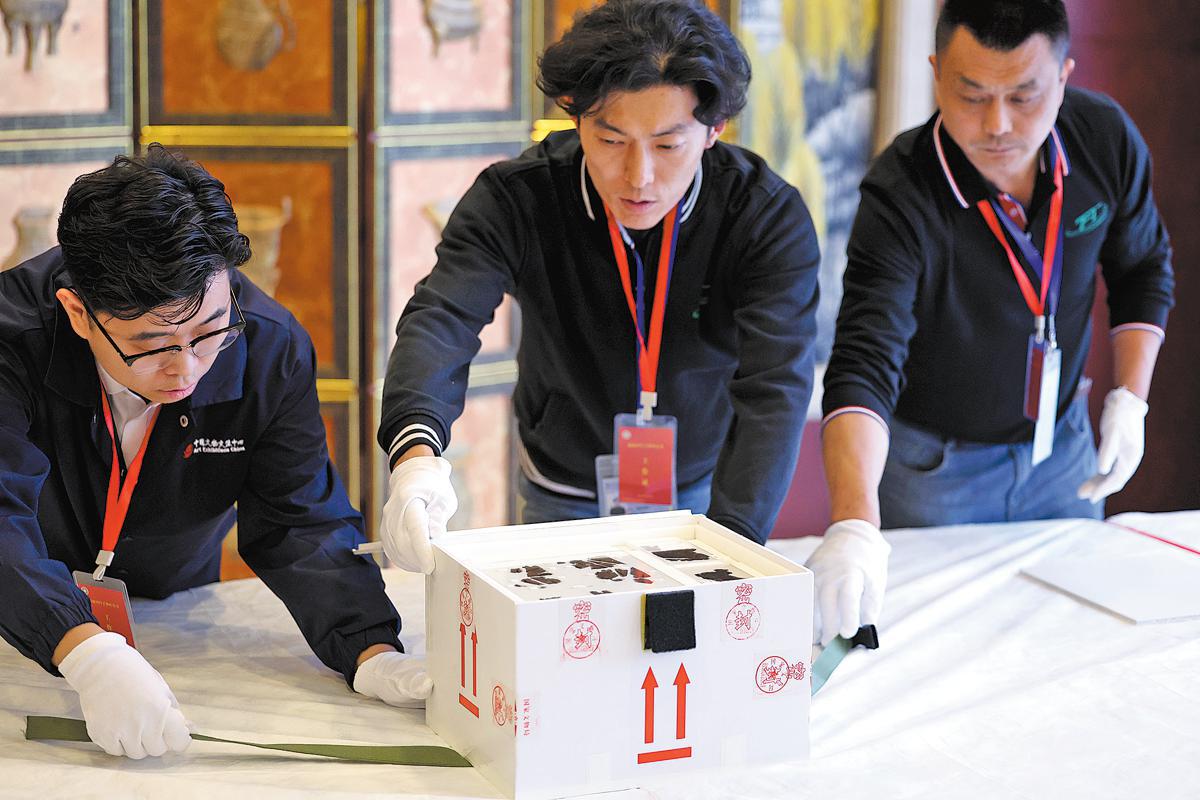
Remnants of an ancient Chinese silk manuscript, lost long ago, finally touched down at Beijing Capital International Airport on Sunday, ending nearly 80 years of overseas wandering.
The flight to Beijing followed a handover ceremony in the United States on Friday at the Chinese embassy in Washington, DC.
The Smithsonian's National Museum of Asian Art returned the remnants of the Zidanku Silk Manuscript, estimated to be more than 2,300 years old, from its collection and formally transferred them to China's National Cultural Heritage Administration.
As the earliest Chinese silk texts discovered to date, and the only known ones from the Warring States Period (475-221 BC) unearthed in China, the manuscript was named after the Zidan-ku area of Changsha, Hunan province, from where it was stolen by grave robbers in 1942. It was then illegally taken to the US in 1946.
The parts of the three-volume manuscript that have been returned to China are Wuxing Ling and Gongshou Zhan, known by scholars as Volumes II and III, respectively. They are about taboos and auspicious practices in rituals and military actions.
Volume I of the manuscript has yet to be returned to China. The Smithsonian said that this volume is privately owned, but the National Cultural Heritage Administration said it will continue to work for its return.
"With more than 900 characters and rich in myth and numerology, the manuscript reflects the depth and endurance of Chinese civilization, having great significance in studying ancient Chinese characters, literature and thinking," said Xie Feng, the Chinese ambassador to the US, during the transfer ceremony at the embassy.
Xie added that the two volumes' return "is a cultural milestone and a testament to China-US cooperation in heritage preservation, bringing new vitality to people-to-people exchange and friendship".
The successful return of the volumes indicated that through dialogue and cooperation based on equality, mutual respect and benefit, the two countries can deliver important and tangible results that are good for both sides and beyond, Xie added.
The envoy said that China and the US have made "notable" progress in heritage cooperation, with around 600 artifacts sent back to China — including more than 40 items since the start of this year.
'Examples of friendship'
"These returns are vivid examples of friendship and international collaboration to reclaim and protect humanity's shared legacy," he said.
Li Ling, a veteran archaeologist from Peking University who has studied the Zidanku manuscript for over 40 years, described the relics as China's equivalent of the Dead Sea Scrolls, a collection of ancient, mostly Hebrew manuscripts first found in 1947.
Just as the Dead Sea Scrolls are crucial for understanding Western and Christian cultures, the Zidanku manuscript offers insights into the ancient Chinese world of occultism, according to Li.
In a video address to the handover ceremony, Vice-Minister of Culture and Tourism Rao Quan, who is also head of the National Cultural Heritage Administration, said the return of the manuscript fulfilled the long-held wish of the Chinese people to repatriate the "treasures of the country" and respected their cultural rights and national feelings.
Rao said their return would ensure that the invaluable artifacts could now be "fully and rightfully protected and studied on the soil from which they came".
Furthermore, their heritage value can be more accurately and comprehensively understood and interpreted, and they will become shared academic and civilizational assets of China and the world, said Rao.
The Smithsonian's National Museum of Asian Art said the transfer of the unique manuscript is an "important step in international cooperation".
Chase F. Robinson, director of the Asian art museum, said that since its inception, the museum has partnered with Chinese cultural institutions to share knowledge and expand the study and understanding of Chinese art history.
"This transfer reflects a carefully considered decision, grounded in our focus on sound stewardship, and the belief that these materials belong in dialogue with their cultural and archaeological context," he said.
The returned manuscript will make its public debut in July at the National Museum of China as part of an exhibition on repatriated cultural relics.
"The transfer is a breakthrough. It's a successful case of the proactive recovery of significant lost cultural artifacts. It can also encourage US museums to collaborate with China on cultural relics repatriation," said Huo Zhengxin, a professor at China University of Political Science and Law's School of International Law.
He noted that Li, the Peking University archaeologist, has conducted a comprehensive study of the manuscript, tracing its excavation origins in Changsha and subsequent transfer to the US.
"Such academic achievement has supported the restitution of the manuscript," Huo said.
China has strengthened cooperation with other countries on cultural heritage preservation in recent years. "Doing this fosters mutual understanding and helps encourage restitution of cultural relics lost overseas," Huo said.
He added that one of the challenges in recovering China's lost cultural relics overseas is their vast number, long history of dispersal and diverse reasons for loss.
"It's important to establish a complete inventory of these lost cultural treasures and research their provenance and transfer history," he said.
Wang Kaihao in Beijing contributed to this story.