


Ancient Chinese silk manuscripts return








A batch of ancient Chinese silk manuscript fragments, believed to be older than the Dead Sea Scrolls, are returning to China after a handover ceremony at the US embassy on Friday, ending their nearly 80-year overseas existence.
The Smithsonian's National Museum of Asian Art has deaccessioned fragments of the Zidanku Silk Manuscript (fourth–third century BC) from its collection and formally transferred them to the National Cultural Heritage Administration, the Washington-based museum said in a statement on Friday.
The earliest known silk texts and the only ones from China's Warring States Period (475-221 BC) were named after "Zidanku," as they were stolen in 1942 by grave robbers, who plundered a sealed tomb from the Warring States Period in the Zidanku area near Changsha, Hunan province.
They were illegally taken to the United States in 1946, according to the National Cultural Heritage Administration.
The parts of the manuscript returning to China are Wuxing Ling and Gongshou Zhan, known by scholars as Volumes II and III. The primary Zidanku silk manuscript, Volume I, has yet to be returned to China.
The Smithsonian said that volume is privately owned.
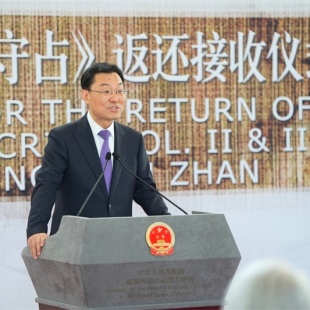
"With more than 900 characters and rich in myth and numerology, the manuscript reflects the depth and endurance of Chinese civilization, having great significance to studying ancient Chinese characters, literature and thinking," Xie Feng, Chinese Ambassador to the US, said at the transfer ceremony at the embassy.
"Their return is a cultural milestone and a testament to China-US cooperation in heritage preservation, bringing new vitality to people-to-people exchange and friendship," Xie said.

The successful return of the manuscript indicated that through dialogue and cooperation based on equality, mutual respect and benefit, the two countries can deliver important and tangible results good for both sides and beyond, he added.
The envoy noted that China and the US have made "notable" progress in heritage cooperation, with around 600 artifacts sent back to China, including more than 40 pieces since the start of this year.
"These returns are vivid examples of friendship and international collaboration to reclaim and protect humanity's shared legacy," he said.
The ceremony began with a video talk by Li Ling, a veteran archaeology professor at Peking University, who has studied the silk manuscript for more than four decades.
Li compared the Zidanku manuscript to China's Dead Sea Scrolls, one of the oldest surviving Hebrew Bible manuscripts.
The scrolls, dating back to 200-100 BC, were discovered five years after the Zidanku manuscript, which dates back to 300 BC.
Just as the Dead Sea Scrolls are crucial for understanding Western and Christian culture, the Zidanku manuscript offers insights into the ancient Chinese world of occultism, according to Li.
Speaking via video, Vice-Minister of Culture and Tourism Rao Quan, also head of the National Cultural Heritage Administration, said the return of Wuxing Ling and Gongshou Zhan fulfilled the long-held wish of the Chinese people to repatriate their "treasures of the country" and respected their cultural rights and national feelings.
Rao said their return would ensure the invaluable artifacts could now be "properly and fully protected and studied under the nourishment of the native soil of the motherland," their heritage value be understood and interpreted more accurately and completely, and they would become the shared academic and civilizational assets for China and the world.
The Smithsonian's National Museum of Asian Art also said the transfer of the unique manuscript is an "important step in international cooperation".
Referring to them as Zidanku Silk Manuscript fragments, the Smithsonian said the transfer strengthened century-old collaborations between the National Museum of Asian Art and Chinese archaeological sites and museums.
"More broadly, this act embodies the museum's commitment to research, access and collaboration," it said in a release.
Also speaking at the transfer ceremony, Chase F. Robinson, the national museum's director, said that since its inception, the museum has partnered with Chinese cultural institutions to share knowledge and expand the study and understanding of Chinese art history.
"This transfer reflects a carefully considered decision, grounded in our focus on sound stewardship and the belief that these materials belong in dialogue with their cultural and archaeological context," Robinson said.
He said the transfer agreement opens up to the museum "new and potentially important" pathways to research, as over the past several months, the museum has had a fruitful dialogue with Chinese partners that can lead to future collaborations.