Luddite futility







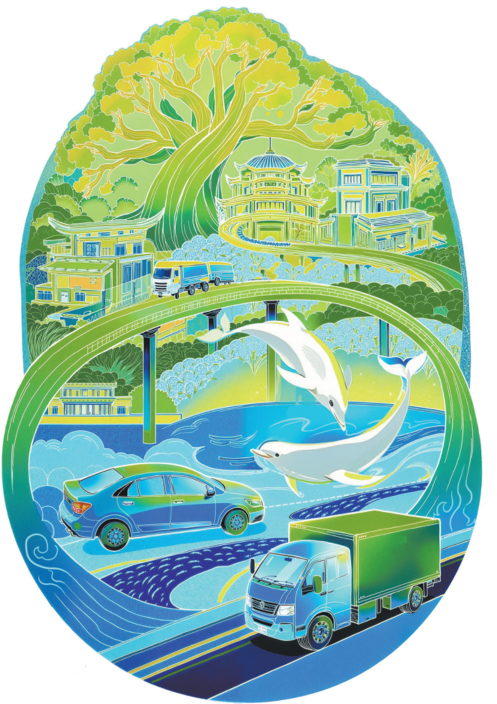
The US cannot halt the transition to clean energy in which China is leading the way
Editor's note: The world has undergone many changes and shocks in recent years. Enhanced dialogue between scholars from China and overseas is needed to build mutual understanding on many problems the world faces. For this purpose, the China Watch Institute of China Daily and the National Institute for Global Strategy, Chinese Academy of Social Sciences, jointly present this special column: The Global Strategic Dialogue, in which experts from China and abroad will offer insightful views, analysis and fresh perspectives on long-term strategic issues of global importance.
Recently, I visited Yadea electric scooter company in Yongchuan, Chongqing. From the wonderful assembly lines, the competent staff makes one brand new electric scooter every few seconds. Yadea is the largest producer of electric scooters in the world. When visiting, two thoughts roamed in my head: first, China is the indispensable nation for the green transformation with an unparalleled industrial ecosystem; second, it is not easy for other countries to compete with China, so China needs to help other nations succeed.
The United States' imposition of tariffs on clean energy products threatens to disrupt the crucial supply chains of affordable green technologies. This is casting a shadow over global green development, especially in the Global South. The US has also terminated $54 billion in overseas aid contracts and disconnected it from global efforts to protect the environment, fight diseases and defeat poverty.
However, despite the immense uncertainty generated by the US, my recent visits to India, China and other nations of the Global South have reinforced my conviction in the resilience of the global green transition and the rapidly emerging potential of South-South cooperation.
In this process, China's role is indispensable. Despite facing increased tariffs, China continues to unwaveringly pursue its climate ambitions. At the recent Leaders Meeting on Climate and the Just Transition co-hosted by United Nations Secretary-General António Guterres and Brazilian President Luiz Inácio Lula da Silva, President Xi Jinping couldn't have been more explicit: "However the world may change, China will not slow down its climate actions, will not reduce its support for international cooperation." Such confidence and determination have driven China to establish the world's largest and fastest-growing renewable energy system. China has contributed approximately one-fourth of the world's newly added green spaces since 2000. Furthermore, China has reaffirmed its commitment to deepening South-South cooperation, pledging continuous and extensive support for other developing countries.
Technological advancement and China's steadfast climate leadership position South-South cooperation as a crucial counterweight to the US' protectionism. At CATL in Ningde, Fujian province, the world's largest electric vehicle battery manufacturer, I witnessed groundbreaking advancements firsthand. Their latest battery can be charged in just five minutes for a driving range exceeding 500 kilometers, maintains 90 percent charge efficiency even at temperatures as low as-40 C, and significantly increases energy density while reducing costs. These are not mere incremental improvements, but a paradigm shift that will substantially accelerate the global adoption of electric vehicles. It makes electric transport the preferred option for the world's poor and rich alike.
In Chandauli district in Eastern Uttar Pradesh, India, I observed a triple-win green success story: reduced pollution, effective climate action and improved rural livelihoods. Solar panels, the cells imported from China and assembled locally in India, are rapidly replacing expensive and highly polluting diesel generators. Owners of small grind mills now pay $180 a month for electricity. The diesel bill was $500. With innovative financing solutions to cover the upfront costs, solar is now by far the cheapest energy for the world's poor nations and peoples. You don't need to be an environmentalist to appreciate the drastic reduced costs of going solar.
However, critical challenges remain. Trade barriers will not only drag down global economic growth but may also complicate the technology transfer.
Transfer of technology doesn't happen at UN conferences or in government meetings. Technology transfer happens when a Chinese electric vehicle manufacturer such as BYD establishes electric car factories in Brazil or Turkiye, or battery storage facility in Saudi Arabia. It happens when CATL invests in Hungary or when Yadea starts an electric scooter factory in Vietnam. China for many decades learned from Volkswagen and BMW, from Tesla and Siemens. We have now entered the era when Chinese companies have more to teach than to learn. More Chinese global investment will benefit both China and the world. Foreign governments should roll out the red carpet. That's the best antidote to tariffs. It will create jobs in the Global South as well as in Europe.
Africa, the continent with most rapidly expanding population, is high on the Chinese agenda and low on the US agenda. The US has cut development aid to Africa and there are plans for US embassy closures. China has implemented zero-tariff treatment for least-developed countries with whom it has established diplomatic relations, while the US has ironically levered high tariffs on some small countries such as Lesotho which can hardly afford to buy anything from the US.
China has implemented numerous clean energy generation and grid projects across Africa, including South Africa's De Aar wind farm, Kenya's Garissa solar power plant and Rwanda's Nyabarongo II hydropower station. These projects serve as landmarks in local clean energy development. They also transfer technology and knowledge through clean energy cooperation.
The US' policies cannot hinder China-Africa cooperation; instead, they inadvertently push Africa closer to China. Some African nations may double up trade ties with China to compensate for their losses from deteriorating relations with the US, which may lead to further South-South cooperation.
Nearly half of China's green energy exports flowed into Global South markets in 2024, reflecting the growing importance of the Global South in China's economic strategy.
Ironically, the US' tariff policy primarily harms the US itself. The International Monetary Fund has recently downgraded the US economic growth forecast by a full percentage point from 2.8 percent growth in 2024, whereas the global average forecast was reduced by only half a percentage point to 2.8 percent for 2025, directly attributing this decline to the administration's protectionist policies. Global trade is not a zero-sum game but a mutually beneficial process for all involved.
The US seems to believe that it can stop the global trend toward green development through political decisions. Actually, that is no longer possible. Solar energy is the cheapest energy everywhere. Even in the US, 66 percent of new energy to the grid last year was solar. Electric cars are far more convenient than gasoline cars.
Trying to stop the Fourth Industrial Revolution of artificial intelligence and renewable energies is following in the footsteps of those in the past who were opposed to the steam machine, the car and train or the internet. Such historical leaders are not treated kindly by historians, they are called Luddites.
How should China respond? China must acknowledge every country aspires to develop its own industries. China should continue investing in other developing nations, with the Belt and Road Initiative serving as a critical vehicle for such investments. Through bilateral technology-sharing mechanisms, China can actively assist these countries in nurturing sustainable local industries, building domestic technological capacity, creating overseas employment opportunities, and embodying the spirit of reciprocity from when China itself benefited from Western experiences.
Ultimately, the path forward must be built on multilateralism and cooperation, not isolation and unilateralism.
The author is vice-president of the Green Belt and Road Coalition and former executive director of the United Nations Environment Programme. The author contributed this article to China Watch, a think tank powered by China Daily. The views do not necessarily reflect those of China Daily.
Contact the editor at editor@chinawatch.cn.