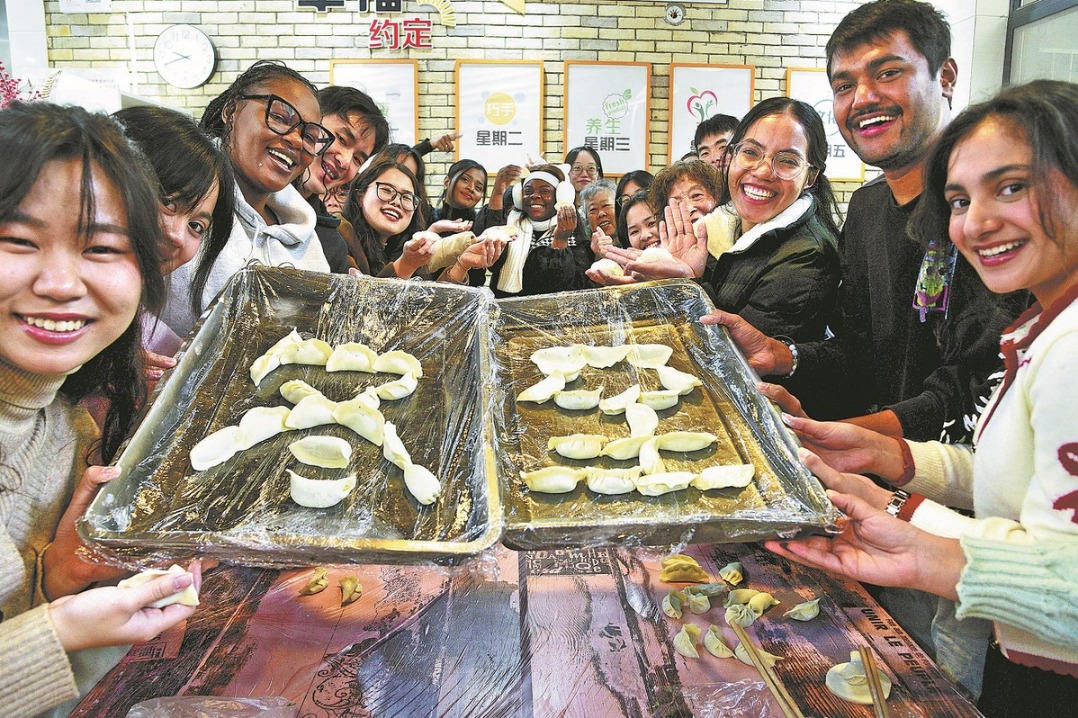
Cooperation program helps boost food output in Africa







A grassroots agricultural education program pioneered by China is helping smallholder farmers in African nations and some other countries improve food production through hands-on science and international collaboration.
Ahead of this year's Youth Day on May 4, the Science and Technology Backyard team from China Agricultural University was awarded the China Youth May Fourth Medal, the nation's top honor for Chinese young people ages 14 to 40.
Established in 2009 in Quzhou county, Hebei province, the team has been stepping up efforts to bring scientific knowledge directly to agricultural fields and find practical solutions for farmers, with results now spreading overseas through the university's Sino-African STB project, which was launched in 2019.
The project has allowed African students to enhance their knowledge and practical skills in modern agricultural practices in China and implement back home what they learned.
For over a decade, the university has been operating its science and technology backyard program, sending postgraduate students specializing in agriculture to rural areas to help farmers solve problems.
Ahead of Youth Day in 2023, President Xi Jinping wrote a reply letter to the students at the university.
In the letter, Xi expressed the hope that the students can closely integrate textbook knowledge with practices in rural areas and devote their youth and strength to speeding up rural and agricultural modernization.
Jiao Xiaoqiang, who is in charge of the project, said that African students spend the first year in China, studying theories in the classroom and practicing core crop techniques in the field. They spend the second year in their home countries, conducting experiments and demonstrations. After that, they return to China to complete their theses based on their experiences in both countries.
"The training mode is adaptable in African countries because, like China, their agriculture also relies on smallholder farmers," said Jiao, who is also an associate professor at China Agricultural University's College of Resources and Environmental Sciences.
So far, over 90 students from 13 African countries have joined the program, and nearly 40 have graduated. Many have returned home to establish programs that are based on the Quzhou model, bringing new techniques to smallholder farmers and dramatically boosting corn yields, Jiao said.
Francina Lerato Kuwali, a former agricultural extension officer in Malawi, joined the program in 2023. After training in Quzhou on soil nutrient management, greenhouse cultivation and machinery use, she returned to Malawi to teach farmers how to improve crop yields and test maize and soybean intercropping.
"In northern Malawi, we face challenges of poor soil quality and pest infestation," she said, adding that local farmers also have limited agricultural resources such as fertilizers.
At the Mzuzu science and technology backyard that she established in her home country, Kuwali introduced fertilizer optimization she learned in China and trained farmers in vermicomposting, a composting process that greatly improves the efficiency of fertilization.
Some of the 30 farmers involved in her backyard program increased their maize yields from 2 to 8 metric tons per hectare, and their incomes tripled, she said.
"Because of the bumper harvest, more farmers became interested in the technology. ... It is very good for smallholder farmers in my country, as it helped them achieve high yields and improve their livelihood," she added.
Chileleko Madubeko, an agroforestry student from Zambia who has spent three months in Quzhou, said that when he returns home, he hopes to introduce affordable drones and tractors to help Zambian farmers increase agricultural efficiency.
So far, China has built 14 overseas science and technology backyards, including eight in Africa and others in Brazil, Thailand, Cambodia, Belarus and Kyrgyzstan.
Jiao said the university plans to launch its first science and technology backyard in Kenya later this year, as three Kenyan students currently studying in Quzhou will return to their home country in October.
"We want to help raise local maize yields to 8 tons per hectare, and promote regional growth through farmer-to-farmer training and digital outreach," he added.



- International mayors gather in Harbin to explore ice and snow economy
- Understand China in the new era: What Chinese modernization means for the world
- In pics: skyline in morning glow in Beijing
- Two more listed as diehard 'Taiwan independence' separatists
- China's postal delivery volume hits 216.5b items in 2025
- Pilot missing after suspected ejection from jet during training mission in Taiwan