



Technical challenges persist despite mounting enthusiasm, progress







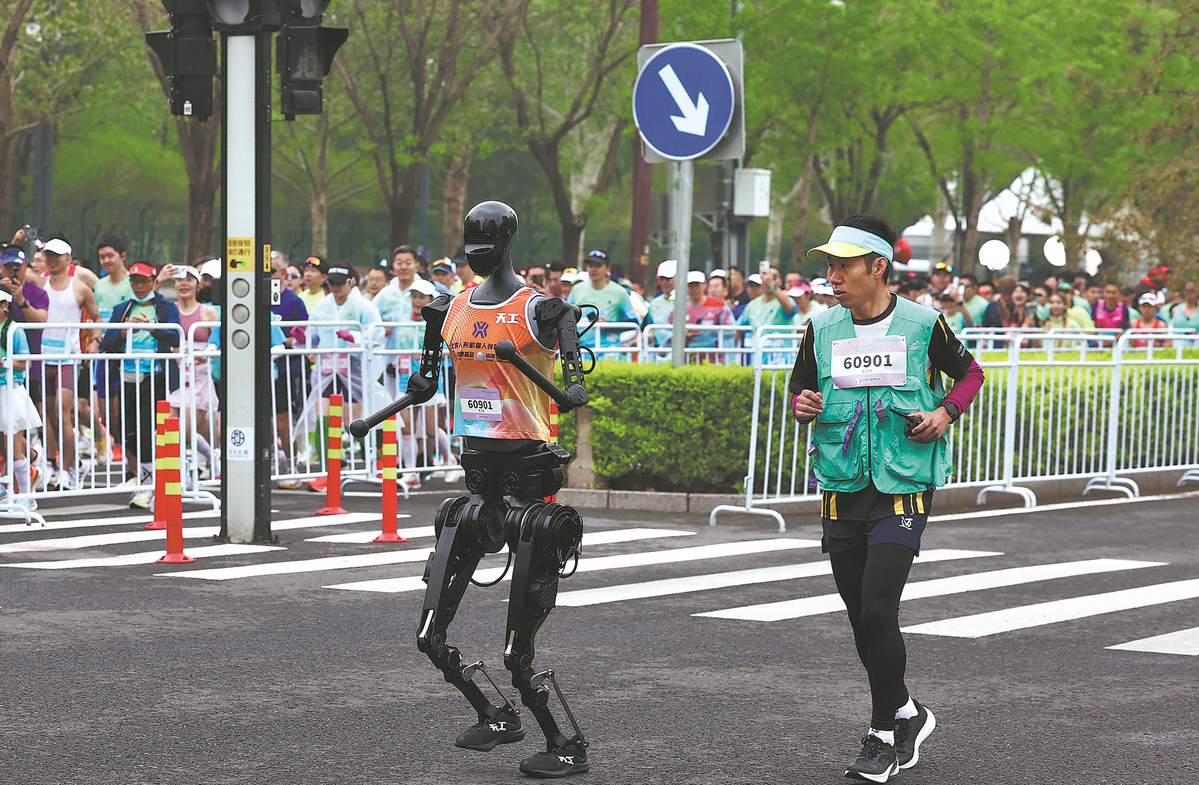
On April 19, Beijing made history by hosting the world's first humanoid robot half-marathon. Twenty teams from universities, research institutions and tech firms raced 21 kilometers alongside human runners, showcasing robots like the towering 1.8-meter "Tiangong Ultra" and the nimble 82-centimeter "Xiaohai".
Liang Liang, deputy director of the management committee of the Beijing Economic-Technological Development Area, one of the organizers of the race, said that while humanoid robots were previously tested in controlled environments like laboratories under fixed conditions, this marathon served as a systematic evaluation of their adaptability to complex real-world scenarios.
"Through this stress test, public attention has focused on how such robots could achieve the technological leap from short-distance mobility to marathon-level endurance," Liang said.
In the marathon, which tested the physical limits of even some human runners, six of the 20 robots managed to finish the race. Tiangong Ultra, standing 1.8 meters tall and weighing 55 kilograms, won the humanoid's race with a time of 2 hours, 40 minutes and 42 seconds.
Beyond marathons, humanoid robots are entering factories, academia, research and specialized industries in China. For example, a powerline inspection robot developed by China Southern Power Grid's Guangdong branch can withstand temperatures as low as — 40 C and as high as 80 C. It has already been deployed to pinpoint faults in remote mountainous areas.
Investment in robotics firms is also surging in China. According to itjuzi.com, a data service provider tracking venture capital and emerging technologies, over 50 companies in the embodied AI sector raised more than 6 billion yuan ($970 million) in the first three months of this year.
Well aware of the opportunities, Chinese tech heavyweights, automakers and startups are all jumping onto the bandwagon for both short-term goals and long-term strategic visions.
Since the beginning of this year, humanoid robots have become the hottest trend in the automotive industry. For instance, as least 15 Chinese automakers including GAC, SAIC, XPeng, Chery and Xiaomi, along with supply chain companies like Huawei, Horizon Robotics and Hesai Technology have entered the humanoid robot race.
Overseas, six automakers including Tesla, BMW, Mercedes-Benz, Honda, Toyota and Hyundai have also proposed their own humanoid robot concepts.
Despite the mounting enthusiasm and technological progress, experts warn that technical challenges still persist, and it will be years away for humanoids to enter households.
He Xiaopeng, chairman and CEO of Chinese automaker Xpeng Motors, said he recently had a discussion with Wang Xingxing, founder of Unitree Robotics, and Zhou Jian, founder of UBTech Robotics. The three reached a consensus that current humanoid robot technology approximates level 2 autonomy or assisted autonomy, while the industry hopes to achieve commercially viable level 3 autonomy, or conditional automation.
He said the leap from level 2 to level 3 in humanoid robots requires exponentially greater capabilities, and humanoid robots need to reach level 4 autonomy before truly entering households.
While autonomous vehicles are considered wheeled robots, humanoid robots face fundamentally greater challenges in perception, decision-making, motion control and hardware across more complex, unpredictable scenarios, experts added.
Hopefully, the progress of large language models such as DeepSeek is injecting new vitality into the sector. US market research company International Data Corp predicted that large language models are key drivers and can help better develop the "brain" of humanoid robots, enhancing perception and enabling autonomous learning and decision-making while improving motion generalization through behavioral interaction training.




















