Inner Mongolia leads way in green computing, data storage
Region fast becoming magnet for major players in high-tech sectors







Beneath the vast skies of North China's Inner Mongolia autonomous region, a powerful wave of digital transformation measured in bytes and flops is taking shape.
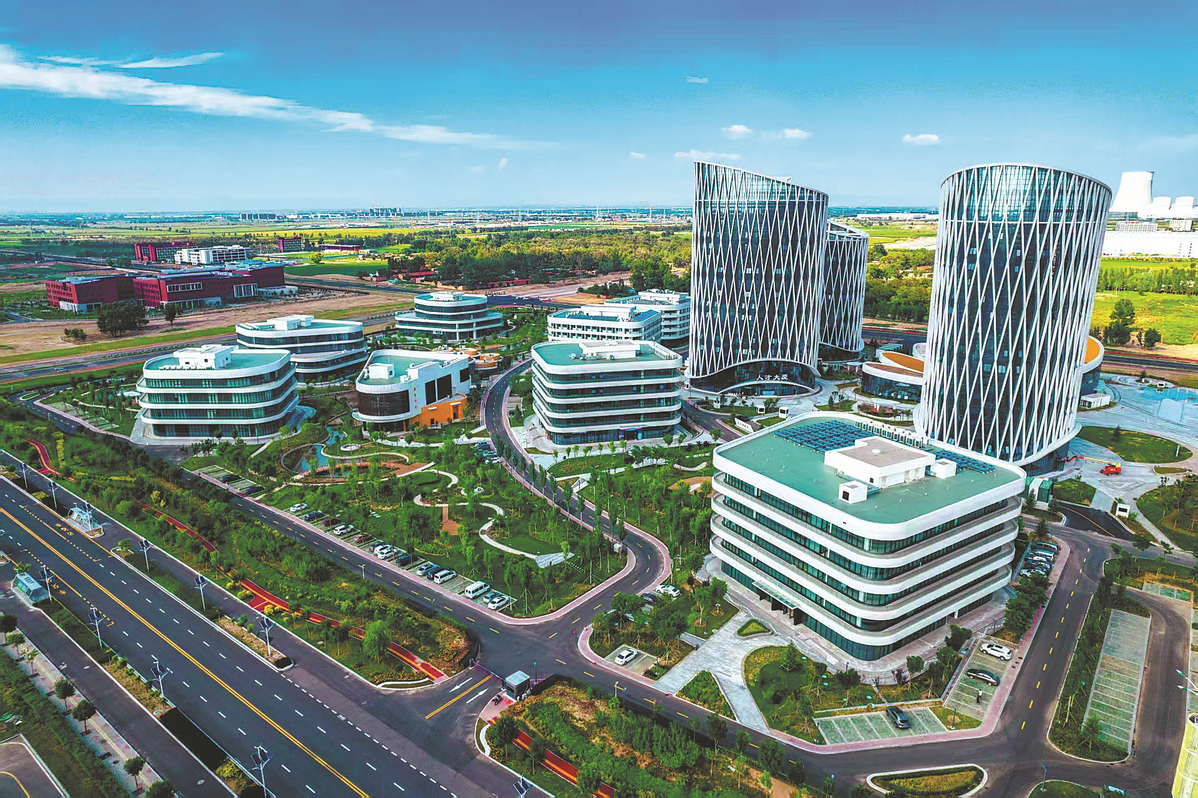
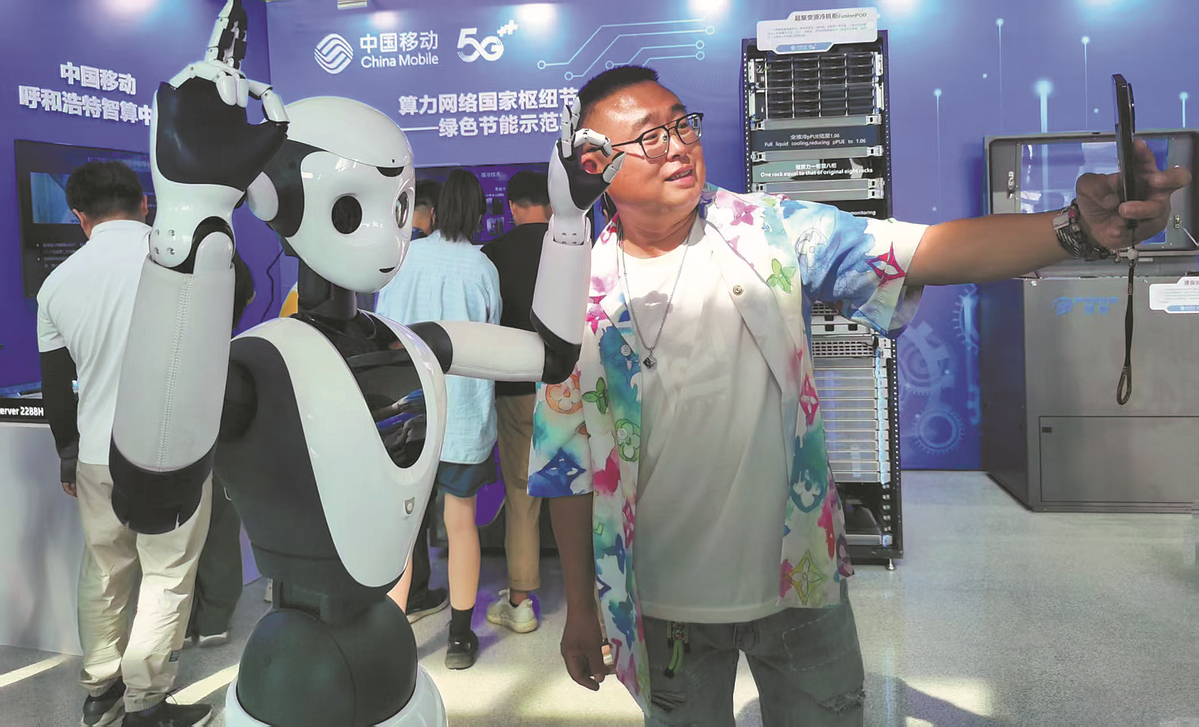
Inside the China Mobile (Hohhot) intelligent computing center in Horinger New Area, Hohhot, the hum of high-performance servers fills the air. With a peak computing capacity of 6,700 petaflops, it is the world's largest single-unit intelligent computing center operated by a telecom provider.
Petaflop is a measurement unit used to determine computing speed. A petaflop is 1 quadrillion calculations per second.
Designed to aid the training of artificial intelligence models and big data analytics, the center is poised to support the nation's computing needs from sectors such as transportation, healthcare, education, energy and finance, said China Mobile.
As China's digital economy accelerates, Inner Mongolia is racing ahead on the digital frontier, emerging as a powerhouse of green computing and data storage.
For example, as part of the nation's data center cluster, Horinger is fast becoming a magnet for major players in the computing industry.
According to Horinger's administrative committee, projects from China Mobile, China Telecom, the China Meteorological Administration, Huawei Cloud and others have all taken root in the area, and by the end of 2025, its total computing power is expected to reach 100,000 petaflops, shaping a globally competitive "valley of computing".
Further west in Ulaanqab, over 50 data centers from companies such as Alibaba, Kuaishou and UCloud are operating with network latency under five milliseconds, seamlessly serving AI needs in Beijing and beyond. The city's computing infrastructure supports both real-time demand in the Beijing-Tianjin-Hebei region and non-real-time services across the Yangtze River Delta and the Greater Bay Area.
As of early this year, Ulaanqab had established 56 data centers with a combined computing power of 68,000 petaflops. By the end of 2025, the figure is expected to reach 120,000 petaflops, said Guo Xiaoling, head of Ulaanqab's big data administration.
In the digital age, computing power has emerged as a production factor. An IDC white paper showed that on average, for every one-point increase in the computing index of a country, the national digital economy and GDP will increase by 0.35 percent and 0.18 percent, respectively.
"The goal is to establish Inner Mongolia as a key national hub for data circulation and trade, as well as a frontier for data-driven development in northern regions," said Zhang Lei, an official from the autonomous region's data management bureau.
Zhang added that the foundation of computing power is largely backed by electricity supply, wherein lies the region's greatest advantage.
Blessed with abundant wind and solar energy — accounting for over half of the nation's wind resources and more than 20 percent of solar potential — Inner Mongolia has the country's lowest electricity rates and rather stable access to renewable energy.
At another intelligent computing center in Horinger, that began operations in September 2023, 672 racks support 20,000 petaflops of computing power.
"With an average annual temperature of 7 C, electricity priced at just 0.32 yuan (4.4 cents) per kilowatt-hour and 80 percent of our power sourced from renewables, our operational costs are two-thirds lower than similar centers in Beijing," said Bai Yang, general manager of Inner Mongolia Zhongke Supercomputing Technology Co, which runs the facility.
According to data from Hohhot's big data administration, over 80 percent of the city's data center is powered by green energy, the highest ratio nationwide.
Ulaanqab is following a similar path. In its high-tech development zone, China Datang Corp is constructing a data center in three phases which will eventually house 6,400 racks offering 6,000 petaflops — equivalent to 10 million high-performance computers.
Once completed, the data center will operate entirely on renewable energy, which is expected to save 15,000 metric tons of standard coal and reduce carbon emissions by 40,000 tons annually, equivalent to the amount of carbon absorbed by 2 million trees, according to local media reports.
As one of eight national computing hubs under China's "eastern data, western computing" initiative, Inner Mongolia's green computing capacity reached 94,000 petaflops in 2024, with over 80 percent of energy supporting its data centers drawn from renewables, according to local government data.
In addition, the continued rollout of favorable policies is injecting strong momentum into the rise of its computing sector. On April 14, two regional standards — one for evaluating storage capacity and another for computing power — were officially implemented, providing the industry with a much-needed benchmark system.
Specifically, the storage capacity classification standard offers an in-depth analysis of a data center's storage capabilities, evaluating dimensions such as total capacity, performance efficiency, security levels and energy usage. Meanwhile, the computing power classification standard provides a scientific grading system, grounded in key metrics such as general-purpose computing, intelligent computing and respective performance efficiencies.
"The standards allow users to accurately match their needs for computing and storage capacity with the right service providers, and enable companies to make targeted improvements, avoiding blind or mismatched choices," said Shi Yanlong, an official at Inner Mongolia's big data center.
In February 2022, China officially began construction of eight national computing power hubs. With the rise of large-scale AI models, regions across the country are now entering the 2.0 phase, establishing super-large-scale intelligent computing centers.
The key distinction between intelligent computing centers and regular computing centers lies in their focus — the former is dedicated to AI-driven training and inference tasks, while the latter typically handles broader computational tasks.
For example, the first phase of the large-scale intelligent computing cluster deployed in Zhengzhou, Henan province, recently became operational. Once fully completed, the center will exceed 100,000 petaflops in computing power, the largest of its kind in Central China.
Similarly, an intelligent computing center project in Huizhou, Guangdong province, officially broke ground at the end of last year, with plans for completion by 2026. It is expected to be the first super-large-scale intelligent computing center in the Guangdong-Hong Kong-Macao Greater Bay Area.
In addition, earlier this year, Beijing's Yizhuang AI public computing platform, the city's largest intelligent computing center, announced an expansion to upgrade its computing power to 5,000 petaflops, and plans to further expand to the 10,000-petaflop scale within this year.
According to a report by the IDC in February, China's intelligent computing power reached 725.3 exaflops by 2024, a year-on-year growth of 74.1 percent, more than three times the growth of general computing power (20.6 percent).
The IDC expects that by 2025, China's intelligent computing power will reach 1,037.3 exaflops, with a market size of $25.9 billion.