



Power points







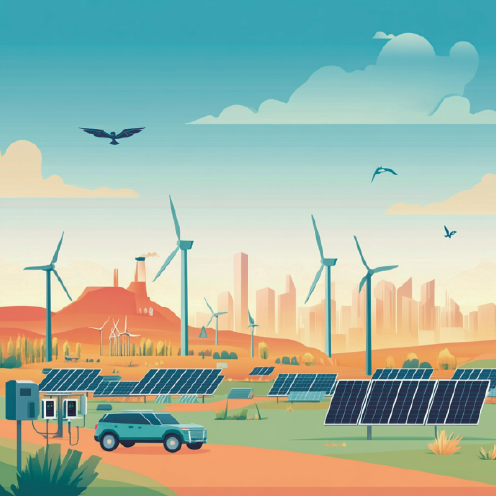
China's innovation, industrial scale and capital are vital for the energy transition of the Global South
As the climate clock ticks, the Global South stands at a critical juncture: how to achieve sustainable development without repeating the high-carbon path that fueled industrialization in the North. For Africa, South Asia, and other Southern regions, the challenge is not only to expand energy access but to do so equitably, without exacerbating environmental degradation or social inequality. In this unfolding energy transition, China's growing leadership in renewable energy and green infrastructure presents both opportunity and responsibility. Its investments and technology exports are increasingly shaping the energy future of the Global South.
Over the past two decades, China has emerged as a dominant force in the global renewable energy landscape. It is the world's largest producer, exporter and installer of solar panels, wind turbines and batteries. In 2023 alone, China accounted for over 60 percent of global solar photovoltaic (PV) manufacturing output and over 70 percent of global battery production. It has also become a major financier and builder of green infrastructure projects in Asia, Africa and Latin America through platforms such as the Belt and Road Initiative and the South-South Cooperation Assistance Fund.
In Africa, Chinese companies have played a significant role in expanding access to solar energy in rural communities, where traditional grid expansion remains cost-prohibitive. From solar mini-grids in Kenya and Nigeria to hydropower and wind energy projects in Ethiopia and South Africa, China's presence is reshaping the continent's energy mix. The Garissa Solar Plant in Kenya, built by China Jiangxi International Economic and Technical Cooperation Co Ltd, is among the largest solar plants in East Africa and has been instrumental in improving grid stability. Similarly, in South and Southeast Asia, Chinese investment has helped countries such as Pakistan, Bangladesh and Vietnam develop large-scale solar and wind installations that contribute to energy diversification and resilience. The Quaid-e-Azam Solar Park in Pakistan, one of the largest in Asia, was constructed with Chinese financing and expertise and now contributes significantly to the country's power grid.
Yet the significance of China's role extends beyond hardware and finance. It is also influencing the structure of global energy governance. As Western investors and multilateral institutions often hesitate to back large-scale projects in fragile or low-income states due to risk or debt concerns, China is filling the gap — albeit with its own strategic calculus. By offering concessional loans, blended finance and turnkey engineering solutions, China enables countries in the Global South to leapfrog into renewable energy without relying on fossil-intensive pathways. In doing so, it offers a model of development that sidesteps the fossil fuel dependency that once characterized industrial growth in the West, aligning more closely with climate imperatives outlined in the Paris Agreement.
However, for this partnership to support a truly just energy transition, several conditions must be met.
First, Chinese-financed renewable energy projects should be embedded in local development plans that prioritize job creation, technology transfer and environmental safeguards. A just transition requires more than decarbonization — it demands economic inclusion and empowerment. Joint ventures, skills training and local manufacturing of green technologies must become integral to China's energy engagements. Encouragingly, there are examples of progress: Chinese solar companies have partnered with local manufacturers in Egypt's Benban Solar Park to produce solar panels domestically, while in Ethiopia, the Aysha Wind Farm project included provisions for training local engineers. These models must be replicated and scaled to ensure broad-based benefits and sustainable ownership.
Second, transparency and debt sustainability are critical. While many African and Asian governments welcome Chinese finance for energy infrastructure, concerns remain about opaque loan terms and debt distress. A just transition cannot be built on an unsustainable financial foundation. Instruments such as the G20 Common Framework for Debt Treatments could serve as a platform for constructive dialogue. Furthermore, building capacity in host governments to conduct robust cost-benefit analyses and environmental impact assessments is vital to ensure projects are not only viable but also socially and environmentally responsible.
Third, China's leadership in critical supply chains — particularly in solar panels and battery storage, could play a transformative role in democratizing access to green technologies. Currently, developing countries face barriers in accessing affordable and high-quality renewable energy components due to supply chain bottlenecks and trade restrictions. By expanding South-South technology partnerships, licensing agreements, and knowledge exchanges, China can help the Global South reduce its dependency on Northern technology monopolies and diversify the sources of clean energy innovation. China's establishment of renewable energy training centers and innovation hubs across Southeast Asia and sub-Saharan Africa could accelerate the diffusion of clean technologies, support regional manufacturing bases, and create ecosystems of innovation that are adapted to local conditions and climate risks.
Importantly, China's recent shift toward greening the Belt and Road — through initiatives such as the BRI International Green Development Coalition and its 2021 pledge to stop building new coal plants abroad — signals a positive turn. But implementation remains uneven. Some countries still see a mix of fossil and renewable investments, and many struggle to ensure environmental compliance. A just energy transition must be consistent and comprehensive. It cannot afford to be undermined by contradictory practices. Monitoring and accountability mechanisms — jointly developed with host countries and civil society actors — can ensure that green commitments are translated into practice. Strengthening environmental and social impact assessments and enhancing public participation in project design are essential steps toward greater legitimacy and trust in Chinese-supported green infrastructure.
As the world looks toward COP30 and other global climate milestones, the role of China in shaping a fair, inclusive and sustainable energy transition in the Global South will continue to grow. African and Asian countries, together with China, should strengthen collaborative efforts to co-design energy projects that align with local development priorities and global climate commitments. At the same time, international financial institutions and Western donors should recognize and complement these efforts, rather than compete or isolate. There is an urgent need to move from fragmented initiatives to coordinated and synergistic action — where Chinese, Western and multilateral actors work together to close the global energy access gap and support climate justice.
China's capabilities in renewable energy — its innovation, industrial scale and capital — can be transformative for the Global South. The future of global energy security depends not just on reducing carbon emissions, but on building systems that are resilient, inclusive and shared. In this, China has both the tools — and the responsibility — to lead.
The author is a visiting senior fellow at Firoz Lalji Institute for Africa at the London School of Economics and Political Science, a senior fellow at the African Center for Economic Transformation, deputy executive director of the Global South-North Center and a visiting associate professor at the Wits School of Governance at University of Witwatersrand. The author contributed this article to China Watch, a think tank powered by China Daily. The views do not necessarily reflect those of China Daily.
Contact the editor at editor@chinawatch.cn.





