



US-centric economic structure not sustainable







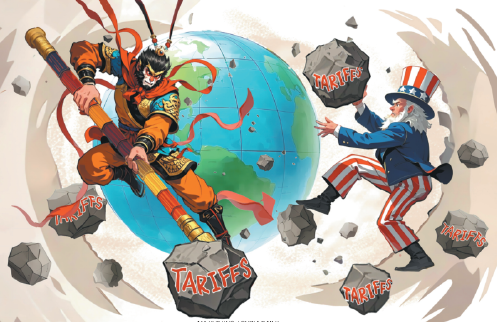
The tariff shock will serve as a catalyst that will shift the global economy's unipolar order to a multipolar one while giving rise to more diversified markets
On April 2, the US government imposed baseline 10 percent "reciprocal tariffs" on all imported goods and significantly higher rates on certain trading partners, sending shock waves through global markets. Five days later, the administration paused the new tariffs on almost all countries for 90 days, but raised the levies on China to 125 percent. When China announced retaliatory measures, the United States further increased duties on China to an absurd 145 percent. In response, Beijing raised its retaliatory tariffs to 125 percent and vowed to "fight to the end". On April 16, the US tariffs on goods imported from China was raised to 245 percent.
China's firm stance to fight the bullying tariffs imposed by the US while keeping the door open for dialogue on an equal footing is not only necessary to safeguard its own interests, but also key to preserving the global free trade system and promoting a more balanced global economic order.
The China-US trade war during Donald Trump's first term was a one-on-one trade war between the two countries, while it has now escalated into a global tariff war waged by the US against the rest of the world. For instance, the US has imposed a 46 percent tariff on Vietnam and 36 percent tariff on Thailand. While China has accumulated a wealth of experience from the first Trump administration's of trade war, the rest of the world is ill-prepared.
China's resolute countermeasures send a clear message to the world that appeasement will not work in the face of the US' moves to undermine World Trade Organization-centered international trade order, and bolster global confidence in free trade.
In the face of the US' damaging tariff war that erodes the very foundation of the WTO system, caving in to US pressure will only embolden the US government to continue its bullying. Therefore, China's commitment to upholding free trade and opposing unilateralism is of immense significance for the world.
China is fully capable of withstanding tariff shocks. Over the past more than one decade, growing domestic demand and the diversification of overseas markets have reduced its reliance on the US market. The share of China-US trade in China's total foreign trade has seen a steady decline. The Association of Southeast Asian Nations has become China's largest trading partner, accounting for 15.9 percent of China's total foreign trade. China-Malaysia bilateral trade alone exceeds $200 billion, nearly double the volume of China-United Kingdom trade. Moreover, China has joined the Regional Comprehensive Economic Partnership and upgraded the ASEAN-China Free Trade Area.
Since the 2008 financial crisis, China has been reforming its economic development paradigm. Its efforts to develop new quality productive forces, represented by the electric vehicle industry, have enhanced the resilience and competitiveness of the Chinese economy.
The US' tariff war will accelerate the restructuring of the Asian economy, strengthening the region's economic autonomy and resilience. During Trump's first term, the administration's focus was on containing China, forcing many multinational companies to circumvent tariffs by moving production from China to ASEAN and other developing countries.
However, the current universal tariffs make such circumvention tactics futile, forcing other countries to reconsider whether it is viable to continue relying on the US market. As a result, supply chains will be restructured, regional cooperation outside the US will be strengthened, and the global economic structure dependent on the US will experience a major shift.
The US has been urging other countries to invest in the country to support its reindustrialization strategy and reduce the trade deficit. But in reality, the risks of investing in the US are growing due to rising protectionism. It's not that Chinese companies don't want to invest in the US. It's that the US does not seem to welcome Chinese investment. In fact, even for US allies, uncertainty about investing in the US is increasing. For instance, the US has blocked Nippon Steel's takeover of US Steel on national security grounds.
Trade protectionism and state intervention have significantly increased investment risks in the US market. Take the auto industry as an example. In the past, many multinational companies benefited from the zero-tariff policy of the former North American Free Trade Agreement, with various auto parts crossing borders multiple times among the US, Canada and Mexico for production and reprocessing before final assembly. If the US demands that automobile production be completed entirely within its borders, it would require massive capital investment, leaving companies with no choice but to vote with their feet. This signals a fundamental shift in the US' economic relations with other countries.
China-US trade negotiations must be conducted through equal dialogue, not deals or appeasement. The US dares to wage a tariff war against the rest of the world precisely because of its deep-seated confidence, or perhaps overconfidence, in the world's dependence on the US market.
While most countries claim to champion a free trade system, many small and medium-sized nations are worried that if great powers make deals, their interests might be sacrificed. This is why China, the world's second-largest economy, takes a firm stance in defending the WTO-centered multilateral trading system.
Countries will wake up to the fact that a US-centric economic structure is not sustainable. The global economy will shift from a unipolar order to a multipolar one with more diversified markets. The US' tariff shock will serve as a catalyst for this historic transformation.
The author is a professor at the School of International Studies at Nanjing University. The author contributed this article to China Watch, a think tank powered by China Daily.
Contact the editor at editor@chinawatch.cn.





