For centuries, palm-leaf scriptures, known as beiyejing in Mandarin, have passed down the wisdom and philosophy of Tibetan Buddhism from one generation to the next.
These sutras in the written word or engraved form on pattra leaves, compose a precious legacy that are housed in the Potala Palace in Lhasa, capital of the Xizang autonomous region. According to the Protection Research Center of the Palm-Leaf-Scriptures of Potala Palace, the content of the palm-leaf works mainly consist of Buddhist scriptures.
The precious ancient literature is also among the top-class protected cultural relics in China that currently has the largest existing collection of palm-leaf manuscripts in the world.
According to Pema Dekyi, an ancient manuscript restoration specialist at the Potala Palace, since the 7th century AD, high-ranking Tibetan monks and translators traveled to places including India, Nepal and the Gandhara region to study Buddhist scriptures and brought back a considerable number of beiyejing. Meanwhile, eminent monks from India, Sri Lanka and Nepal came to present-day Xizang to spread Buddhism, bringing a certain number of beiyejing, thus making Xizang the most concentrated place in the world for the collection.
The Potala Palace houses 465 volumes of beiyejing (nearly 30,000 leaves), accounting for more than half of the total collection of type in Xizang. Beiyejing in the Potala Palace collection dates mostly from the 7th century to around the 13th century. The content of the scriptures mainly includes Buddhist scriptures from various historical periods, as well as documents on dramas, epics, stories, medicine, astronomy, astrology, and divination, among other subjects.
"They have high historical, scientific, and cultural value," Pema Dekyi says.
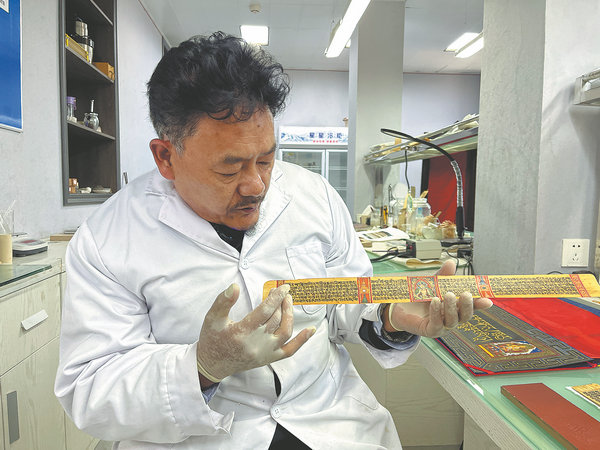
The Potala Palace Management Office created an experimental restoration team for palm-leaf manuscripts in 2019, and its main purpose is to overcome the difficulties of restoration.
Pema Dekyi says that the common problems of the ancient palm-leaf scripture include fiber delamination, warping and wrinkles.
"There are also some incomplete fractures in its blank areas, as well as some minor contamination, therefore, the leaf's disease is complex, and it is not a single problem, so during our repair work, the problems need to be analyzed on a case-by-case basis," Pema Dekyi says. "We have to assess the severity of each disease and select the appropriate repair method. While repairing, we are also exploring and learning."
The goal is to restore them in their original forms with minimal intervention, she adds.
Tsering Wangdu, another Tibetan ancient text restoration specialist at the center, says they use three common repair methods. First, imitating the production method of Tibetan paper, they grind the palm-leaves. Then they grind the paper into a powder to fill the missing parts. Finally, they grind the paper into a thin sheet, soak it in water and use it for patching.
"We've tried several traditional sutra styles on the new Tibetan paper and also attempted to replicate them in the form of photographs," says Tsering Wangdu.
"We can't read these characters on the palm-leaf scriptures because they are extremely ancient, even those who can read and write wouldn't be able to understand," he says.
At present, there is no technology or experience in the world to draw upon for palm-leaf restoration, according to the restoration team. That's why the Potala Palace set up this experimental group. The group has been carrying out experiments for years.