Astronomers' dark energy breakthrough sheds new light on cosmic accelerated expansion







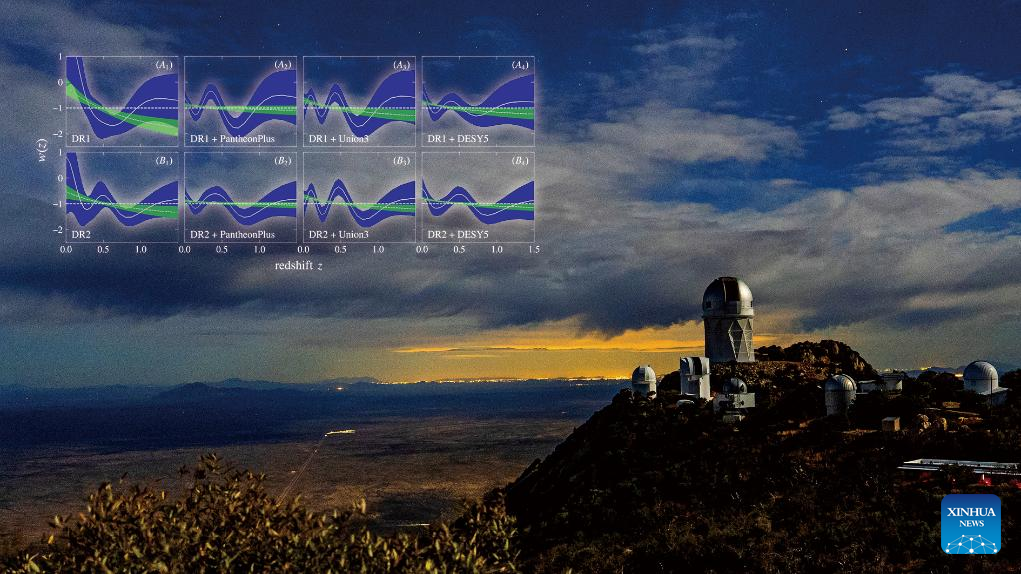
BEIJING -- Chinese and foreign astronomers have achieved a breakthrough in dark energy research, offering fresh insights into the physical mechanisms behind the accelerated expansion of the universe.
The findings, announced by the National Astronomical Observatories of the Chinese Academy of Sciences (NAOC) on Wednesday, suggest potential new physics beyond the standard cosmological model.
Dark energy remains one of the most profound mysteries in modern physics. Since the discovery of accelerated cosmic expansion in the late 1990s, scientists have attributed this phenomenon to an enigmatic cosmic component called dark energy. Yet its true nature remains a mystery.
Scientists have mapped the cosmic composition through studies on cosmic microwave background radiation, supernova explosions, gravitational waves, and baryon acoustic oscillations. Ordinary matter accounts for only about 5 percent of the universe, while the rest is unknown dark matter (27 percent) and dark energy (68 percent), said Zhao Gongbo, deputy director of the NAOC.
Dark energy is a broad concept that could represent either a tangible energy component or an unknown physical mechanism. "While we cannot yet explain its fundamental essence, we have identified certain properties -- such as pressure and density -- which produce observable effects. These effects allow us to constrain its proportion and behavior," Zhao noted.
The standard cosmological model interprets dark energy as a static vacuum energy. While successfully explaining a large number of cosmological observations for over two decades, recent advancements in observational precision have exposed inconsistencies among different datasets under this framework, challenging its completeness and opening avenues for alternative theories.
Leading this quest is the Dark Energy Spectroscopic Instrument (DESI), a global collaboration that maps the universe's 3D large-scale structure by measuring redshifts of tens of millions of celestial objects utilizing a 4-meter optical telescope.
The Galaxy Survey and Cosmology Group at NAOC, led by Zhao, and the Wide-field Survey and Galaxy Physics Group at NAOC, led by Zou Hu, have been involved in the DESI project for over a decade.
In the latest study, Zhao's team, leading the DESI collaboration, has achieved significant breakthroughs in the dynamical properties of dark energy.
By employing a novel methodology independently developed by the researchers, the team conducted an in-depth analysis of the latest cosmological distance measurements from DESI observations, combined with data from supernovae and cosmic microwave background radiation. Their findings revealed that the equation of state for dark energy changes as the universe evolves.
This result confirms the previous conclusion of the DESI collaboration derived through distinct analytical approaches, that dark energy is likely to have dynamic properties. The conclusion implies that dark energy may not be a constant vacuum energy, but rather exhibits more complex evolutionary behavior.
The study not only pioneers new research pathways for unraveling the physical essence of dark energy but also provides pivotal clues for constructing a more comprehensive theoretical framework in cosmology.
This represents a landmark breakthrough for astronomy, Chang Jin, an academician of the Chinese Academy of Sciences and president of the University of Science and Technology of China, emphasized the significance of the findings. It signals that dark energy research has entered a new phase, with significant potential for advancements in both observational techniques and theoretical frameworks, he added.
The research team developed novel analysis methods for dark energy in the study. By integrating DESI's latest measurements with supernova and cosmic microwave background radiation data, researchers achieved mutual corroboration across multiple observations, significantly enhancing the reliability of the analysis and conclusions, Zhao said.
Dragan Huterer, professor of physics at the University of Michigan and a member of the DESI collaboration, hailed the research as "an important stepping stone in our understanding of dark energy."
Zhao stated that his research team will continue conducting refined analyses using the complete observational data from DESI. Collaborating with international peers, they aim to perform more comprehensive and rigorous examinations of dark energy's dynamical properties through high-precision measurements and enhanced theoretical models.
The NAOC also pledged to strengthen partnerships with leading global astronomical institutions, actively promote the application of emerging technologies like big data and deep learning in astronomical research, and accelerate the development of next-generation observational platforms and core instruments.
DESI is an international project with more than 900 researchers from over 70 institutions around the world and is managed by the US Department of Energy's Lawrence Berkeley National Laboratory (Berkeley Lab).
DESI is supported by the DOE Office of Science and by the National Energy Research Scientific Computing Center, a DOE Office of Science national user facility. Additional support for DESI is provided by the US National Science Foundation; the Science and Technology Facilities Council of the United Kingdom; the Gordon and Betty Moore Foundation; the Heising-Simons Foundation; the French Alternative Energies and Atomic Energy Commission (CEA); the National Council of Humanities, Sciences, and Technologies of Mexico; the Ministry of Science and Innovation of Spain; and by the DESI member institutions.
The DESI collaboration is honored to be permitted to conduct scientific research on I'oligam Du'ag (Kitt Peak), a mountain with particular significance to the Tohono O'odham Nation.






- Island county in Zhejiang guarantees high school for all students
- Telecom fraud losses fall in Beijing as police step up crackdown
- Chinese researchers develop capsule-sized self-powered micro pacemaker
- NW China's Gansu hit by 5.5-magnitude quake, no casualties reported
- Chinese research report draws roadmap for development of high-temperature superconducting materials
- Direct high-speed trains now connect Beijing with Xiong'an