



Leading the tech revolution







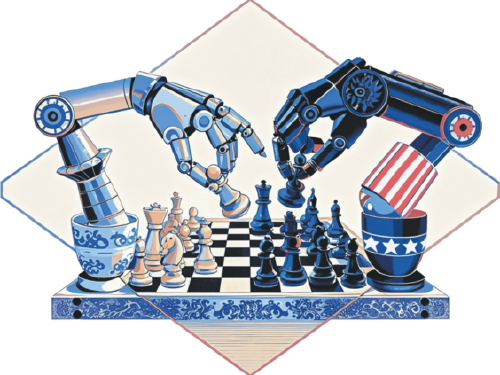
Beijing can play an active role in global tech governance and champion a fair, open and sustainable international cooperation framework
China's rapid rise has intensified the relative decline of US hegemony. During the fourth industrial revolution, technology has become a critical factor in the global balance of power. Ever since Washington reinitiated its strategic competition with Beijing in 2017, technology has emerged as the frontline of confrontation. The United States has shifted its tech policy toward China from limited engagement to outright suppression, steadily escalating toward what increasingly resembles a full-fledged tech war. The US' tech war with China stems from both the shifting balance of power in the world order and the accelerating role of technology in reshaping that balance. As the fourth industrial revolution advances at breakneck speed, Washington's tech war against Beijing is taking on new characteristics.
First, the scope of technological competition has expanded beyond cutting-edge technologies to encompass applied research and development. Both the first Donald Trump administration and the Joe Biden administration outlined their strategic priorities through the National Standards Strategy for Critical and Emerging Technology.
Initially proposed in 2020 in Trump's first term, this strategy identified key technologies deemed essential to US military, intelligence and economic security. The list was updated in 2022 and again in 2024, refining Washington's focus on technologies closely tied to China's rapid advancements. On the one hand, the US has adopted a broad competitive framework, prioritizing high-level technologies while reinforcing its position in mid-level and foundational tech sectors. On the other hand, unlike Report to the President by Vannevar Bush in 1945"Science: The Endless Frontier "that emphasized basic research, Washington's current approach places greater weight on applied technologies and their industrial applications. The focus of US tech policy has shifted toward high-end manufacturing while targeting strategic and productivity-enhancing service industries.
Second, the pursuit of national security has become the dominant underlying logic of the technological competition. From Washington's perspective, China's rapid technological progress threatens US dominance and national security. As the power gap between the two nations narrows, Washington's competition strategy has led to the increasing overstretching of security concepts in sci-tech development. On the one hand, Washington views China's strategy of military-civil fusion as an aggressive pursuit of technological, economic and military supremacy. On the other hand, the US perceives the nexus between the economy and technology primarily through the prism of security, thereby recasting US-China tech competition as a security threat rather than a market-driven contest. As a result, market dynamics have been subordinated to national security considerations. Under the pretext of protecting national security, Washington has sought to constrict the application space for Chinese technological advancements and limit market access for Chinese tech products. Administrative measures have even been used to push Chinese companies out of market competition.
Third, the core of the competition has shifted from a narrow emphasis on technological supremacy to a broader contest that includes the capacity to shape global technological norms and standards. Since the end of the Cold War, control over international rule-making has become a central feature of strategic competition among major powers. In the digital era, this has evolved into a battle over setting global technology standards. Standard-setting is crucial because first-mover advantages allow dominant players to capture market share early, lock in technological pathways for competitors, and set up technical barriers to entry. As standards expand in scope and conversion costs rise, network effects and economies of scale reinforce the advantage of standard-setters, enabling a winner-takes-all outcome. To maintain the US' lead, Washington has increasingly intervened in global standardization bodies. However, inconsistent enforcement of global technology regulations and diverging national interests on issues such as cross-border data flows, privacy, tech ethics and security risks have fueled mutual recriminations, intensifying the ideological divide in US-China tech competition.
As technology becomes a central battleground in the US-China strategic competition, Washington has combined its defensive and offensive strategies.
On the defensive front, Washington has focused on integrating policies, talent, and infrastructure to strengthen the US' technological innovation ecosystem and reinforce its competitive edge. Strategically, Washington has taken a government-led approach to tech policy, refining its national innovation system through industrial policies, legislative measures and regulatory safeguards. On talent, Washington has sought to boost education in science, technology, engineering and mathematics while leveraging immigration policies to attract global talent, using naturalization as a tool to erode other nations' talent advantages. In terms of fiscal and industrial policies, Washington has increased funding for basic and applied research while offering targeted tax incentives to offset market shortfalls in long-term high-risk technology investments, facilitating the localization of advanced industries.
On the offensive front, Washington has implemented four major tactics — attrition, denial, punishment and risk escalation — to suppress China's technological rise. Through attrition, Washington sought to degrade China's access to global research collaboration and venture capital, weakening its capacity for tech R&D and industrialization. Denial has involved the systematic tightening of export controls to cut off China's access to critical technologies. This has been institutionalized through mechanisms such as the Entity List, the Unverified List and the Military End User List. Punishment has come in the form of market blockades, directly constraining the commercialization of Chinese technological breakthroughs and forcing Chinese companies out of global competition. Meanwhile, risk escalation has been used to internationalize Washington's unilateral tech war against China by forming technology alliances with major tech powers in an attempt to isolate China.
The new Trump administration is expected to escalate the US-China tech war even further, reinforcing both its defensive and offensive measures to preserve the US' technological hegemony. On the defensive side, the Trump administration is likely to intensify domestic manufacturing incentives, expand research investments, and aggressively recruit top-tier global talent to shore up its competitive position. On the offensive side, it is expected to ramp up export controls, tighten market restrictions, escalate standards-based competition, and deepen technology alliances. As the administration doubles down on this hegemonic approach, the escalating tech war will not only deepen US-China tech decoupling but also disrupt global supply chains and hinder international scientific collaboration.
Faced with Washington's increasingly aggressive tech war, Beijing must enhance self-reliance in key technology sectors and secure strategic and comparative advantages in selected fields. Strengthening the governance of China's tech ecosystem and enhancing national security awareness will be critical to ensuring the independence and safety of the country's technological development. At the same time, China must continue to embrace globalization while carefully managing the systemic risks associated with full-scale decoupling from the US.A long-term strategy for tech stability should prioritize sustained industrial growth while mitigating geopolitical shocks. More importantly, Beijing must remain steadfast in its commitment to multilateralism, playing an active role in global technology governance and championing a fair, open and sustainable international tech cooperation framework. By pursuing these strategies, China can maximize the role of technology in improving public well-being, fostering global development, and leading the way for the healthy development of global tech revolution.
Cai Cuihong is a professor at the Center for American Studies at Fudan University. Wang Biye is a graduate student at the School of International Relations and Public Affairs at Fudan University. The authors contributed this article to China Watch, a think tank powered by China Daily.
The views do not necessarily reflect those of China Daily.
Contact the editor at editor@chinawatch.cn.





