Coffee craze hits China's smaller cities via budget-friendly brews








ZHENGZHOU -- As China's county economies continue to thrive, a wave of coffee brands is venturing into lower-tier markets, offering affordable and high-quality beverages that are quickly winning over local consumers.
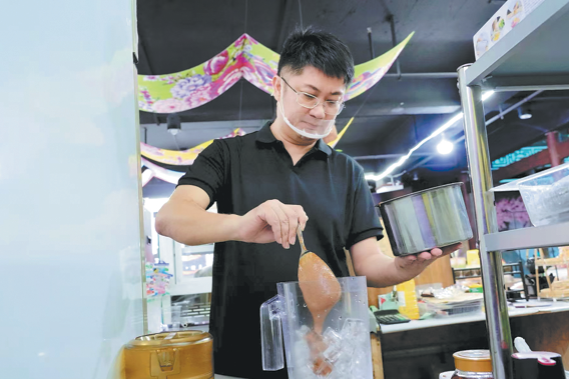
In a small town of Huojia county in Central China's Henan province, a Lucky Cup cafe, with an average order price of just 6 yuan (about 83 US cents), draws a steady stream of customers.
"We use three rolls of receipt paper and five kilograms of coffee beans on average every day," said Wang Zechang, head of the cafe. In less than 10 months, the cafe has already generated nearly 800,000 yuan in turnover.
Wang has opened two cafes in the county, and plans to launch two more this year to meet rising demand.
Founded in 2017, Lucky Cup is a coffee chain under China's beverage giant Mixue Bingcheng, dedicated to delivering high-quality yet affordable coffee. The chain has since expanded to over 5,000 outlets nationwide, with 61.5 percent located in third-tier or smaller cities, according to regional manager Ge Shihao.
As coffee consumption habits take root, first- and second-tier cities have seen a saturation of coffee shops. Now, the spotlight is shifting to smaller markets. "Third- and fourth-tier cities are the next 'blue ocean' for the coffee industry," said Shi Jun, secretary general of the coffee professional committee of the Shanghai Food Association.
International brands are also diving into these emerging markets. Starbucks, for instance, reported in its fiscal first quarter of 2025 that it had entered over 1,000 county-level markets across the Chinese mainland.
Data from leading e-commerce platform Meituan show that in 2024, coffee delivery orders in county-level areas for brands such as Starbucks and Cotti had surged by 97 percent, while the number of coffee shops soared by 159 percent.

According to food industry analyst Zhu Danpeng, residents in around half of China's counties and townships have already developed a basic "coffee consciousness." However, many still associate coffee drinking with upscale consumption, often assuming prices to be around 30 yuan per cup. The emergence of affordable coffee options of good quality has successfully tapped into and activated latent demand.
In addition to flavor and affordability, coffee has also taken on emotional and social significance. On social media platform rednote, the hashtag #GoodCoffeeInSmallTowns has racked up over 9 million views, with netizens sharing artfully staged photos and recommendations for hidden-gem cafes.
The rise of cost-effective coffee relies on streamlined supply chains and advanced logistics systems, which combine to improve operational efficiency and cut down costs. According to Wang, Lucky Cup can source coffee beans of equal quality at a cost of around 30 yuan per kilogram lower than the market price, thanks to Mixue Bingcheng's integrated logistics network, which provides everything from raw materials and packaging to equipment.
As of September 2024, Mixue Bingcheng's warehousing and logistics system had enabled 12-hour delivery in 90 percent of counties across China, while cold-chain logistics now cover 97 percent of its domestic stores, revealed Hu Xinyu, head of one of the company's warehouses.
Consultancy firm McKinsey predicted that by 2030, county economies would account for more than 66 percent of China's personal consumption growth.
The booming coffee scene in small towns is not only a testament to rising disposable incomes but also a signal of evolving consumer trends in China's lower-tier markets, said Zhu.





- Former Qingdao legislature chief under investigation
- Former Xinjiang prosecutor Guo Lianshan under investigation
- Shandong and SCO discuss trade, investment and supply chain cooperation
- China courts see surge in maritime cases, foreign disputes
- Guangzhou–Zhanjiang high-speed rail to open Dec 22
- Beijing slams US over planned $11 billion Taiwan arms sale