Xi Focus: How Xi's crackdown on excess reshapes China







BEIJING -- The Communist Party of China has launched a four-month campaign to urge its around 100 million members to bolster compliance with a code of conduct that has strengthened the Party over the past 12 years.
This education campaign on the eight-point rules was planned by none other than China's top leader Xi Jinping. During his inspection tour to Southwest China last week, Xi urged Party organs at all levels to meticulously organize and implement the campaign.
He called for fighting misconduct and corruption as a whole, and making relentless efforts to root out the underlying conditions for corruption.
Exercising full and rigorous Party self-governance has been a signature and cornerstone of Xi's leadership. In his first press appearance as the newly elected general secretary of the CPC Central Committee in November 2012, he candidly acknowledged that the Party faced "numerous severe challenges," with corruption being a primary concern.
He immediately started addressing the issue by tackling the deteriorating conduct of officials — some had indulged in extravagance, grown content with empty formalities, or put on an air of bureaucracy.
"The Party's conduct is crucial to winning the people's support and is a matter concerning the Party's survival or demise," Xi said.
In less than 20 days, the eight-point rules were introduced by the CPC central leadership. Spelled out in just over 600 words, the eight-point rules established regulations for Party leaders regarding research tours, meetings, documentation, and other official duties, cracking down on lavish banquets, red carpet events, pomp, entourages, unnecessary meetings, and luxury perks that had once been regarded by some as typical symbols of power.
According to the eight-point rules, when conducting grassroots field studies, officials should learn from the people on the ground. Ceremonial formalities such as banners and floral arrangements are not allowed. Official meetings and events must be streamlined. Security protocols such as traffic controls and road or venue closures should be minimized.
The code of conduct started off with a bang, yielding immediate and remarkable results.
"Few anticipated that the persistent issues of official extravagance plaguing China's political circles would undergo such a striking transformation," Singapore's Lianhe Zaobao newspaper observed.
Over the past decade, the eight-point rules have kept evolving and today remain a defining hallmark of Xi and the CPC's efforts to ensure good and clean governance.
A LONG-HELD TRADITION
Son of revolutionary leader Xi Zhongxun, Xi Jinping learned from his father's rigorous and disciplined approach to life and work from a young age.
Four children of the family studied at a boarding school, and every weekend, they took the bus home. The elder Xi had never picked them up with his official car.
He taught his children to live frugally and always maintain a humble and modest attitude.
Over the years, a frugal lifestyle, strict self-discipline, and strong ties with the masses remained with Xi Jinping.
In the late 1980s, when he served as the Party chief of Ningde, a poor prefecture in Fujian province, Xi Jinping refused to take a new imported car as his vehicle for official use, and insisted on using an old one left by his predecessor.
"We are in a poverty-stricken area, and we should not flaunt wealth or indulge in extravagance," Xi told his staff.
As he once explained, issues of official misconduct often stemmed from the improper handling of private and public interests, along with the abuse of power.
In 1989, Ningde introduced a set of 12 rules promoting clean governance and self-discipline among officials. These straightforward guidelines prohibited misconduct such as excessive wining and dining during inspection tours and the use of official vehicles for personal purposes.
"The power of us Communists, regardless of its extent, is granted by the people and is mandated solely to work for their benefit," Xi said.
In the early 2000s, after Xi was appointed as Zhejiang's provincial Party chief, Sun Guangming served on his staff, overseeing the planning of Xi's inspections.
He recalled that during these inspections, Xi consistently demanded corrections whenever local officials arranged lavish receptions featuring expensive dishes, fine liquor, or gifts of local specialties.
Sun said that based on Xi's instructions, the general office of the provincial Party committee imposed strict standards for official receptions, giving a heads-up along with Xi's itinerary to local authorities before each inspection tour. These requirements, typically consisting of seven or eight points, resembled the eight-point rules now in effect.
Sun believes the rules, adopted at the Political Bureau meeting chaired by Xi on Dec 4, 2012, signify that Xi has ushered in a new era of the Party's full and rigorous self-governance.
LEADING BY EXAMPLE
When the eight-point rules were established, some questioned whether the campaign was merely a passing fad or a political show. Xi knew enforcement was crucial.
"Promises made must be kept. In the Political Bureau, it (enforcement) starts with me," he said.
Three days after the rules were issued, Xi visited Guangdong province. He declined the option of staying in a presidential suite, choosing instead to stay in a standard suite at a hotel.
"He told us not to upgrade anything in the room — no new purchases, no extra additions," recalled a manager of the hotel, surnamed Qu.
At the hotel, Xi opted for a simple buffet and finished his meal in less than 20 minutes. This surprised a catering manager surnamed Yang, who noted that the restaurant typically served more dishes even for standard corporate events.
That afternoon, Xi traveled in an unassuming convoy that blended into regular traffic, traveling alongside taxis and buses, following traffic lights. Everything proceeded as usual — no cleared paths, roadblocks, banners, or trailing entourage.
The next day, no red carpets were laid out when Xi attended an event at Lianhuashan Park either.
It was a tone-setting trip that defined the simple style of Xi's over 100 domestic inspections in the following decade. He has consistently eschewed special arrangements, instead opting to follow local customs and minimize disruption to residents.
In rural Shaanxi, he dined with locals on Loess Plateau staples like buckwheat noodles and fried dough. In Gansu, he had five meals on the train to ease the reception burden on local authorities.
As the top commander of the armed forces, Xi once queued up with sailors at a lunch buffet onboard a warship and ate with them.
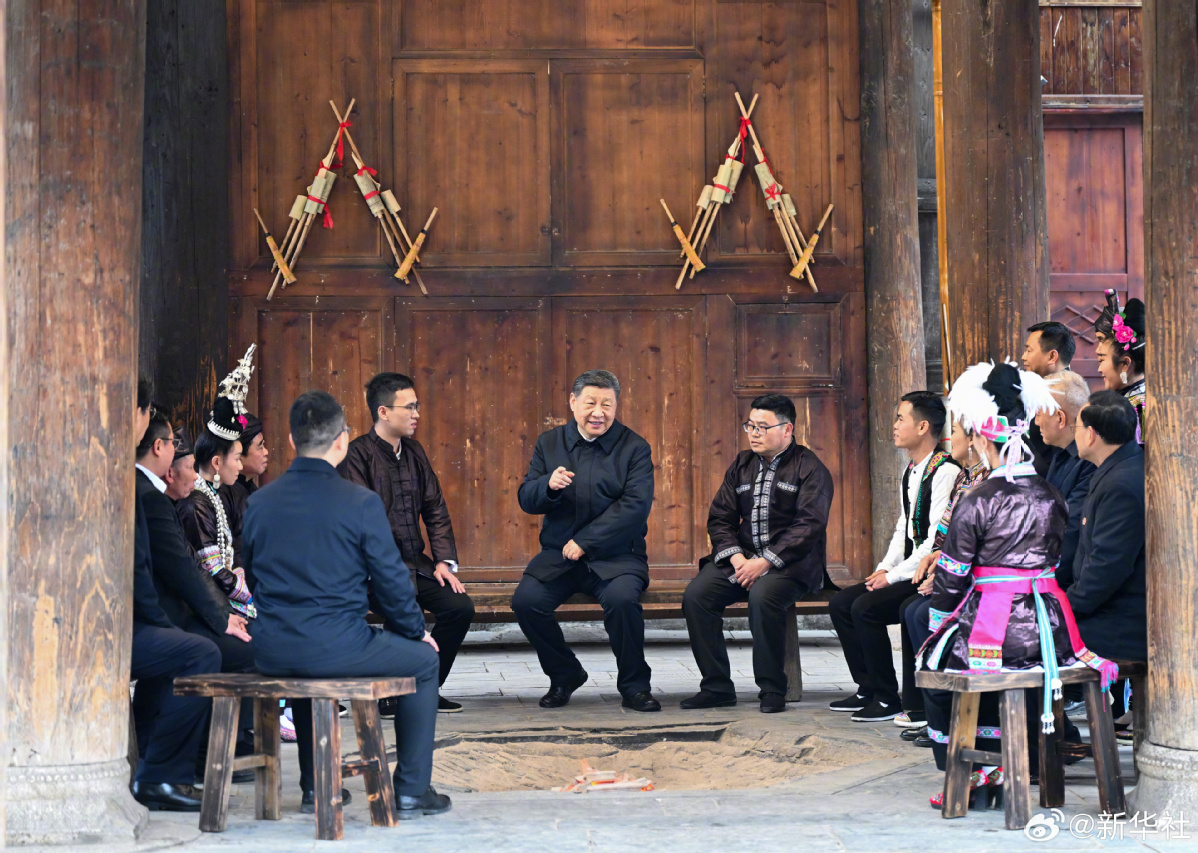
During his recent inspection trip to Guizhou province last week, Xi sat on a bench at a drum tower, chatting with folk song singers, batik artists, and college graduates in a mountainous village.
Netizens compared the scene to a series of similar encounters, noting that it reflected Xi's natural and comfortable way of connecting with the public, reinforcing his image as a man of the people — something that has remained unchanged since his teenage years working in the countryside and throughout his political career.
"I often remind myself that all fellow members within the Party have entrusted me to serve as general secretary, so I must hold myself to even stricter standards, leading by example in upholding the Party Constitution and adhering to Party discipline and rules," Xi said.
He is strict with his family members, too. Xi said anyone who claims to be his friend or relative to seek favors should be firmly rejected and reported without delay.
"Communists don't play by the rules of favoritism in which someone gains power, and people connected to them receive special privileges," he has repeatedly said.
"Don't assume that being a cadre's child makes one immune to consequences. Anyone who violates Party discipline or state laws must be held accountable, and they must be dealt with even more strictly to set an example for the people," Xi said.
He demanded that the implementation of the eight-point rules begin with the 20-plus-member Political Bureau. For years, it has been a standard practice for Political Bureau members to report on their adherence to these rules during the annual criticism and self-criticism session.
STARTING SMALL TO CRACK HARD NUTS
Fighting corruption is no easy task. By starting with officials' indulgence in lavish banquets — a visible symbol of excess and privilege — Xi made a strategic first strike that addresses public discontent.
Even mooncakes were put in the spotlight. A traditional treat during the Mid-Autumn Festival, mooncakes had, at the height of the bribe-giving culture, morphed into a convenient cover for bribery.
Xi applauded the graft-busters' attention to mooncakes. "Targeting mooncakes may seem trivial, but it's actually about tackling the corruption hidden behind such practices," he said.
Observers describe Xi's strategy as tackling issues one by one, making steady progress. By targeting seemingly small matters such as the misuse of public funds for mooncakes, greeting cards, fireworks and so on, the effort moved from simple to complex, gradually making breakthroughs.
To add more weight to the eight-point rules, the Party's top disciplinary watchdog regularly names and shames violators and announces the punishments they receive to deter others.
Such measures serve not only as punishment but also as a wake-up call, pulling offenders back before minor infractions spiral into more serious wrongdoing or even criminal acts.
In a decade, about 1.1 million people were reminded, reprimanded, or punished for violating the rules.
Xi's decision to target misconduct was a well-thought-out move. With misconduct and corruption stemming from the same root, the rules represented a decisive first blow at the heart of the problem.
After assuming the top position, Xi launched an unprecedented anti-corruption storm that has swept every corner of public office, netting both high-flying "tigers" and lower-level "flies." Some of the most senior officials — including former members of the Political Bureau and its Standing Committee, top military brass, and retirees who left their leading positions years ago — have been brought to justice.
Fully aware that corruption is an issue the people resent most, Xi said: "If we don't offend a few thousand corrupt officials, we'll fail 1.4 billion Chinese people."
An overwhelming victory had been achieved, but Xi warned that the fight against corruption and misconduct would never end.
Indeed, new forms of practices dodging the eight-point rules have continuously emerged. Some officials tried to bypass hotels and restaurants to indulge in luxury in private villas and secluded rural retreats. A few even sought extravagance abroad.
Xi used a metaphor to emphasize the long-term nature of improving conduct: "Just as a room needs regular cleaning, the dust in our minds must be cleared away regularly."
At times, he was more direct, saying that "if 10 years aren't enough, then 20 years; if 20 years aren't enough, then 30 years."
PROFOUND TRANSFORMATIONS
The ban on extravagant official receptions, along with restrictions on expenses for official overseas visits and vehicle use, eased long-standing public frustration. Once-symbolic perks of officialdom — lavish banquets, wasteful junkets and personal use of official vehicles — have largely faded.
With the eight-point rules firmly in place, transparency has improved as government departments and agencies continue to upgrade their practices for regularly disclosing expenses. The focus of the public has also shifted, from outrage over excess to scrutinizing how the money saved from curbing extravagance is being reinvested.
Wang Jixia, a former official overseeing vegetable cultivation in Laoling, Shandong province, was all too familiar with the health problems commonly afflicting government officials: fatty liver, high blood pressure, and soaring cholesterol — all consequences of endless rounds of lavish banquets. "Social drinking twice a day seemed part of the job," he recalled.
But things are different now. The crackdown on extravagant receptions allowed Wang to refocus on his real work. He had more time to visit farmers to assess vegetable production. His health also improved.
Xi also noted such lifestyle changes among officials. "Instead of attending lavish events and downing drinks, many officials now feel a renewed sense of relief," he once said at a meeting.
And the impact of the eight-point rules goes beyond that. As civil servants enhanced their awareness to serve the populace, their push to streamline administration picked up pace, saving time and trouble for businesses and the public.
This transformation has reshaped social norms as well. Simplicity is now valued over extravagance. Restaurants have shifted to offering smaller portions, with diners readily packing up leftovers. Foods that were once overpriced have become affordable again.
Even weddings and funerals are reducing extravagant banquets, choosing simpler and more budget-friendly arrangements instead. Likewise, agencies and institutions now favor modest venues over luxury hotels or tourist resorts for conferences.
The eight-point rules have helped restore public trust. A recent poll revealed that 94.9 percent of respondents approved of the rules.
"We must show that we are not only capable of delivering results but also doing so with genuine dedication," Xi said. "Only then can we truly earn the trust of the people."
HAMMERING NAILS
Xi has transformed the Party and the country through the eight-point rules. Yet, he remains keenly aware that the mission is far from accomplished.
"Certain areas have grown lax, some blind spots remain unaddressed, and unhealthy practices have begun to resurge," Xi noted last week during his inspection tour.
One high-profile case in December 2022 underscored the persistence of misconduct.
Six senior officials in Northwest China's Qinghai province held a drinking spree in the dormitory of the provincial Party School, in a blatant violation of rules.
The hours-long drinking session led to severe consequences the next day. One of the officials was hospitalized due to a heart attack, while another died from alcohol intoxication.
Investigations revealed that these officials had formed a clique over the years of socializing, leveraging their positions to exchange favors. They all received severe punishments.
Following the 20th CPC National Congress in late 2022, China's disciplinary agencies have handled 768,000 cases of malpractice and corruption at the grassroots level, imposing penalties on 628,000 officials.
In January this year alone, disciplinary agencies nationwide investigated and addressed 16,430 cases of violations of the eight-point rules.
"Conduct issues are recurrent and deeply entrenched; they cannot be resolved overnight or eradicated through a single decisive campaign. We must avoid superficial, short-lived efforts that fade like a passing gust of wind," Xi has warned.
At a top-level anti-corruption meeting in January, Xi identified the deeply intertwined nature of misconduct and corruption as a "prominent problem" and called for an integrated crackdown.
The latest education campaign marks Xi's renewed push to tackle the issue. During talks with local officials last week, he cautioned against mere surface-level compliance, stressing that such an approach runs counter to the eight-point rules themselves.
"Like hammering a nail, we must strike it a few more times," he said, "until the change becomes deeply ingrained in people's behavior and way of thinking."



- Woman executed for abusing and killing stepdaughter
- Zhangjiakou academy students hit Olympic ski slopes as winter break begins
- Chelsea legend Gianfranco Zola visits Chongqing fans
- Winter storm transforms Zhangjiajie's Tianmen Mountain into frosty wonderland
- Wuhan receives first snow of year, images go viral
- China steps up emergency response as temperatures drop sharply