



Lifting the gloom







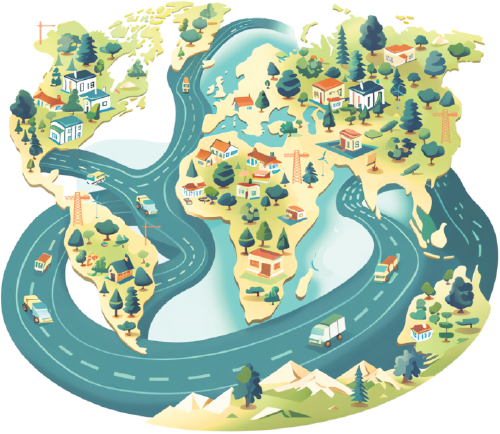
The BRI is driving new era of globalization that is bringing benefits to both developing and developed nations
Globalization refers to the increasing connectedness of the world's economies through the widespread international movement and exchanges of goods, capital, technology, services and information. Western economics textbooks describe the period from 1870 to 1914 as "the Golden Age of Globalization", from the non-Western point of view, however, nothing could be further from the truth. The 19th century was the century of imperialism, with most nations in Asia and Africa being colonized by the great powers, which forced them to sign unequal treaties. Under these treaties, colonies were prevented from setting import duties higher than 3 percent. Unable to have an industrial policy of their own, they could only produce raw materials and agricultural products. It is interesting to note that all Western countries enacted industrial policies during their takeoff stage.
The second wave of globalization, under the Pax Americana, roughly from 1980 to the present, increased global trade, capital flows and communications. The United States, motivated by geopolitical considerations, helped countries in East and Southeast Asia to modernize in order to act as a shield against the expansion of the Soviet Union. The problem with this system is that it practically excluded other regions. Washington also used multinational institutions (e.g. the International Monetary Fund) as a tool to impose its neoliberal economic system on developing nations. This included the unfettered movement of speculative capital, which resulted in the 1997 Asian financial crisis. Recent protectionist moves enacted by President Donald Trump have signaled that the US is no longer the champion of free trade, and for all practical purposes US-led globalization is now at an end.
The question that thus poses itself is what's next. On the surface, the picture tends to be gloomy as the slowing growth rate of global trade and decline in foreign direct investment have been accompanied with the decline of the economic fortunes of rich nations and serious challenges (e.g. debt issues) facing poor and emerging economies. This point of view, however, is unduly pessimistic. The reason is that it does not take into account the long-term impact of the China-led Belt and Road Initiative. The BRI focus is on modernizing infrastructure, spreading industrialization, and people-to-people exchanges. Through the BRI, China is supplying the world with global economic public goods in the form of low-cost funding and the sharing of its successful experience of development. China is a natural member of the Global South. At root, the BRI is a distillation of Chinese wisdom combined with Beijing's pragmatic understanding of present geopolitical challenges. An appreciation of the initiative is incomplete unless one recognizes that most of the participating developing nations share with China the "painful" experiences of modernization under the West-led order.
The BRI is the largest development initiative in history. China's share of the world's manufacturing output is expected to increase from 30 percent in 2024 to 45 percent in 2030. As China climbs the technological ladder and the price of labor goes up, many Chinese companies are moving their production facilities to BRI countries, thus accelerating the growth of new supply chains. The industrial hubs formed represent new growth engines. Overtime, the integration of these hubs will form industrial clusters in the six BRI corridors.
According to the Lowy Institute, in 2001, some 80 percent of economies worldwide did more two-way trade with the US than with China. Over 20 years later, there has been almost complete reversal: Now China lies at the heart of international trade. Around 70 percent of economies trade more with China than they do with the US and more than half of all economies now trade twice as much with China compared with the US. Furthermore, the value of China's trade with BRI partners exceeded 50 percent of its world trade for the first time in 2024. Chinese trade with BRI nations now exceeds that with the US, the European Union and Japan combined. Trade with BRI countries has totaled $1.3 trillion, outpacing China's trade growth by 7.4 percent. In the case of the Association of Southeast Asian Nations, Chinese exports to its members, all of whom are BRI partners, exceeded that of the US in 2023.
There has also been an irreversible trend in the destination of Chinese FDI. In 2016, the developed countries received 70 percent of China's outbound investment, largely in mergers and acquisitions. However, Chinese FDI going to developed nations decreased to only 28 percent in 2023. In the same year, the Global South received 70 percent of China's outbound FDI, mostly in greenfield investments. In ASEAN countries, for example, Chinese FDI increased from less than $4 billion in 2010 to $19 billion in 2023. One-third of this investment was in the manufacturing sector.
Thanks to the BRI, China is sharing its valuable development experience with other partners. In Africa, for example, countries such as Ethiopia and Rwanda have achieved double-digit growth rates. These nations have been learning from the Chinese model of development. Thousands of their officials and students have been involved in people-to-people exchanges with their counterparts in China.
Africa is also a region where the BRI is making a unique change. As has been the case in ASEAN countries where overseas Chinese represent a dynamic entrepreneurial class, more than 1 million Chinese, who have decided to make Africa their second home, could form another dynamic class of entrepreneurs — introducing new methods of management, and helping the technology transfer process. This bodes well for accelerating the rate of economic growth in the continent.
With the European economy stagnating and the US economy growing at an anemic rate, the Western media paint a pessimistic picture of the future of the world. This is the same media that have painted the BRI with a tar brush. The result is that the West is blinded by its ignorance of the fact that new supply chains, quietly being formed in the Global South, are laying the foundation for the new coming globalization.
For long, the West has sold non-Western nations the narrative that it and it alone can deliver prosperity. The continued success of the BRI, however, is bound to disabuse the West of that delusion. The Global South, with 40 percent of global GDP, is already contributing around 80 percent of global growth. More importantly, unlike previous globalizations where the rules were made solely to serve the interests of the West, the developing nations are now playing a major role in setting the rules of the coming globalization in a way that reflects the interests of the majority of humanity. Thus, the present gloom about the future of the world is certainly unwarranted. This should be a cause for celebration.
The author is a former professor of economics at the Stuart School of Business at the Illinois Institute of Technology and the author of The Belt and Road Initiative: Chinese Solution to a Deficient Global Order. The author contributed this article to China Watch, a think tank powered by China Daily. The views do not necessarily reflect those of China Daily.
Contact the editor at editor@chinawatch.cn.





