



Silicon soldiers of fortune
'Tech hawks' are increasingly influential in shaping US policy toward China







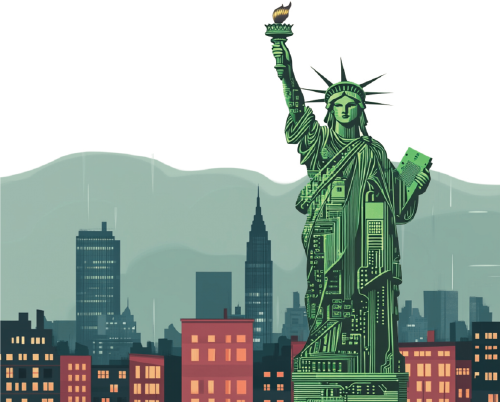
As Washington escalates its rhetoric on strategic competition with Beijing, technological rivalry between China and the United States has intensified. The ties between the national security apparatus and the tech industry in the United States are growing stronger, with artificial intelligence companies, quantum computing companies, industry associations and think tanks focusing on tech competition emerging as key partners for US security agencies.
Through such mechanisms as the National Security Commission on Artificial Intelligence, the Defense Innovation Unit and the Hill and Valley Forum, the US government is deepening its coordination with the tech sector — while the latter seeks to leverage these ties for greater financial and political gains.
A new generation of tech companies at the forefront of emerging fields, such as Palantir Technologies, Anduril Industries, and SpaceX, has assumed an increasingly prominent role in Washington's national security strategy. These companies are part of what analysts have described as a modern version of the military-industrial complex, now evolving into a broader "tech-security complex" that is central to maintaining US primacy and shaping the geopolitical landscape of technological competition with China. The influence of these companies on China-US competition deserves utmost attention.
During the Cold War, in response to the "Soviet threat", the US military-industrial complex expanded rapidly. Defense contractors such as Lockheed Martin, Northrop Grumman and General Dynamics became the primary beneficiaries of US military spending, helping drive technological innovation in tandem with national security interests. Today, under Washington's "great power competition" framework, technology is at the core of US-China rivalry, and a growing ecosystem of high-tech companies and venture capital is exerting ever-greater influence on the relationship between the two countries.
This shift is particularly evident in the US Congress, where an emerging bloc of "tech hawks" is shaping US national security strategy from a legislative standpoint.
The legislative branch has become a key driver of strategic competition and ideological confrontation with China, with some Neo-Reaganite lawmakers taking an especially hard-line stance, viewing Beijing as Washington's most formidable adversary. Over the past few years, hundreds of China-related bills have been introduced in Congress, many of which focus on restricting China's access to key technologies, such as the CHIPS and Science Act and ENFORCE Act.
Several members of the Congress with tech backgrounds have played a pivotal role in framing China as a technological threat and advocating for a tougher approach. Senate Intelligence Committee Vice-Chairman Mark Warner, a former tech entrepreneur, has argued that "national security now is a technology race with China". Senator Jacky Rosen, who previously worked as a computer programmer, has called for increased defense spending in areas such as hypersonic, space and autonomous weapons systems to ensure that the US maintains its edge over China.
The growing alignment among US Congress, tech companies and venture capitalists reflects the increasing influence of "tech hawks" in shaping US policy toward China. In addition to the long-dominant "economic hawks" and "ideological hawks", this new faction has become a driving force in Washington.
Jacob Helberg, a Silicon Valley veteran with extensive industry experience and connections, spearheaded the creation of the Hill and Valley Forum, a mechanism that exemplifies the growing convergence between Silicon Valley and the US government on tech nationalism. Helberg, a staunch China hawk, has described the US-China relationship as a "gray war" and has advocated technological decoupling with Beijing. He has characterized the Hill and Valley Forum as "a coalition to win the second Cold War with China". He was tapped by President Donald Trump to be under secretary of State for Economic Growth, Energy, and the Environment.
Beyond Helberg, other prominent Silicon Valley figures with right-wing political leanings, including billionaire investor Peter Thiel and Anduril founder Palmer Luckey, have taken a hard-line stance on China. These tech elites have used their growing political influence to shape US national security strategy, funding the Senate campaign of JD Vance, supporting Trump's presidential bid, and pushing for legislation to ban TikTok. In doing so, they have helped forge an increasingly tight-knit alliance among Silicon Valley, Congress and the federal government, while also reaping substantial financial benefits from the narratives of great power competition and China-US conflict.
At the same time, core pillars of the US national security apparatus, including the US Department of State, the military and intelligence agencies, are deepening their cooperation with the tech sector. The Department of State has strengthened its focus on "tech diplomacy", investing in AI and other digital tools to enhance US diplomatic capabilities. It has also established the Bureau of Cyberspace and Digital Policy to oversee issues related to cybersecurity, the digital economy and emerging technologies.
The Ukraine crisis has further accelerated the militarization of emerging technologies, underscoring the urgency of integrating AI and data-driven warfare into US military operations. The Pentagon has ramped up its efforts to build a "data-driven, AI-enabled force", with the Army, Air Force and Space Force launching targeted initiatives in partnership with companies such as Palantir. Meanwhile, through newly established mechanisms such as the Central Intelligence Agency's Transnational and Technology Mission Center, the US intelligence community is striving to build public-private partnerships for the digital age, leveraging innovation to strengthen its strategic advantage.
To conclude, the fusion of government and corporate power in the US tech-security complex is accelerating — a trend that is likely to intensify during the Trump administration. The interplay among "tech hawks", "economic hawks" and "ideological hawks" is anticipated to deepen, further reinforcing Washington's whole-of-government and whole-of-society approach to exerting pressure on China in the technology sphere.
The author is a professor at the Institute of International Studies at Fudan University and a China Forum expert. The author contributed this article to China Watch, a think tank powered by China Daily. The views do not necessarily reflect those of China Daily.
Contact the editor at editor@chinawatch.cn.





