



Cultural connections
Archaeological findings in Thailand offer means to strengthen links between ASEAN and China







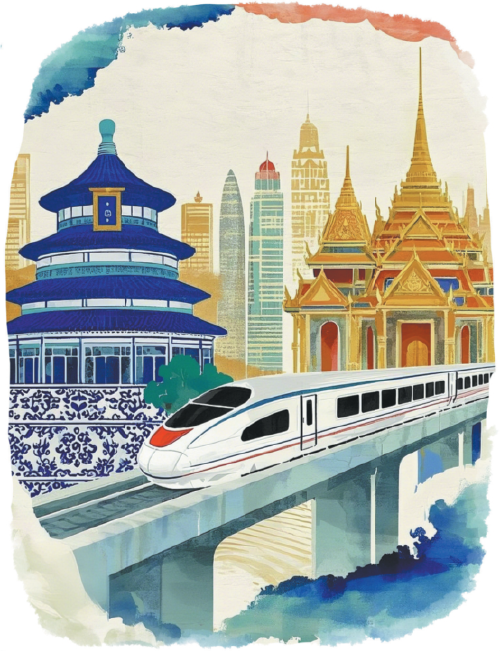
On Feb 4, the Thai Cabinet approved the implementation of a cooperation project between the Thai and Chinese governments to construct the high-speed railway from Nakhon Ratchasima to Nong Khai, with a budget of about $10 billion. It is expected that the construction of the 357-kilometer railway will begin this year, with the goal of commencing service in 2031.
Many parties agree that the Thai government must expedite the construction of the high-speed railway between Thailand and China so that it can serve as a fresh impetus for economic and social development in Thailand, China and the Association of Southeast Asian Nations region.
Thailand's GDP growth rate was only 2.5 percent in 2024, according to the National Economic and Social Development Council. Thailand needs to find new tools to stimulate the economy. Recently, Supavud Saicheua, chairman of the NESDC, stated that Thailand should develop from its own strengths.
Currently, the industries where Thailand holds a competitive advantage include tourism, food production and logistics. To build on these advantages, Thailand should pursue cooperation with China under the framework of the Belt and Road Initiative. The BRI framework that China has proposed includes support for exchanges between people, fostering in-depth dialogues on civilizations with participating countries, and establishing a network of cities along the overland and maritime Silk Road routes.
In the past four to five years, since Anek Laothamatas assumed the role of minister of Thailand's Ministry of Higher Education, Science, Research and Innovation, he has initiated, promoted and supported in-depth research on the Suvarnabhumi civilization. This research has involved Thai and international archaeologists and researchers working together to excavate and study the area, uncovering abundant evidence from the Suvarnabhumi period. This has enabled the Southeast Asian region to trace its history back approximately 2,000 to 2,500 years, revealing that the area, particularly the southern region of Thailand, was once a prosperous center of international trade connecting the western and eastern parts of Thailand's southern peninsula. Numerous artifacts, including ancient artifacts, coins and beads from the eras of ancient Greece, Persia, India and China, have been discovered.
The Suvarnabhumi civilization linked major civilizations on the eastern side of the peninsula, namely China, with those on the western side, such as India, Persia, Greece and Rome. In this way, it was similar to the Silk Road, which China has used as a historical foundation for its BRI. At the same time, the Suvarnabhumi civilization has a historical connection with Chinese civilization through maritime trade along the ancient Maritime Silk Road. The ASEAN members could leverage this shared history to develop and promote the Suvarnabhumi civilization, making it more widely recognized, bringing the past to serve the present to create economic value by attracting tourists from China and around the world, as well as fostering academic collaboration to study the Suvarnabhumi civilization in deeper and broader contexts.
Leveraging the Suvarnabhumi civilization as a basis for Belt and Road cooperation will not only enable the ASEAN members to engage with China across various dimensions but will also foster greater collaboration among the ASEAN members themselves. The role of the Suvarnabhumi civilization as a bridge connecting East and West could extend to creating partnerships in ancient cultural archaeology and academic exchanges with other countries, such as India and those that were part of the Persian civilization.
Importantly, it is also possible to initiate collaboration in connecting cities that share a history with the Suvarnabhumi civilization. This could help extend cultural collaboration into economic development efforts in international tourism. An example of such an initiative can be found in South America, where six countries — Argentina, Bolivia, Chile, Colombia, Ecuador and Peru — collaborated in 2014 to have the Inca Roads, an age-old network of tourism and transportation among one of the most significant ancient civilizations on the continent, listed by the United Nations Educational, Scientific and Cultural Organization as a world heritage site. This initiative represents a cross-border tourism collaboration that fosters a friendly atmosphere and reduces hostility among the participating countries.
Similarly, within the framework of the BRI, a cross-border cultural tourism initiative based on the sites of the Suvarnabhumi civilization as revealed by archaeological discoveries in various cities in Thailand and other ASEAN members can be established. This initiative could connect through both sea and land travel. The sea routes could involve cruise tourism, potentially linking to the 21st Century Maritime Silk Road. For example, travelers could start their journey from South China and visit historical sites of the Suvarnabhumi civilization along the coastlines of the ASEAN members on both the Gulf of Thailand and the Andaman Sea, as well as navigate through the ancient canals of southern Thailand's peninsula, ultimately ending in India.
On the land side, there is an opportunity to encourage tourists from China to explore and study the sites of the Suvarnabhumi civilization in the northeastern and central regions of Thailand through the high-speed rail project between Thailand and China under the BRI. This is particularly true for tourism in the inner regions, where many areas have histories and narratives believed to date back to the era of the Suvarnabhumi civilization. These routes could also connect to the southern peninsula, which is home to numerous archaeological sites and artifacts that are contemporary with the Suvarnabhumi civilization. Currently, scholars are beginning to discover more evidence in places such as Khao Sam Kaeo in Chumphon Province and Chaiya in Surat Thani Province, among others.
This initiative could introduce an innovative aspect to the Belt and Road project, fostering tangible cultural cooperation between China, Thailand and the ASEAN members. It could serve as a platform for in-depth discussions on the region's shared history, particularly the Suvarnabhumi civilization. Furthermore, the initiative aims to establish a network of tourism cities along the Suvarnabhumi route, connected to the modern Maritime Silk Road. This would promote cultural tourism and economic cooperation, shifting the focus from mere economic engagement to strengthening relationships through cultural exchanges.

The author is director of the Klangpanya Institute, a Thailand-based think tank. The author contributed this article to China Watch, a think tank powered by China Daily.
The views don't necessarily reflect those of China Daily.
Contact the editor at editor@chinawatch.cn.





