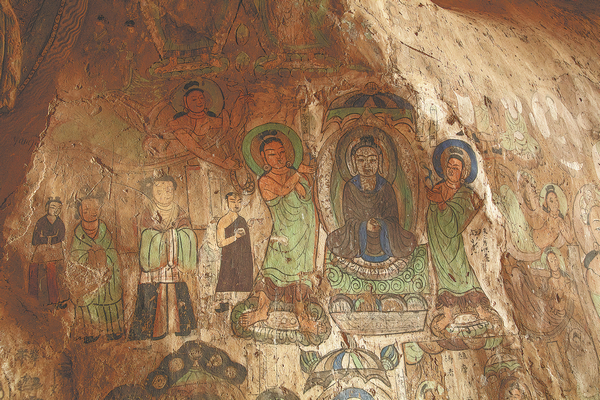
"Inside they discovered the earliest dated inscription in a Chinese grotto — a groundbreaking find that ushered in a new era of grotto archaeology," Cao says.
The inscription is a testament to the time when Linxia was the capital of the Western Qin state, which was founded by a branch of Xianbei nomads. The state lasted less than 40 years under four rulers, and faced threats from powerful rivals.
This left its people longing for peace and stability, and the ruling family's belief in Buddhism encouraged the religion to thrive.
In 420, the then ruler declared his successor and changed the era's name to Jianhong. To mark the event, high-ranking officials, royalty, and esteemed monks made donations to renovate the temple, resulting in the inscription and images of them being preserved in the murals.
The grottoes continued to be expanded for more than 10 dynasties until the Qing Dynasty. Today, the site comprises 216 numbered caves and niches, some 800 statues, 1,000 square meters of murals, 56 pagodas, and 438 registered cultural artifacts.
Since ancient times, the Linxia region has been inhabited by different ethnic groups. This multiethnic presence created a thriving cultural environment and provided the conditions for the spread and development of Buddhism.
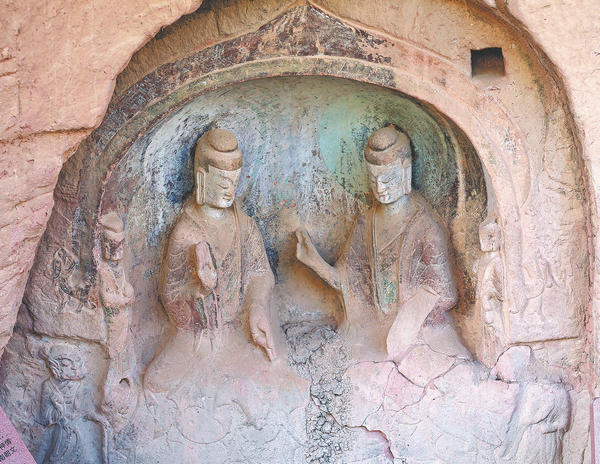
Artwork in the grottoes reflects influences from the two main Buddhist schools in China: the Tibetan tradition and the Han Chinese tradition.
"This region was a key junction on the ancient Silk Road, and a way-point along the Tang-Bo Ancient Road that ran across the western regions of China, so it was an important hub with developed trade and flourishing Buddhist traditions," Liu says.
In 2014, the Bingling Cave-Temple Complex was inscribed on the UNESCO World Heritage Site list as part of the Silk Roads: the Routes Network of Chang'an-Tianshan Corridor, a joint application by China, Kazakhstan and Kyrgyzstan.
In 2017, the institute was placed under the unified management of the Dunhuang Academy in Dunhuang, Gansu province.
The geological conditions pose both advantages and challenges for the grottoes. For example, the sandstone of the mountains is fine and soft, which makes it easier to carve detailed reliefs, but also makes it prone to weathering and crumbling, especially when exposed to water.
Liu says that in around 15 years of working at the temple, two heavy rainstorms in 2012 and 2018 posed a danger to the grottoes. In 2012 particularly, mud and sand blocked the drainage system, and more than 20 staff members worked all night to scoop out water.
"We have been continually reinforcing the mountains to prevent rockfall, and whenever it rains too heavily, we close the grottoes and reopen them when the weather clears up," Liu says.
In recent years, a series of conservation projects sponsored by national- and provincial-level funds have been undertaken to protect and restore the grottoes.
A comprehensive monitoring and warning system has been installed to address the protection, use, and management of the grottoes, with a digital platform to monitor aspects such as the overall environment, the environment inside the caves, cultural artifacts, and the number of visitors.
Ongoing preservation projects include restoring the murals and statues that have deteriorated, dealing with hazardous rock formations, as well as digitalizing heritage.
Contact the writers at chengyuezhu@chinadaily.com.cn