AI expected to accelerate self-driving tech
Lawmakers, advisers call for improved regulations for autonomous vehicles







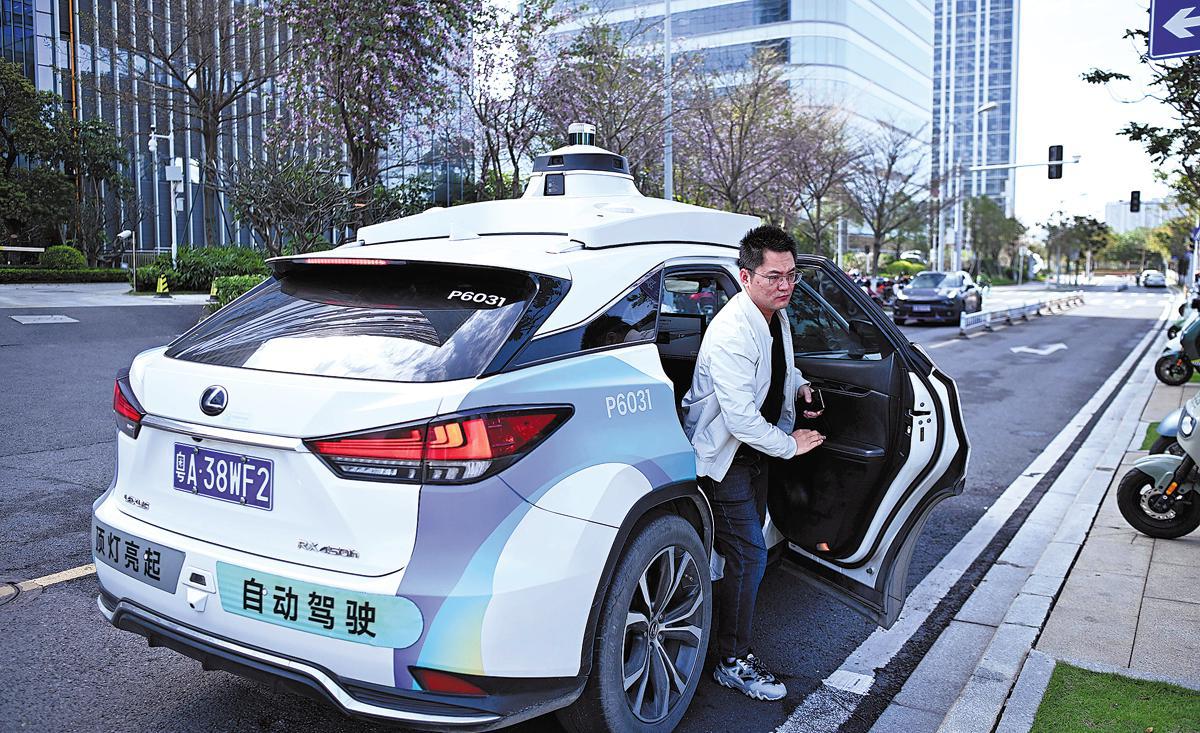
The fast-evolving artificial intelligence technology is expected to spearhead an industrial revolution and expedite the development of China's autonomous and intelligent connected vehicles, as AI is emerging as a critical strategic opportunity for the automotive industry, said national lawmakers, political advisers and experts.
As China is accelerating steps to advance the mass production and commercialization of self-driving vehicles, more efforts should be made to improve the regulations and standards for autonomous driving, speed up the construction of intelligent transportation infrastructure, and expand the testing and application for autonomous vehicles in a wider range of scenarios, they added.
Their comments follow this year's Government Work Report which stated that under the AI Plus initiative, China will support the extensive application of large-scale AI models and vigorously develop new-generation intelligent terminals and smart manufacturing equipment, including intelligent connected new energy vehicles.
He Xiaopeng, chairman and CEO of Chinese electric vehicle maker Xpeng Motors, said a transformative AI era is approaching, and AI will accelerate the arrival of self-driving vehicles and even driverless vehicles. He emphasized that his company has continued to invest in AI and launched its self-developed AI-powered chips to enhance the intelligent driving capabilities of vehicles.
The Xpeng CEO, who is also a deputy to the 14th National People's Congress, China's top legislature, said he believes that 2025 will mark a significant turning point in intelligent driving. With the continuous advancements and breakthroughs in core technologies such as algorithms, sensors and computing platforms, it is appropriate to bolster the mass production of Level 3 autonomous driving technology, he added.
Autonomous driving is categorized from Level 0 to Level 5. The higher the level, the more intelligent the technology and the lesser the involvement of humans.
Level 3 refers to conditional automation, which allows vehicles to perform autonomous driving tasks under certain conditions. Such vehicles have "environmental detection" capabilities and can make some informed decisions, but are still subject to a human override.
"Xpeng is planning to roll out its Level 3 capabilities in the second half of the year," He said, adding that by 2026, the company aims to explore Level 4 (high automation) capabilities, including fully driverless parking.
Level 4 vehicles can intervene if there is a system failure and do not require human assistance in most circumstances. However, a manual override option is still available.
Feng Xingya, chairman of automobile manufacturer GAC Group, said, "The advancements in AI technology are becoming the core driving force bolstering the development of intelligent connected vehicles, and the application of AI will help reshape the automotive industry."
AI is reshaping the intelligent experience of automobiles — from intelligent driving to human-machine interaction — and driving the transformation of automobiles toward "intelligent terminals", said Feng, who is also a national lawmaker.
Looking ahead, GAC will promote the iteration of advanced intelligent driving and AI models, while speeding up the application of AI in fields such as automobile research and development, manufacturing and marketing, he added.
While highlighting the significance of bolstering the commercialization of self-driving technology, Feng said that autonomous driving serves as the core technology of intelligent connected vehicles and a vital link in intelligent transportation.
GAC is among the first carmakers to test Level 3 autonomous vehicles on public roads, and it plans to mass produce these vehicles this year. Feng suggested revising the Road Traffic Safety Law to clarify the liabilities concerning autonomous vehicles and accelerating the research and establishment of a specific law related to intelligent driving.
China has introduced a series of policies to promote the development and commercialization of autonomous vehicles in recent years.
According to the Ministry of Industry and Information Technology, the country supports the commercial application of Level 3 and above autonomous driving systems. Over 50 cities nationwide have released autonomous driving pilot demonstration policies, and stepped up efforts to expand the application scenarios of self-driving technology.
Wang Xianjin, vice-president and chief engineer of the China Academy of Transportation Sciences, said the testing and operation of self-driving vehicles has accelerated significantly in China, laying a good foundation for the commercialization of autonomous driving, a tech frontier in which all major economies are scrambling to establish a beachhead.
Wang, who is also a national political adviser, called for efforts to speed up formulation and revision of policies and regulations supporting the commercial application of self-driving technology, and continuously expand the scale of pilot operations of autonomous vehicles in more cities.
Lei Jun, founder, chairman and CEO of Xiaomi Corp and a national lawmaker, proposed establishing a national testing and verification system for autonomous vehicles. He stressed the need to accelerate the commercial mass production of self-driving vehicles, with the goal of supporting their use on highways, expressways and urban roads by 2026.